English
 Arabic
 French
 Spanish
 Portuguese
 Deutsch
 Turkish
 Dutch
Dutch
 Italiano
 Russian
 Romaian
 Portuguese (Brazil)
 Greek
Greek
The Integration of Augmented Reality in Live Dealer Games: Revolutionizing Player Interaction and Engagement in Online Casinos by 2025
Games |
2026-08-25 18:42:59
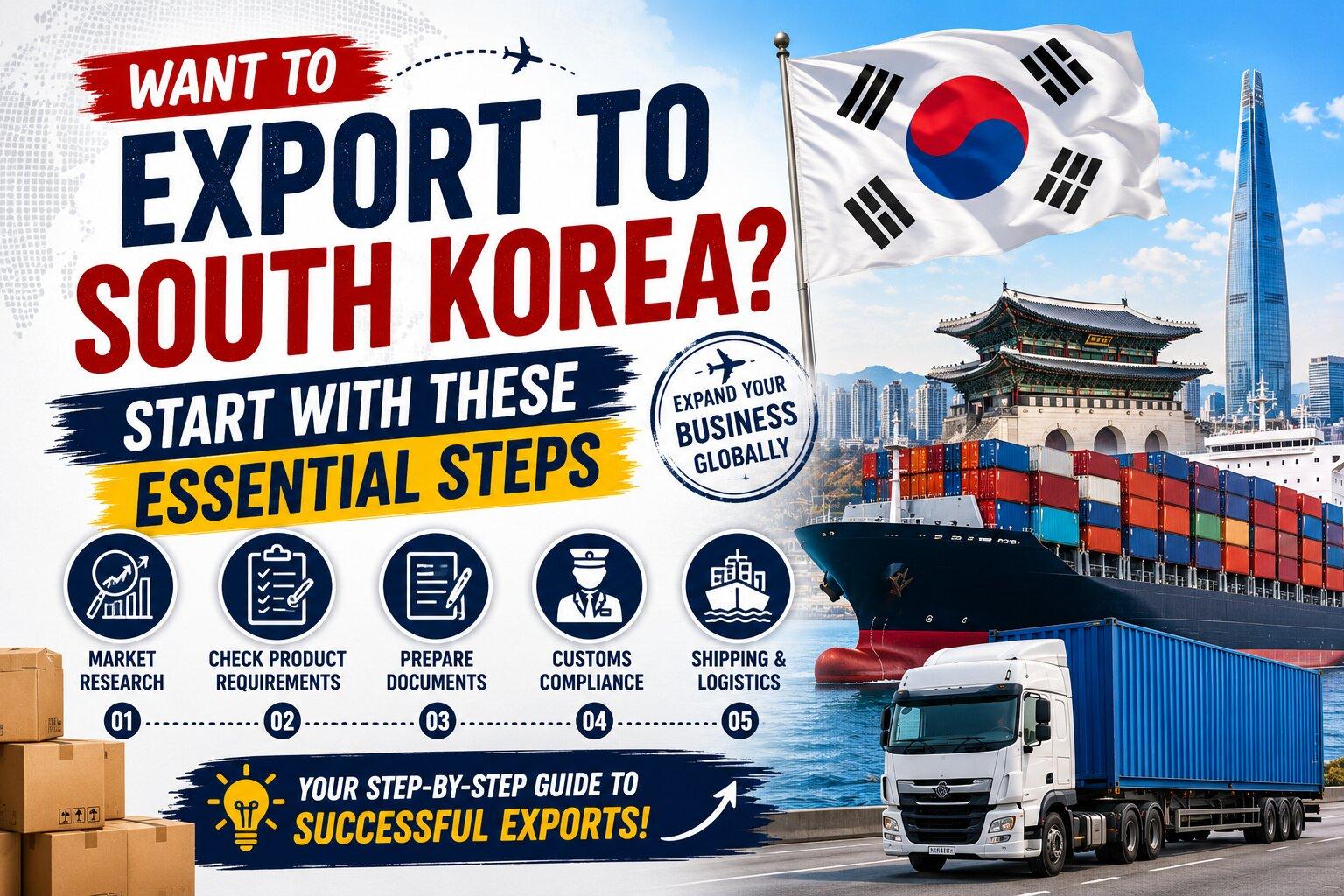
South Korea has become an important destination for businesses looking to expand beyond their domestic markets. The country has a highly developed economy, sophisticated consumers, strong manufacturing industries, and demand for products ranging from agricultural goods and food to machinery, technology, chemicals, consumer products, and specialized equipment.
For businesses considering export to South Korea, the opportunity can be attractive. But international sales require more planning than simply finding a Korean buyer and putting products on a ship.
Successful exporting to South Korea means understanding your target market, checking product requirements, calculating the complete landed cost, preparing accurate documents, choosing suitable shipping terms, and making sure your buyer is ready to handle the import process.
The U.S.–Korea Free Trade Agreement, commonly called KORUS, can also be important for qualifying U.S. products. The agreement entered into force in 2012 and provides a framework for improved market access between the two countries. However, businesses still need to verify the rules that apply to their specific products rather than assuming that every shipment receives preferential treatment.
So, where should a new exporter begin?
South Korea offers opportunities across a wide range of industries.
Depending on your product and target customers, potential markets can include:
The country's sophisticated business environment can be appealing to exporters, but competition can also be strong.
That means you should not approach the market simply because South Korea has a large economy.
Instead, ask a more useful question:
Who in South Korea needs my product, and why would they buy it from me?
That question should shape your research, pricing, distribution, and shipping strategy.
The first step in an export to South Korea strategy is market research.
Start by identifying the customers most likely to purchase your product.
Research:
A product that sells successfully in the United States may require a different approach in South Korea.
For consumer products, packaging, labeling, design, pricing, and customer preferences can influence purchasing decisions.
For industrial products, buyers may care more about technical specifications, reliability, certifications, warranty support, and compatibility with their existing equipment.
Do not spend heavily on inventory before you have evidence that a suitable market exists.
A small test shipment or carefully researched buyer relationship can provide useful information before you scale up.
Finding the right business partner can make the export process much easier.
Depending on your product, your Korean partner could be:
Before agreeing to a transaction, conduct reasonable due diligence.
Check the company's:
Be especially careful when a new buyer requests unusual payment arrangements or asks you to ship before important commercial terms have been settled.
A strong buyer relationship is useful, but it should never replace proper export controls and documentation.
One of the biggest mistakes new exporters make is checking only whether they can legally export a product from their own country.
You also need to determine whether the product can legally enter South Korea.
Requirements vary by product.
Certain goods may be subject to:
Food, agricultural products, chemicals, medical products, electronics, and other regulated goods can have additional requirements.
Do this research before manufacturing or packaging a large shipment.
It is much easier to correct a compliance issue before the goods leave your warehouse than after they arrive at a Korean port.
Correct product classification is one of the foundations of international trade.
The Harmonized System, or HS, provides internationally recognized product classifications.
Your classification can affect:
Do not choose an HS code simply because another company uses the same code for what appears to be a similar product.
Classification can depend on the product's:
If you plan to use KORUS preferential treatment, classification and origin requirements become particularly important. USTR provides resources for exporters to review tariff treatment and certification-of-origin issues under the agreement.
For U.S. businesses, the U.S.–Korea Free Trade Agreement can be an important consideration.
However, do not assume that simply shipping a product from the United States makes it eligible for preferential treatment.
You need to determine whether the specific product meets the applicable requirements.
Depending on the transaction, exporters may need to consider:
USTR maintains resources designed to help businesses understand how to use the agreement.
Treat the agreement as a tool that needs to be applied correctly—not as an automatic duty-free guarantee.
A profitable sale can become an unprofitable shipment if you calculate only the product price.
Before exporting to South Korea, estimate the complete landed cost.
Your calculation may include:
For example, imagine that your goods cost $40,000.
That $40,000 is not necessarily the customer's final cost.
Freight, insurance, customs charges, taxes, and local transportation can substantially increase the amount paid before the product reaches its final destination.
Knowing the landed cost helps you set a realistic selling price and avoid unpleasant surprises.
This point should be settled before the shipment leaves your facility.
Clearly identify:
Who is the importer of record?
Depending on the transaction, the Korean buyer, distributor, or another authorized party may handle the import process.
Korean Customs states that import declarations are processed electronically through its UNI-PASS system. Import documentation can include an import declaration, invoice, packing list, bill of lading, certificate of origin, and inspection or quarantine documentation where applicable.
The exact requirements depend on the goods.
Before shipping, establish:
Clear responsibilities can prevent many avoidable delays.
Incoterms define important responsibilities between buyers and sellers.
Common terms include:
The right choice depends on your transaction and how much control you want over transportation and delivery.
For example, one arrangement may leave the buyer responsible for most transportation after pickup, while another may place substantially more responsibility on the seller.
Before choosing an Incoterm, understand:
Never choose an Incoterm simply because it appears on a previous invoice.
Make sure it actually reflects the commercial agreement.
Good documentation is essential when you export to South Korea.
Depending on the product and transaction, documents may include:
Pay particular attention to consistency.
Your invoice, packing list, shipping documents, and other records should not contain conflicting information.
Check:
Avoid descriptions such as “goods” or “parts” when a precise description is available.
Korean Customs emphasizes accurate customs declarations and may conduct documentary reviews or inspections during clearance.
Product compliance does not end when customs releases your shipment.
Your product may also need to meet requirements before it can legally be sold in South Korea.
Depending on the product, review requirements involving:
Requirements can differ considerably between product categories.
If your product requires Korean-language information or other market-specific labeling, address this before production.
Changing packaging after goods arrive can be expensive and inconvenient.
When planning an export to South Korea, do not focus exclusively on Korean regulations.
Your own country's export rules matter too.
For U.S. exporters, this can include reviewing:
Some shipments may require Electronic Export Information through the Automated Export System.
The U.S. Census Bureau explains that eligible U.S. exporters can file EEI themselves or authorize an agent, and ACE AESDirect is the primary filing tool for EEI submissions.
Whether a particular shipment requires filing depends on the applicable rules and shipment details, so verify the requirement before transportation begins.
Your shipping method should match the product and commercial requirements.
Ocean freight is often appropriate for:
It can provide cost advantages for larger shipments but generally requires more transit time.
Air freight can be useful for:
The trade-off is generally a higher transportation cost.
Some shipments may use a combination of truck, rail, ocean, and air transportation.
When comparing options, do not compare freight rates alone.
Consider:
The cheapest freight quote is not necessarily the cheapest complete logistics solution.
International transportation creates risks that do not exist in the same way with domestic shipments.
Cargo may experience:
Do not automatically assume that a carrier will cover the full commercial value of your goods.
Review the carrier's liability terms and determine whether cargo insurance makes sense.
This becomes particularly important for expensive machinery, electronics, specialized equipment, and other high-value shipments.
A simple pre-shipment checklist can prevent many problems.
Confirm:
Make sure the buyer knows when the shipment is expected to arrive.
The importer should also be prepared to provide information required by customs.
Korean Customs allows import declarations to be submitted electronically and, in certain circumstances, before goods arrive, which can help with clearance planning.
Preferential treatment depends on applicable product and origin requirements.
Confirm product requirements before the goods leave your facility.
Incorrect classification can affect customs treatment and tariff calculations.
Freight is only one component of the final cost.
Make sure both parties understand exactly where responsibility and risk transfer.
Missing or inconsistent information can create clearance delays.
A product that clears customs may still need to meet requirements before it can be sold.
Exporters should understand their own export-control and restricted-party obligations.
Before your first export to South Korea, ask these questions:
The decision to export to South Korea can open the door to a valuable international market, but success depends on preparation rather than simply finding a buyer.
Start with market research.
Then confirm your product requirements, classify the goods correctly, review KORUS eligibility where applicable, calculate the complete landed cost, and clearly define who handles import clearance.
Prepare accurate documents and choose your shipping method and Incoterm carefully.
Most costly export problems are not caused by the physical movement of cargo. They often begin with something much simpler: an incorrect assumption.
An exporter assumes the buyer will handle customs.
Another assumes a trade agreement automatically means zero duty.
Someone else discovers after production that the product needs additional labeling or certification.
These mistakes are avoidable when you investigate the requirements before shipping.
Korean Customs specifically emphasizes accurate declarations and provides an electronic import-clearance system through UNI-PASS, while U.S. exporters can use official resources to understand KORUS and U.S. export-filing requirements.
The goal of exporting to South Korea should therefore be more than completing one shipment.
Build a process that you can repeat.
Research the market. Verify compliance. Calculate costs. Prepare documents. Clarify responsibilities. Communicate with your buyer.
When these pieces are in place, international shipping becomes much more predictable—and your first shipment becomes the beginning of a sustainable export strategy rather than an expensive learning experience.
Many categories can be exported, including food, agricultural products, machinery, technology, consumer goods, chemicals, and industrial equipment. Requirements vary by product, so verify applicable Korean regulations before shipping.
Not automatically. Preferential treatment depends on the product, classification, applicable origin requirements, and other conditions under the agreement. Check the specific product before quoting a buyer.
The responsibility depends on the transaction and Incoterm. The Korean importer or an authorized customs broker commonly handles the import declaration, but the parties should establish responsibilities before shipping.
Requirements vary, but common documents include a commercial invoice, packing list, bill of lading or air waybill, and applicable origin, inspection, certification, or permit documents. Korean Customs provides specific guidance for import declarations.
One of the most common mistakes is shipping before confirming product requirements, customs responsibilities, total landed costs, and documentation. Taking time to verify these details can prevent costly delays.