
How AI Search Is Changing Ecommerce SEO in 2026
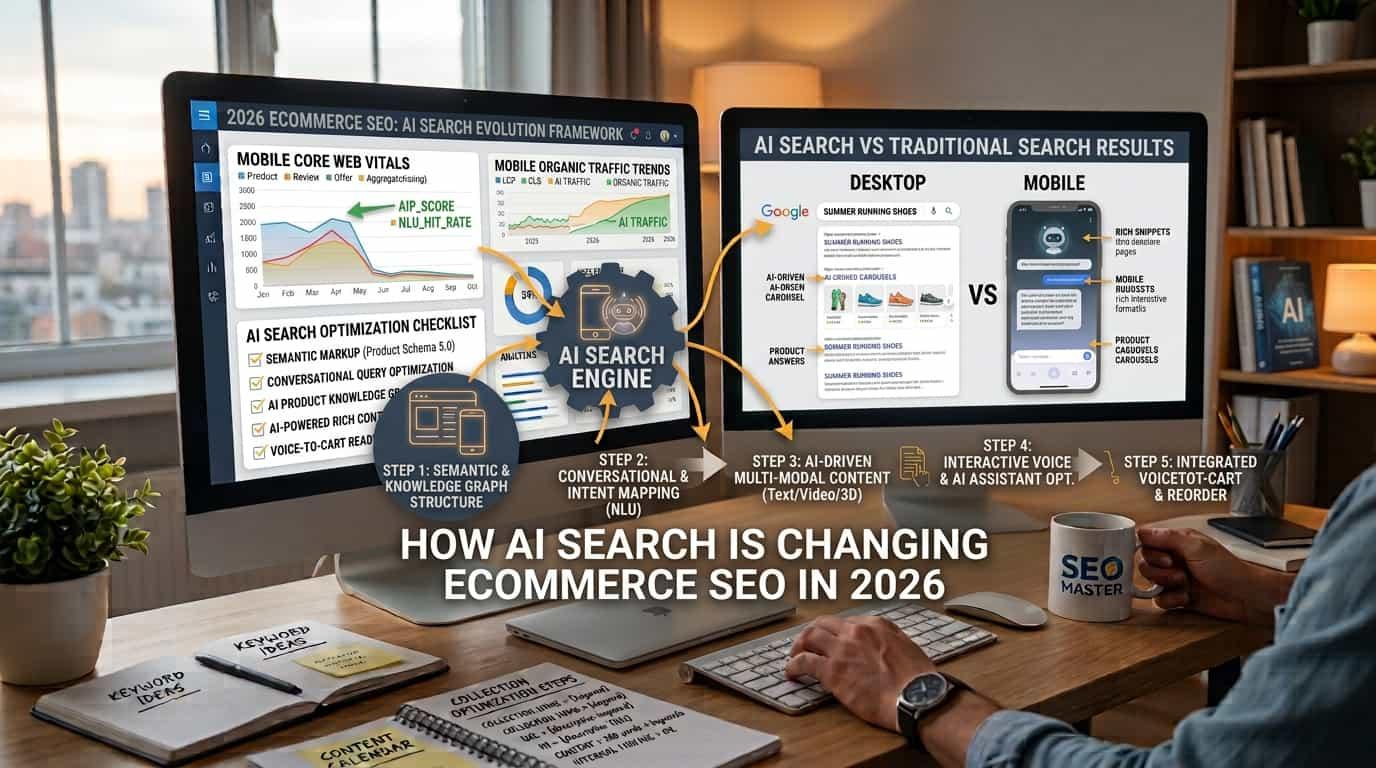
Ecommerce SEO is entering a new phase in 2026. For years, online stores focused mainly on ranking product and category pages in traditional Google search results. Today, shoppers are increasingly using AI-powered search and conversational tools to research products, compare options, and make purchasing decisions.
AI search platforms such as Google AI Mode, ChatGPT, Gemini, and Perplexity are changing how customers discover ecommerce brands. Instead of simply receiving a list of blue links, shoppers can ask detailed questions and receive product recommendations, comparisons, and buying advice within a conversation.
For ecommerce businesses, this means SEO is no longer only about ranking for keywords. Brands also need to make their products easy for AI systems to understand, evaluate, trust, and recommend.
What Is AI Search in Ecommerce?
AI search uses artificial intelligence to understand the meaning and intent behind a user's query rather than relying only on exact keyword matches.
For example, a traditional search might be:
"Best running shoes UK"
An AI-powered shopping query could be:
"I need comfortable running shoes for long-distance running under £120. Which options are suitable for beginners?"
The AI can interpret the user's requirements and provide a more personalized response.
This creates a major opportunity for ecommerce brands because AI can recommend individual products rather than simply directing users to a search results page. Shopify's 2026 data shows that AI-referred sessions to Shopify stores grew significantly, while AI-referred shoppers also showed stronger purchasing behaviour than traditional organic visitors.
Traditional SEO vs AI Search SEO
Traditional ecommerce SEO focuses heavily on:
-
Keyword rankings
-
Search volume
-
Backlinks
-
Meta titles and descriptions
-
Product and category pages
-
Technical SEO
-
Organic traffic
These fundamentals remain important, but AI search adds another layer.
AI systems need to understand:
-
What the product is
-
Who it is suitable for
-
Its features and specifications
-
Its price and availability
-
How it compares with alternatives
-
Whether the brand is trustworthy
-
What customers and other websites say about it
This means ecommerce SEO in 2026 is becoming more focused on context, product information, authority, and user intent.
Product Data Is Becoming More Important
One of the biggest changes brought by AI search is the importance of accurate and detailed product data.
A product page should provide more than a short description. Include important information such as:
-
Product name
-
Brand
-
Price
-
Sizes and colours
-
Materials
-
Dimensions
-
Features
-
Benefits
-
Compatibility
-
Availability
-
Shipping information
-
Frequently asked questions
-
Reviews
AI systems can use this information to better understand whether a product matches a shopper's request.
For Shopify stores, this is particularly important because Shopify is developing infrastructure that allows product catalog information to be used across AI shopping experiences. Shopify states that its Catalog provides product information to AI channels, while Agentic Storefronts are designed to support discovery and commerce through AI platforms.
Keyword SEO Is Moving Towards Search Intent
Keywords are not disappearing, but the way they are used is changing.
Instead of creating separate pages for every slight keyword variation, ecommerce brands should create content that answers the underlying search intent.
For example, instead of targeting only:
"waterproof hiking boots"
an ecommerce store could address related questions such as:
-
What are the best waterproof hiking boots?
-
Which hiking boots are suitable for winter?
-
Are waterproof boots good for long walks?
-
What is the difference between waterproof and water-resistant boots?
-
Which boots are best for muddy terrain?
This approach gives AI systems more useful information to work with and can help establish the brand as a reliable source.
Content Quality Matters More Than Content Volume
AI makes it easier than ever to produce large amounts of content. However, publishing hundreds of generic AI-generated pages does not automatically improve visibility.
Ecommerce websites should focus on useful, original, accurate content.
Good ecommerce content can include:
-
Buying guides
-
Product comparisons
-
Detailed FAQs
-
How-to guides
-
Original research
-
Product reviews
-
Expert insights
-
Case studies
-
Comparison tables
-
Troubleshooting guides
The goal is to provide information that genuinely helps shoppers make decisions.
Shopify's guidance on AI discovery similarly emphasizes strong SEO foundations, detailed product pages, and building authority through trusted publications and other sources.
Brand Authority Is Becoming a Bigger SEO Factor
AI search does not only look at your website.
AI systems can use information from multiple sources to understand a company or product. This makes brand reputation increasingly important.
For ecommerce businesses, authority can be strengthened through:
-
High-quality backlinks
-
Product reviews
-
Customer reviews
-
Digital PR
-
Industry publications
-
Expert mentions
-
Original research
-
Community discussions
-
Relevant third-party websites
For example, if several reputable websites discuss a particular ecommerce brand positively, this can provide additional context about the brand's expertise and credibility.
Therefore, ecommerce SEO is becoming broader than simply optimizing your own website.
Technical SEO Still Matters
The growth of AI search does not mean traditional technical SEO is dead.
Your website still needs to be:
-
Crawlable
-
Indexable
-
Mobile-friendly
-
Fast
-
Secure
-
Well-structured
-
Easy to navigate
Product pages should also use appropriate structured data where relevant, helping search engines understand product information such as price, availability, ratings, and reviews.
A technically weak website can make it harder for both traditional search engines and AI systems to understand and access your content.
AI Search Is Compressing the Buying Journey
One of the most important changes in 2026 is the way AI can shorten the customer journey.
Previously, a shopper might:
-
Search Google.
-
Visit several websites.
-
Compare products.
-
Read reviews.
-
Search for alternatives.
-
Return to a website.
-
Purchase.
With AI search, much of this research can happen inside a single conversation.
The shopper explains what they need, the AI compares potential products, and the shopper may then visit a specific product page with a stronger purchase intention.
Shopify's Q1 2026 data found that more than half of AI-referred sessions started on product detail pages, compared with about 20% for organic search. AI-referred visitors also converted at nearly 50% higher rates and had 14% higher average order values in that dataset.
This means being recommended for the right product can be more valuable than simply generating large amounts of traffic.
What This Means for Shopify Stores
Shopify merchants should prepare their stores for both traditional search and AI-powered discovery.
A strong Shopify SEO strategy in 2026 should include:
1. Optimised Product Pages
Write detailed, helpful product descriptions that clearly explain features, benefits, specifications, and use cases.
2. Structured Product Information
Keep pricing, inventory, variants, product attributes, and other information accurate and consistent.
3. Strong Internal Linking
Connect products, collections, blogs, buying guides, and related content so search engines and AI systems can better understand relationships between pages.
4. Helpful Supporting Content
Create guides and comparison content around the questions customers ask before purchasing.
5. Reviews and Social Proof
Encourage genuine customer reviews and showcase useful product feedback.
6. Technical SEO
Improve site speed, crawlability, indexing, mobile usability, canonicalisation, and structured data.
A Shopify SEO company can help ecommerce businesses audit these areas and build an SEO strategy that combines traditional search optimisation with emerging AI-search requirements.
AI Search Does Not Replace Traditional SEO
One of the biggest misconceptions about AI search is that traditional SEO is becoming irrelevant.
That is not the case.
Shopify's latest 2026 data indicates that organic search remains a major discovery channel even as AI-referred traffic grows rapidly. The two channels are increasingly being used for different purposes rather than one simply replacing the other.
The better approach is to optimise for both.
Traditional SEO can help your website establish visibility, authority, and traffic, while AI-focused optimisation can help your products appear in conversational recommendations and AI-generated answers.
How an Ecommerce SEO Company Can Help
As search behaviour changes, ecommerce businesses may need a more advanced SEO strategy.
An ecommerce SEO company can help with:
-
Keyword and intent research
-
Product page optimisation
-
Technical SEO
-
Structured data
-
Content strategy
-
Internal linking
-
Digital PR and link building
-
Brand authority
-
Product feed optimisation
-
AI-search visibility
-
Performance tracking
The objective is no longer simply to rank at position one for a keyword. It is to make the brand and its products discoverable across the entire modern search ecosystem.
The Future of Ecommerce SEO in 2026
AI search is changing ecommerce SEO from a simple ranking exercise into a broader discovery strategy.
Successful ecommerce brands will need to make their products:
Easy to find → Easy to understand → Easy to trust → Easy to compare → Easy to buy.
The fundamentals of SEO remain important, but businesses now need to think beyond traditional Google rankings. Detailed product information, helpful content, strong technical foundations, brand authority, customer reviews, and structured data can all contribute to better visibility across traditional and AI-powered search.
For ecommerce businesses, the key lesson is simple: don't abandon SEO because of AI—evolve your SEO strategy for the AI search era.
With AI-referred traffic growing rapidly and shoppers increasingly using conversational tools for product research, 2026 is an important time for ecommerce brands to prepare for the next generation of search.

 English
 Arabic
 French
 Spanish
 Deutsch
 Turkish
 Dutch
 Italiano
 Russian
 Romaian
 Portuguese (Brazil)
 Greek