
The Rise of Agentic AI in US Enterprise Tech | 2026 Trends
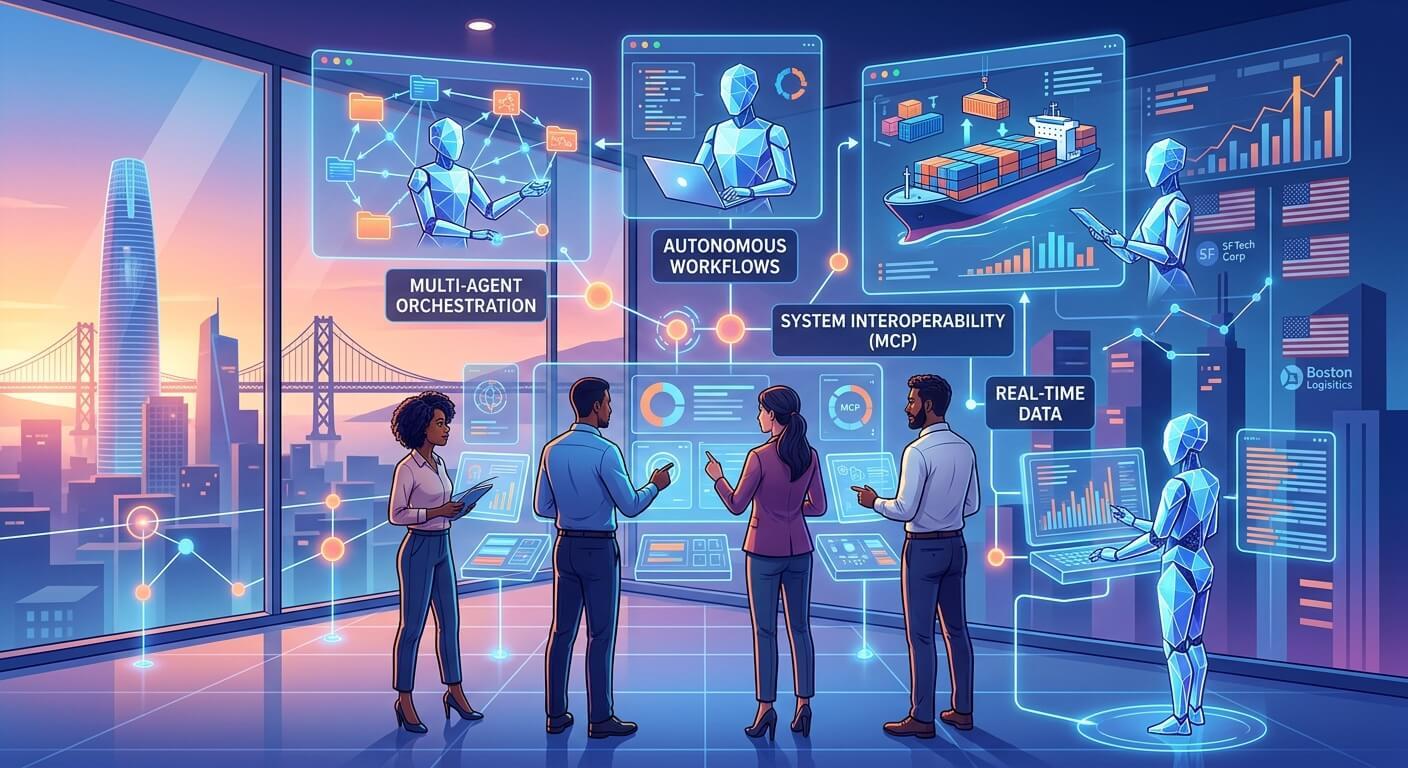
Over the past few years, artificial intelligence across US business environments has largely functioned as a high powered digital assistant. Generative AI tools excelled at drafting emails, writing code snippets, and summarizing dense PDFs, but they still relied on continuous human prompts and manual oversight.
That operational dynamic has reached a major turning point. Enter Agentic AI a structural shift from assistive language models to goal oriented, autonomous software agents that execute complex, multi step workflows with minimal human intervention.
Gartner predicts that 40% of enterprise software applications will feature task specific AI agents, up from under 5% just a short time ago. US enterprise tech leaders are shifting away from passive chatbots and embracing autonomous execution engines capable of planning, decision making, and self correction.
What Makes Agentic AI Different?
Traditional generative AI models wait for instructions, process inputs, and output static text or code. In contrast, agentic AI operates with agency and context.
When assigned a higher level business goal such as "reconcile inventory discrepancies across third party fulfillment centers" an agentic AI system breaks down the challenge into sub tasks:
-
Connects to enterprise databases via unified APIs or protocols.
-
Identifies missing shipments across vendors.
-
Cross-references internal ERP data with supplier stock.
-
Generates purchase orders or contacts vendor platforms to resolve the issue autonomously.
Rather than answering questions, agentic systems take direct operational action.
Core Drivers Fueling US Enterprise Adoption
Several converging business factors have accelerated the transition toward autonomous AI ecosystems across American corporations:
1. The Shift to Multi Agent Collaboration
Single function AI tools often struggle when tasked with managing complex end to end processes. Modern enterprise architectures increasingly favor multi agent orchestration. Specialized agents act as a coordinated unit where a financial analysis agent passes data directly to a compliance agent, which in turn hands off tasks to an automated procurement system. Research indicates multi agent architectures can cut task execution timelines significantly compared to traditional single step automation.
2. Standardized Interoperability
Historically, connecting disparate SaaS tools required time consuming custom software integration. The widespread arrival of standardized communication protocols (such as the Model Context Protocol, or MCP) enables agents from different software vendors to securely talk to one another and access company data safely.
3. Measurable ROI vs. "AI Hype"
US enterprises face growing pressure to demonstrate quantifiable returns on early AI pilot investments. According to recent enterprise survey data, US companies implementing agentic AI workflows project average return on investment figures approaching 192% due to lower labor overhead, faster cycle times, and reduced operational error rates.
Top Enterprise Use Cases in Action
-
IT Operations & Service Desk: Agents autonomously triage incoming software tickets, run diagnostic tests, deploy patches, and resolve system issues before escalation.
-
Healthcare Administration: Hospital networks use agentic clinical assistants to manage documentation, handle patient scheduling logic, and synthesize patient records, saving clinicians over an hour of administrative friction per day.
-
Supply Chain & Logistics: Autonomous agents track inventory fluctuations in real time, auto-reorder parts when supplier delays surface, and reroute shipments to prevent warehouse downtime.
-
Agentic Customer Experience (CX): Instead of pointing customers to static FAQ pages, customer support agents process refunds within policy guidelines, modify subscriptions, and execute account changes directly.
Navigating the Roadblocks: Security & Governance
Despite massive enterprise momentum, scaling agentic AI is not without its hurdles. Giving software systems the power to make decisions and execute actions introduces genuine operational risk if left unmonitored.
-
Guardian Agents & Guardrails: Enterprise security teams are deploying governance focused "guardian agents" designed specifically to monitor operational agent actions, enforce data access boundaries, and flag anomalous behavior.
-
Human-in-the-Loop Frameworks: High risk workflows (such as releasing multi million dollar wire transfers or changing enterprise system configurations) retain human approval checkpoints while letting agents execute all underlying background logistics.
-
Context Readiness: An AI agent is only as reliable as the underlying enterprise data it accesses. Companies must resolve fragmented data silos before unleashing autonomous systems across production environments.
-
Frequently Asked Questions (FAQs)
1. What is Agentic AI, and how is it different from traditional generative AI?
Traditional generative AI models (like standard chatbots) are assistive and passive they wait for manual prompts, generate text or code, and require humans to execute the resulting output. Agentic AI refers to goal oriented, autonomous software agents capable of planning, executing multi step workflows, interacting with enterprise systems, and self correcting with minimal human intervention.
2. How are US enterprises currently using Agentic AI?
US companies are deploying agentic workflows across several key sectors:
-
IT Operations: Automatically triaging tickets, running diagnostics, and deploying patches.
-
Healthcare Administration: Managing documentation, scheduling logic, and synthesizing records.
-
Supply Chain: Tracking live inventory, auto reordering parts, and rerouting shipments.
-
Customer Experience: Processing policy compliant refunds and executing direct account changes.
3. What security and governance risks are associated with Agentic AI?
Because agentic systems have the authority to make decisions and execute operational actions, they introduce risks regarding data access and unauthorized changes. To mitigate this, enterprises use governance focused "guardian agents" to monitor behavior, enforce strict data boundaries, and implement human in the loop checkpoints for high risk actions (such as financial transfers or major system configurations).
4. What tools or technologies enable multi-agent systems to work together?
Historically, connecting different software tools required complex custom integrations. Today, standardized communication protocols such as the Model Context Protocol (MCP) allow specialized agents from different vendors to securely communicate, share context, and access corporate data safely.
5. What kind of return on investment (ROI) are US companies seeing from agentic AI?
Early enterprise adoption data indicates that US companies implementing agentic workflows project average return on investment figures approaching 192%. This ROI is driven primarily by reduced labor overhead, faster cycle times, and significantly lower operational error rates.
-
The Road Ahead
The trajectory of US enterprise technology is moving from assistive tools to autonomous execution. Over the next several years, the most competitive businesses won't just be those whose employees use AI to draft emails faster; they will be the enterprises that build robust, governed ecosystems of autonomous agents working behind the scenes 24/7.
For CTOs and business leaders across North America, the message is clear: the future of work isn't just about asking better questions it's about deploying agents that deliver complete solutions.

 English
 Arabic
 French
 Spanish
 Deutsch
 Turkish
 Dutch
 Italiano
 Russian
 Romaian
 Portuguese (Brazil)
 Greek