English
 Arabic
 French
 Spanish
 Portuguese
 Deutsch
 Turkish
 Dutch
Dutch
 Italiano
 Russian
 Romaian
 Portuguese (Brazil)
 Greek
Greek
BBA in Multan: A Complete Guide to Building a Successful Business Career
Other |
2026-07-10 07:56:24
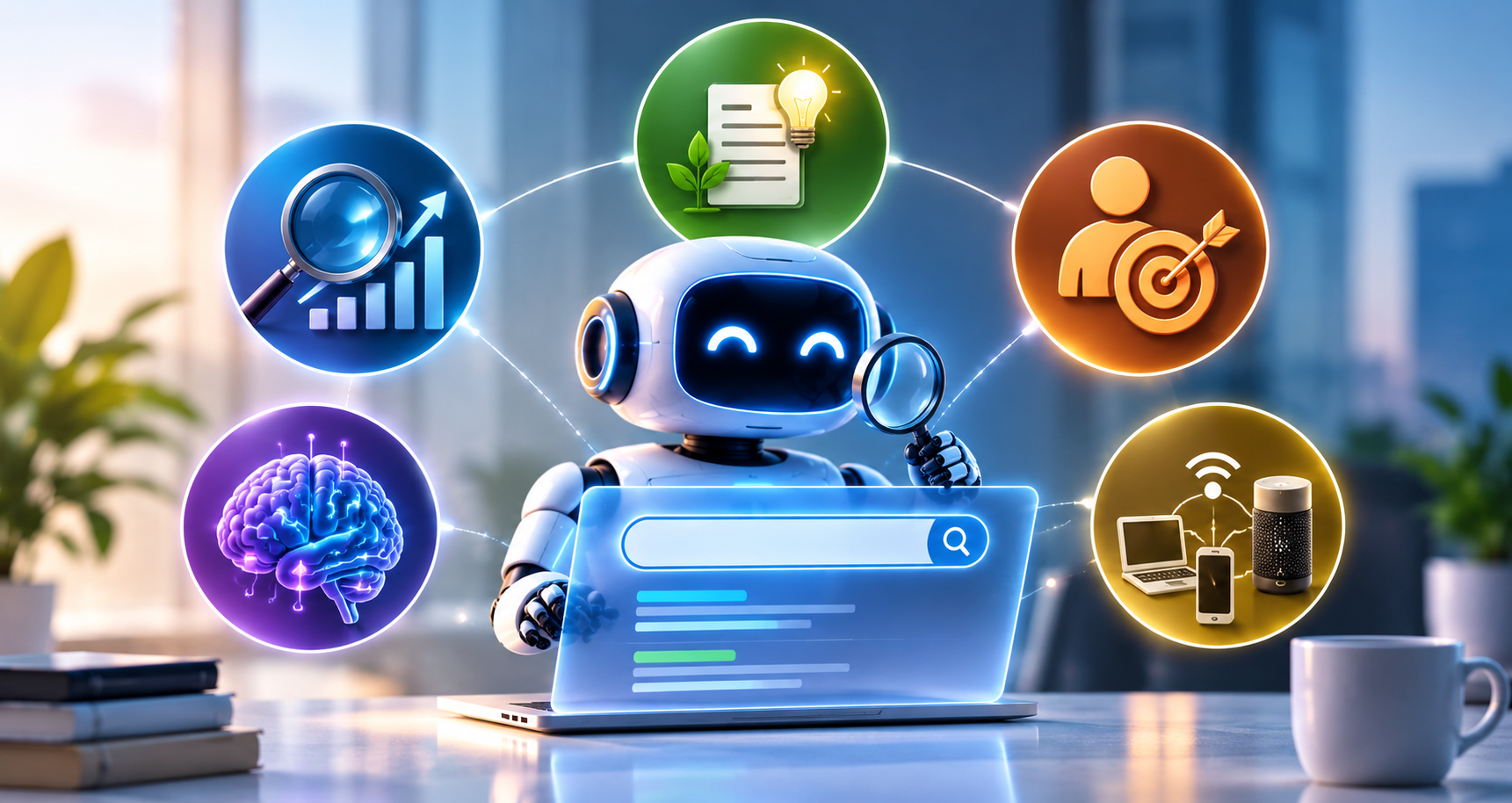
Search is changing.
A few years ago, you would type a keyword into Google, scan the blue links and choose one. Today, people can ask longer questions and get AI-generated answers that bring together information from different sources.
This change has created a new area of digital marketing called AI Search Optimization.
AI Search Optimization is the practice of creating and structuring online information so that AI-powered search systems can understand, trust, and potentially reference it when answering users' questions.
But is it simply the new name for SEO?
Not quite.
Traditional SEO still matters. At the same time, marketers now need to think about how content works when search experiences provide answers instead of only lists of links.
If you're learning digital marketing in 2026, this is a topic worth understanding.
Quick Answer
AI Search Optimization means preparing your website and content so AI-powered search systems can better understand your information and use it when generating answers. It involves clear content, strong topical coverage, trustworthy sources, structured information, useful answers and a good overall website experience.
It does not mean writing content specifically for robots. The best approach is still to create information that genuinely helps people.
AI Search Optimization focuses on visibility in search experiences that use artificial intelligence to understand questions and generate answers.
These experiences can include AI-generated summaries in search engines and conversational AI platforms.
Traditional SEO often asks:
“How can I rank this page for this keyword?”
AI Search Optimization asks a slightly broader question:
“How can my information become a useful and trustworthy source for an answer?”
That difference matters.
For example, imagine someone searches:
“What should a beginner learn before starting digital marketing?”
They may not be looking for one page targeting that exact phrase.
They may want an answer covering SEO, social media, content writing, analytics, paid advertising and practical experience.
A website that explains these relationships clearly gives search systems more useful information to work with.
Keywords still have a place in SEO.
But AI-powered search makes understanding search intent even more important.
Search intent is simply the reason behind a search.
A person searching:
“What is SEO?”
probably wants an explanation.
Someone searching:
“SEO course fees in Nagpur”
has a different need.
They may be comparing courses and prices.
Someone searching:
“Best Digital Marketing Institute in Nagpur”
has stronger commercial intent and may be ready to compare training options.
Before creating content, ask:
This simple exercise can improve your content more than adding the keyword ten more times.
A Simple Example
Instead of writing a page around:
“digital marketing course”
you could answer related questions such as:
Now, the content answers the topic rather than chasing one phrase.
AI systems need to understand information easily.
Long introductions that take five paragraphs to answer a simple question aren't very helpful.
Start with the answer.
For example:
What is AI Search Optimization?
AI Search Optimization is the process of making online content easier for AI-powered search systems to understand and use when answering questions.
That's clear.
You can then explain the topic in more detail.
This structure also helps human readers. Most people want the answer first and the background later.
A Useful Content Structure
For important questions, try this format:
Question → Direct answer → Explanation → Example → Practical tip
For example:
How does AI Search differ from traditional search?
Give a short answer first.
Then explain how AI-powered systems can synthesise information and respond conversationally.
Then provide an example.
Then tell the reader what marketers should do differently.
Simple structure. Easy to follow.
One article rarely explains an entire subject.
Suppose you're writing about SEO.
You might naturally need to discuss:
These aren't random keywords.
They are connected concepts.
When you explain those relationships naturally, you help readers understand the subject and give search systems more context.
This is often called topical coverage.
Think in topics, not keyword lists.
A common mistake is creating sentences like:
“SEO course, SEO training, SEO classes, best SEO course, SEO institute...”
The text becomes awkward.
Instead, write naturally about what a person actually needs to know.
Good content should sound like a person explaining something, not a keyword spreadsheet being turned into paragraphs.
AI search can pull together information from many sources.
That makes trustworthy information important.
If you're publishing content about health, finance, education or other subjects where incorrect information can cause problems, you should be especially careful.
Show where important claims come from.
Use credible sources when needed.
Give the author clear information.
For business websites, include useful details about the organisation and its experience.
For expert content, explain who wrote or reviewed it.
What can strengthen trust?
Don't add an “expert reviewed” label unless an actual qualified expert reviewed the content.
That small detail can make a big difference to trust.
AI Search Optimization isn't just about blog articles.
Your website itself provides context.
Search systems can look at information across your online presence.
That means your:
can all contribute to how your organisation is understood online.
For a local digital marketing institute in Nagpur, for example, it helps to clearly communicate:
Don't hide important information behind vague marketing language.
Tell people what they actually want to know.
|
Traditional SEO |
AI Search Optimization |
|
Focuses strongly on rankings |
Focuses on being useful in AI-generated answers |
|
Keyword targeting is important. |
Search intent and context are important. |
|
Links and technical SEO matter |
Links and technical SEO still matter. |
|
Optimises individual pages |
Looks more broadly at topics and entities |
|
Targets search queries |
Targets questions and information needs |
|
Measures rankings and traffic |
Also considers mentions, citations and visibility in AI search. |
This isn't an either-or situation.
You don't need to abandon SEO.
Think of AI Search Optimization as another layer of modern search visibility.
Writing only for AI
This usually produces unnatural content.
Write for people first.
Copying information from other websites
AI systems don't need another version of the same generic article.
Add something useful.
A personal observation, original example, expert explanation or practical experience can make the content more valuable.
Ignoring traditional SEO
Technical problems don't disappear because AI search exists.
Your website still needs to be crawlable, understandable and useful.
Making unsupported claims
Don't publish statistics just because an AI tool gave you a number.
Check the source.
Adding too many keywords
Keyword stuffing can make even a good topic difficult to read.
Use related terms naturally.
You don't need a complicated process.
Try these steps.
Step 1: Start with the main question
What does the reader actually want to know?
Step 2: Answer early
Don't make people search through your introduction.
Step 3: Add related questions
Think about what the reader will ask next.
Step 4: Use clear headings
Question-based headings can make the structure easier to understand.
Step 5: Add examples
Explain concepts with real situations.
Step 6: Support important claims
Use reliable sources when the subject requires evidence.
Step 7: Review the content like a reader
Ask yourself:
“If I found this page today, would it actually answer my question?”
If the answer is no, improve it before worrying about rankings.
Digital marketing is no longer limited to Google rankings.
Marketers now need to understand how people discover information across search engines, social platforms, AI tools and other digital channels.
If you're considering a Best Digital Marketing Institute in Nagpur, look for training that teaches the fundamentals first and then introduces newer areas such as AI-assisted marketing and AI search.
A good learning path should give you opportunities to practise.
For example, you could:
These exercises help you understand what the concepts actually mean.
What is AI Search Optimization?
AI Search Optimization is the practice of making online information clear, useful, trustworthy and easy for AI-powered search systems to understand. It builds on traditional SEO by paying more attention to questions, context, entities, topical coverage and the quality of information that can support an AI-generated answer.
Is AI Search Optimization the same as SEO?
No. The two are closely connected, but they are not the same. Traditional SEO focuses heavily on helping web pages appear in search results. AI Search Optimization also considers how information may be understood, selected or referenced within AI-powered search experiences. Strong technical SEO and useful content remain important for both.
How can I optimise my content for AI search?
Start by understanding the user's question and intent. Give a direct answer early, use clear headings, explain related concepts, add useful examples and support important claims with reliable sources. Keep the writing natural and avoid keyword stuffing. Your goal should be to make the information genuinely useful to the person reading it.
Does traditional SEO still matter in 2026?
Yes. AI search does not make traditional SEO irrelevant. Websites still need good technical foundations, useful content, relevant information and clear site structures. SEO also helps search engines discover and understand webpages. Marketers should learn traditional SEO and then understand how AI-powered search adds another way for people to discover information.
Should students learn AI Search Optimization?
Students interested in digital marketing can benefit from learning how AI is changing search. It should not replace the basics. Understanding SEO, content, analytics, search intent and digital marketing strategy first makes it much easier to understand AI Search Optimization and use AI tools sensibly.
Final Thoughts
AI Search Optimization may sound complicated, but the basic idea is fairly simple.
Create useful information. Make it easy to understand. Answer real questions. Support important claims. Build trust.
You don't need to rewrite every article because AI search exists.
Start by looking at your content from the reader's point of view.
If someone asks a question, can your page answer it clearly?
If they have a second question, does your content help with that too?
That's a good starting point.
For students and aspiring marketers, learning these skills alongside traditional SEO can make digital marketing knowledge more relevant to how people search in 2026.