
Yagi Antenna: High-Gain Directional Antenna Solutions by Star Antenna
In today's rapidly evolving communication industry, reliable signal transmission and reception are essential for maintaining efficient wireless communication systems. A Yagi antenna is one of the most widely used directional antennas, known for its high gain, focused signal reception, and excellent directional performance. It is designed to provide effective communication over specific frequency bands, making it suitable for applications in telecommunications, defence, broadcasting, industrial communication, and wireless networking.
Star Antenna, a trusted antenna manufacturer, offers a range of high-performance Yagi antenna solutions designed to meet the diverse requirements of modern RF communication systems. With a focus on quality, reliability, and engineering excellence, Star Antenna delivers antenna solutions for professional and industrial applications.
What Is a Yagi Antenna?
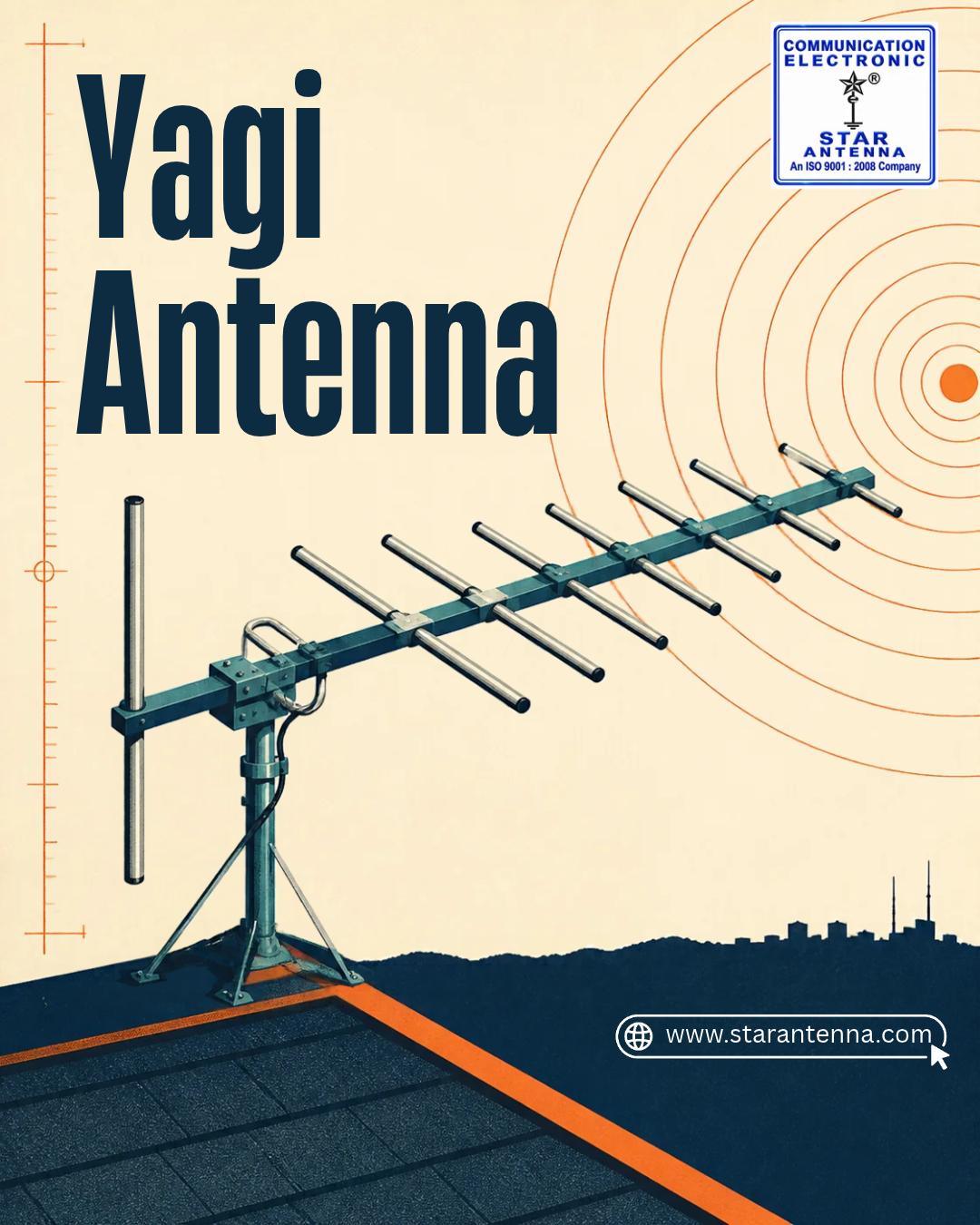
A Yagi antenna, also known as a Yagi-Uda antenna, is a directional antenna that consists of multiple parallel elements arranged along a central supporting structure called a boom. Its typical design includes three main components: a driven element, a reflector, and one or more directors.
The driven element is responsible for transmitting or receiving radio frequency signals. The reflector, positioned behind the driven element, helps direct the signal forward, while the directors focus the radiation pattern in the desired direction.
This arrangement allows a Yagi antenna to provide higher directional gain compared to many conventional omnidirectional antennas. It is particularly useful in situations where signals need to be transmitted or received from a specific direction.
How Does a Yagi Antenna Work?
The working principle of a Yagi antenna is based on electromagnetic coupling between its elements. When an RF signal is supplied to the driven element, the reflector and directors interact with the electromagnetic field to shape the antenna's radiation pattern.
The resulting directional pattern concentrates energy toward a particular direction, improving signal strength and communication efficiency along the antenna's main beam.
Similarly, during reception, the antenna focuses on signals arriving from its preferred direction. This directional capability helps reduce unwanted signals and interference from other directions, depending on the antenna design and installation environment.
Key Advantages of Yagi Antennas
Yagi antennas offer several benefits that make them suitable for professional communication and wireless applications.
1. High Directional Gain: Yagi antennas concentrate RF energy in a specific direction, providing improved signal strength and effective communication over longer distances when properly installed.
2. Focused Signal Reception: Their directional radiation pattern helps receive signals from a particular direction while reducing unwanted interference from other directions.
3. Efficient Communication: By focusing transmitted and received signals, Yagi antennas can improve communication reliability in suitable operating environments.
4. Multiple Frequency Options: Yagi antennas can be designed for different frequency bands, including VHF and UHF, depending on specific application requirements.
5. Customizable Design: The number of elements, antenna dimensions, gain, polarization, and frequency range can be customized to meet different operational requirements.
6. Versatile Installation: Depending on their mechanical design, Yagi antennas can be installed on rooftops, towers, poles, and other suitable mounting structures.
Applications of Yagi Antennas
Due to their directional characteristics and high-gain capabilities, Yagi antennas are widely used across several industries.
-
Telecommunication Systems: Used in wireless communication networks where directional signal transmission and reception are required.
-
Defence and Military Communication: Suitable for specialized communication, monitoring, and surveillance applications.
-
SCADA Systems: Used in industrial automation and remote monitoring systems for communication between distributed equipment.
-
Broadcasting: Supports directional signal transmission and reception in selected broadcasting applications.
-
Wireless Networking: Helps establish point-to-point wireless communication links in suitable network configurations.
-
RF Monitoring: Used in signal monitoring and radio frequency measurement applications.
-
Industrial Communication: Provides directional connectivity for various industrial wireless communication requirements.
Why Choose Star Antenna for Yagi Antennas?
Choosing the right antenna manufacturer plays an important role in achieving reliable communication performance. Star Antenna, a registered brand of Communication Electronic, has been serving the antenna manufacturing industry since 1990.
With decades of experience in RF antenna design and manufacturing, Star Antenna offers a diverse range of antenna solutions for communication, defence, marine, aviation, navigation, UAV, and industrial applications.
Its Yagi antenna product range includes different configurations, such as standard Yagi antennas, dual-stacked Yagi antennas, and back-to-back Yagi antennas. These options help address different requirements for directional coverage, gain, and installation.
Star Antenna emphasizes quality, reliability, and performance throughout its antenna manufacturing process. Its in-house research, development, manufacturing, and testing capabilities support the development of antenna solutions for demanding professional applications.
The company also offers customized in-band and out-of-band antenna versions on request, allowing customers to explore solutions based on their specific frequency and operational requirements.
Whether you need a VHF Yagi antenna, UHF Yagi antenna, or a specialized directional antenna for industrial communication, Star Antenna provides solutions designed to support dependable RF performance.
Choose the Right Yagi Antenna for Your Requirements
Before selecting a Yagi antenna, it is important to evaluate technical parameters such as operating frequency, gain, VSWR, impedance, polarization, front-to-back ratio, power handling capacity, and beamwidth.
Installation height, mounting arrangement, cable quality, and the surrounding environment can also influence overall antenna performance. Selecting an antenna that matches your communication requirements helps ensure efficient operation and dependable connectivity.
Conclusion
Yagi antennas remain an important solution for applications that require directional signal transmission, focused reception, and high-gain performance. Their versatile design makes them suitable for telecommunications, defence, SCADA, industrial communication, broadcasting, and wireless networking.
With extensive experience in antenna engineering and manufacturing, Star Antenna continues to provide quality RF antenna solutions for diverse industries. Explore the Yagi antenna range from Star Antenna and find a suitable solution for your communication requirements.

 English
 Arabic
 French
 Spanish
 Portuguese
 Turkish
 Dutch
 Italiano
 Russian
 Romaian
 Portuguese (Brazil)
 Greek