
CBSE Class 12 Boards 2027: How to Balance Board Preparation and Entrance Exams
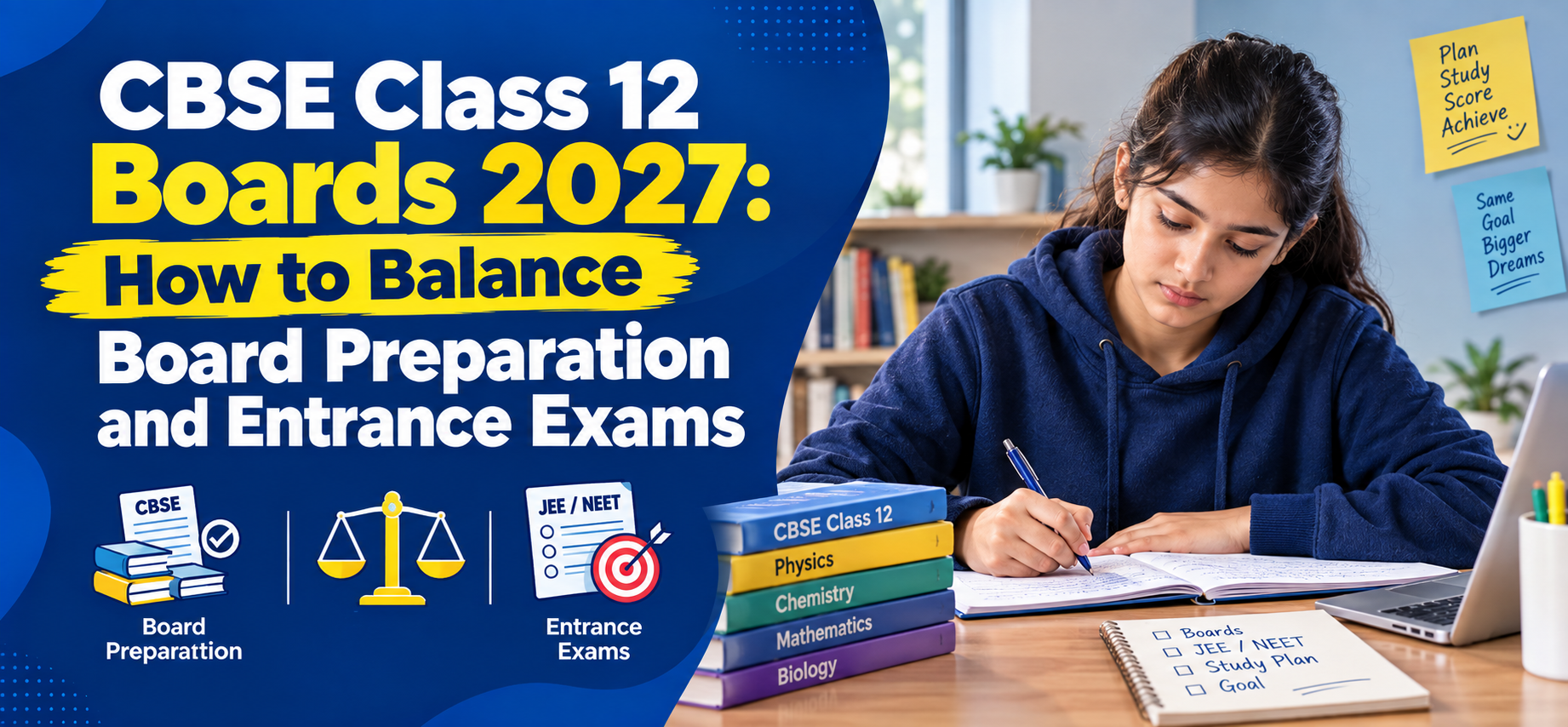
Ask any Class 12 student what the toughest part of the year is, and you will rarely hear "the syllabus." It is the tug-of-war. Board exams demand written, well-structured answers, while entrance tests like JEE, NEET and CUET reward speed, accuracy and application. Both arrive within weeks of each other, and both feel non-negotiable.
The good news is that these two goals overlap far more than most students realise. Choosing the right school environment, a realistic routine, and smart revision habits can make the year manageable. Many families begin by looking for the Best CBSE School in Sikar precisely because strong faculty guidance and a well-planned academic calendar can lighten this load. Whatever your setting, the strategies below will help you approach the 2027 session with clarity rather than panic.
Why the Balance Matters More Than Ever
Board marks and entrance scores serve different purposes, but neither can be ignored. Boards decide your eligibility for many universities and courses, and for admission through counselling systems such as JoSAA, a minimum board performance is typically required. Entrance exams, meanwhile, decide the actual seat. Neglecting either one can quietly close doors.
Students who stumble usually do so for one of three reasons:
-
They treat boards as a "formality" and leave them for the last two months.
-
They spend all their energy on coaching material and never write full-length answers.
-
They study in rushed bursts with no revision cycle, so nothing stays in memory.
Recognising these traps early is half the battle.
Understand How the Two Exams Differ
Before building a timetable, it helps to see what each exam actually tests.
|
Aspect |
CBSE Class 12 Boards |
Entrance Exams (JEE / NEET / CUET) |
|
Question style |
Descriptive, case-based, and objective mix |
Mostly MCQs, some numerical-answer formats |
|
Skill tested |
Concept clarity, presentation, and explanation |
Speed, accuracy, and application |
|
Syllabus base |
NCERT-centred |
NCERT plus deeper problem-solving |
|
Marking |
Step-wise marks for partial working |
Negative marking in many exams |
|
Preparation focus |
Writing practice and diagrams |
Mock tests and timed practice |
The takeaway is simple: NCERT is the common foundation. If your fundamentals are strong, both exams become easier to handle.
Start With the Official Information
Exam schedules change, so rely on official sources rather than social media rumours. Keep an eye on the CBSE website (cbse.gov.in) for the date sheet, sample papers, and marking schemes, and on the National Testing Agency (nta.ac.in) or the relevant authority for entrance exam notifications. Historically, the main JEE session has been held in January, the second in April, NEET UG in May, and CUET UG in May-June, while CBSE boards begin around mid-February. Treat these as rough patterns, not guarantees, and confirm the 2027 dates once they are announced.
Build a Year Plan in Three Phases
Rather than a rigid hour-by-hour routine that collapses in week two, think in phases.
|
Phase |
Approximate Period |
Main Goal |
|
Foundation |
Now to December |
Finish syllabus, strengthen NCERT, start topic-wise practice |
|
Integration |
January to February |
Revise boards while continuing timed entrance practice |
|
Sprint |
March to exam months |
Full mock tests, error analysis, final revision |
Phase 1: Foundation. This is when the bulk of learning happens. Complete each chapter with both exams in mind: read the NCERT text carefully, solve its exercises, then attempt higher-level questions on the same topic. One chapter, two purposes.
Phase 2: Integration. The months close to the boards are delicate. Shift more time toward board-style writing, sample papers, and diagrams, but keep a daily block for entrance practice so your speed does not fade.
Phase 3: Sprint. After the boards, the focus turns almost fully to entrance strategy. Since concepts are already fresh from board revision, this phase becomes about mock tests, weak-area repair, and stamina.
Practical Daily Habits That Actually Work
A perfect plan means nothing without everyday discipline. These habits keep momentum steady:
-
Study in blocks. Work in 45 to 60 minute sessions with short breaks instead of marathon hours that leave you drained.
-
Rotate subjects. Alternate a theory-heavy subject with a numerical one to keep your mind fresh.
-
Keep an error notebook. Write down every mistake from tests, along with the correct approach. Reviewing it weekly is one of the most effective revision tools available.
-
Write, don't just read. Practise answers by hand at least a few times a week, especially for Chemistry mechanisms, Biology diagrams, and Physics derivations.
-
Protect your sleep. Seven hours of rest improves recall far more than an extra late-night hour of cramming.
Subject-Wise Overlap: Where You Save Time
Some subjects reward you twice for the same effort.
Physics and Chemistry. Topics such as electrostatics, current electricity, electrochemistry, and chemical kinetics feature heavily in both boards and entrances. Solve numericals first for entrance readiness, then practise writing the full derivation or explanation for boards.
Mathematics. Calculus, matrices, and probability are common ground. Board papers give step marks, so present your working neatly, while entrance practice trains you to reach answers quickly.
Biology. NEET aspirants should treat NCERT as the primary text. Nearly every line can be tested, and the same reading works for board theory answers. Add diagram practice for the boards.
English and other languages. Do not ignore these. They can boost your overall percentage, and CUET aspirants need language skills anyway. Short, regular writing practice is enough.
Mock Tests and Sample Papers: Use Both Wisely
Mock tests sharpen entrance performance, while CBSE sample papers and previous year papers teach you the board pattern. Do not treat them as competing tasks.
A useful rhythm is one full entrance mock per week during the foundation phase, increasing to two as the exam nears. Alongside that, attempt one board-style paper every fortnight, gradually raising the frequency after January. After every test, spend at least as long analysing it as you did writing it. A test you never review is wasted effort.
Managing Stress and Staying Healthy
Pressure is normal, but it should not take over your life. Short walks, light exercise, hobbies and conversations with friends genuinely improve concentration. If anxiety starts affecting sleep or appetite, talk to a parent, teacher or school counsellor early. Asking for support is a sign of maturity, not weakness.
Parents play a role too. Encouragement and a calm home environment matter more than daily comparisons or constant reminders about marks.
Common Mistakes to Avoid
-
Postponing NCERT revision until the last month
-
Changing study material every few weeks
-
Skipping board practical work and internal assessments, which carry real marks
-
Comparing your progress with classmates instead of your own past performance
-
Ignoring health, sleep and breaks in the name of productivity
A Quick Weekly Template
A sample structure many students find useful:
-
Weekdays: School hours, then 2 to 3 hours of concept work, 1 hour of problem practice, and 30 minutes of revision.
-
Saturday: One entrance mock test followed by analysis.
-
Sunday: Board-style writing practice, a light revision session, and proper rest.
Adjust the numbers to your own energy and school timings. The best routine is the one you can sustain.
Final Thoughts
Class 12 is not really two separate battles. It is one long journey where boards build your foundation, and entrances test how well you can apply it. Start early, lean on NCERT, revise in cycles, test yourself regularly, and take care of your health. Students who stay consistent, rather than intense for a few weeks and absent for the rest, tend to come out ahead in both.
FAQs
1. Can I prepare for boards and entrance exams together?
Yes. NCERT forms the base for both. Study each chapter thoroughly, then add advanced practice questions, so one effort serves both boards and entrance preparation effectively.
2. When should I start focusing on board exam practice?
Begin light board-style writing early, but increase sample paper practice from December or January. This gives enough time to refine presentation and speed before the February exams.
3. How many hours should a Class 12 student study daily?
Quality matters more than quantity. Most students do well with six to eight focused hours including school, provided they revise regularly, take breaks, and sleep adequately.
4. Is coaching necessary for entrance exams?
Not always. Disciplined self-study, a strong command of NCERT, and regular mock tests work for many students. Coaching helps mainly with structure, doubt-solving, and a competitive peer environment.
5. Where can I find the official CBSE Class 12 2027 date sheet?
Visit cbse.gov.in for circulars, date sheets, and sample papers. Avoid unofficial pages, as dates can change and unverified sources often circulate inaccurate information.

 Arabic
 French
 Spanish
 Portuguese
 Deutsch
 Turkish
 Dutch
Dutch
 Italiano
 Russian
 Romaian
 Portuguese (Brazil)
 Greek
Greek