
Why More Architecture and Construction Firms Are Outsourcing BIM Modeling
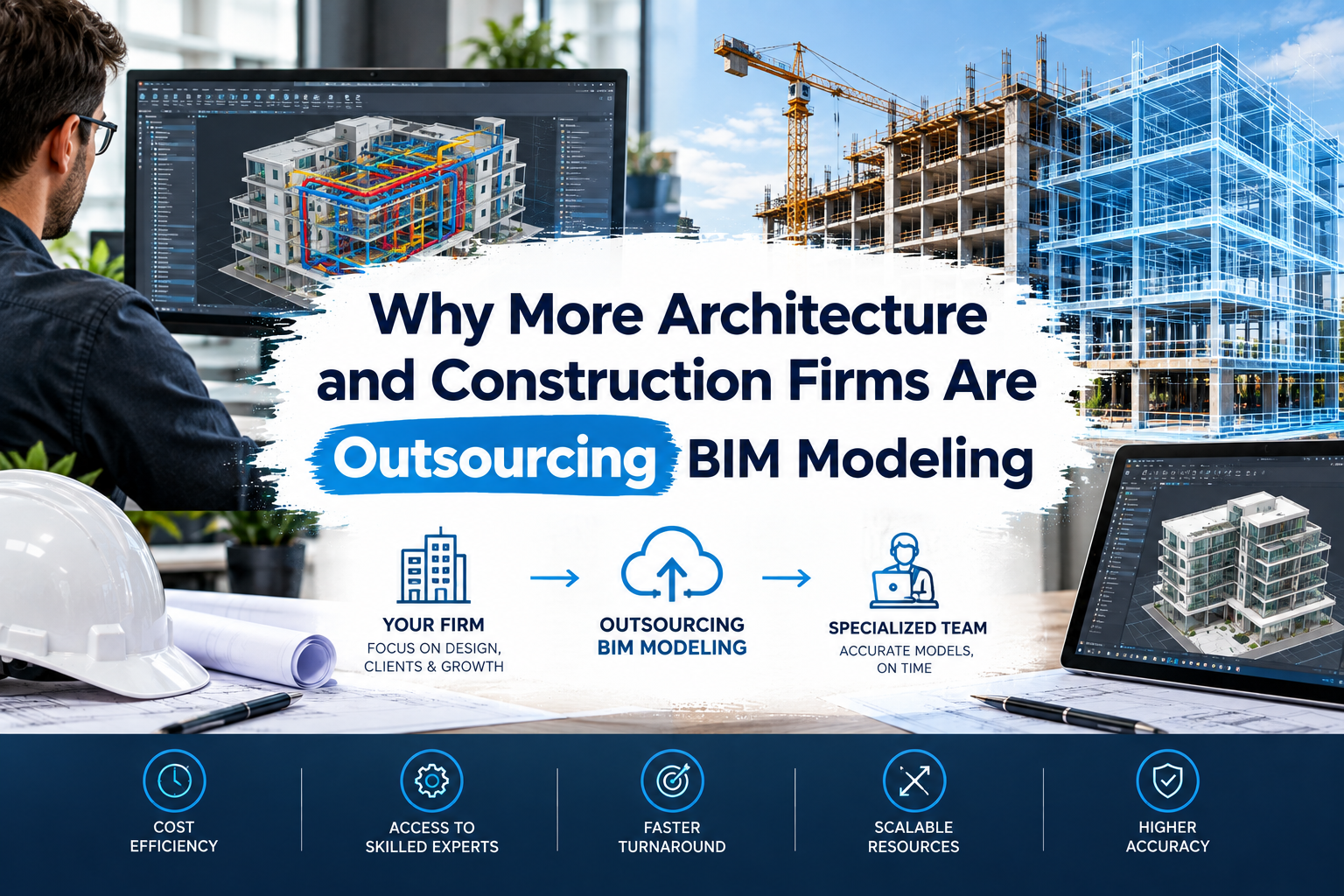
Building projects have gotten more complicated, and the margin for error has gotten smaller. Clients expect faster turnarounds, contractors need coordinated drawings before breaking ground, and everyone involved wants fewer surprises once construction starts. That pressure is a big reason why Building Information Modeling, or BIM, has moved from a specialized add-on to a standard part of how architecture and construction firms operate.
What BIM Actually Solves
At its core, BIM is a way of building a digital version of a structure before the physical one goes up. But it's not just a 3D shape sitting on a screen, it's a model loaded with data: materials, dimensions, systems, and how every element relates to the others. That distinction matters, because it's the reason BIM has changed how teams catch problems.
Instead of finding out during construction that a duct clashes with a structural beam, that kind of conflict shows up in the model weeks or months earlier, when it costs almost nothing to fix. That single shift catching issues on screen instead of on site is behind most of the reasons firms adopt BIM in the first place.
Fewer Costly Surprises on Site
Rework is one of the biggest hidden costs in construction. A coordinated BIM model lets architects, engineers, and contractors check their work against each other before anything is built, which cuts down on the kind of last-minute redesigns that blow past budgets and timelines.
Better Communication With Clients and Contractors
A detailed 3D model communicates a design far more clearly than a stack of 2D drawings. Clients can understand what they're approving, and contractors get a model that actually reflects how the building is supposed to go together, not just what it's supposed to look like.
Why Firms Are Choosing to Outsource This Work
Building and maintaining an in-house BIM team is expensive. It means investing in software licenses, training, and staff who can keep up with evolving standards, a heavy lift for firms whose core focus is design or construction management, not modeling software itself.
That's pushed a lot of architecture and construction companies toward outsourced BIM modeling instead. It gives them access to trained modelers and current software without carrying that overhead year-round, and it lets in-house teams stay focused on design decisions rather than production drafting.
What to Look for in a BIM Modeling Partner
Not all BIM providers offer the same depth of service, so it's worth being specific about what a project actually needs before choosing one:
-
Experience with the specific project type (residential, commercial, industrial, or infrastructure)
-
Familiarity with the software your team already uses, so files move back and forth cleanly
-
A track record of meeting deadlines on multi-discipline coordination, not just single-model work
-
Clear communication throughout the process, not just a finished file at the end
Firms that take the time to vet these points tend to have a much smoother experience than those who choose a provider purely on price.
A Closer Look at What's Included
Full-service BIM work usually covers more than just modeling geometry. It can include clash detection, quantity takeoffs, construction documentation, and coordination across architectural, structural, and MEP disciplines. If you want to see how a modeling partner structures that kind of work in practice, SMA Archviz has a detailed breakdown of its BIM modeling services, covering how the process fits into a typical project workflow from early design through construction documentation.
Where BIM Is Headed Next
BIM isn't static; it keeps absorbing more of the project lifecycle. Facility management teams are increasingly using BIM data long after construction wraps, pulling maintenance schedules and system information straight from the model instead of digging through paper records. Cloud-based collaboration is also making it easier for distributed teams to work on the same model in real time, rather than passing files back and forth.
For firms still relying mostly on traditional 2D drafting, the gap between them and BIM-driven competitors is likely to keep widening. It's less a question of whether to adopt BIM at this point, and more a question of how to bring it in efficiently whether that's building internal capacity over time or working with a modeling partner who already has it in place.

 English
 Arabic
 French
 Spanish
 Portuguese
 Deutsch
 Dutch
 Italiano
 Russian
 Romaian
 Portuguese (Brazil)
 Greek