
E Way Bill Under GST Rules Explained Today
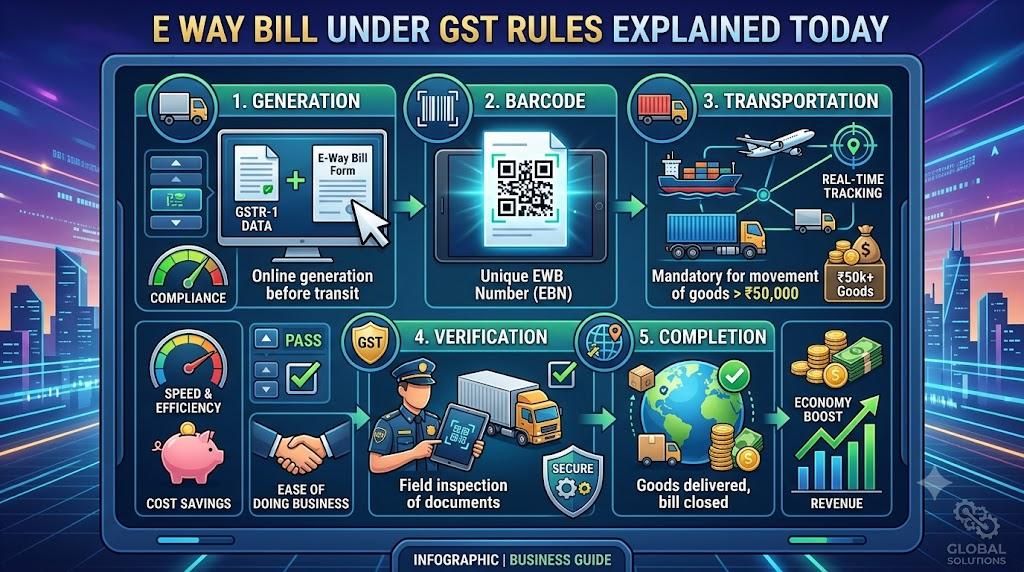
If you run a business that moves goods from one place to another, you have probably come across the term "e way bill" more than once. Maybe a transporter asked for it, or your accountant mentioned it while filing returns. Whatever the reason, understanding the e-way bill under GST is not optional anymore; it is a legal requirement for anyone transporting goods worth more than a certain value in India.
In this guide, we will break down everything about the e way bill in simple language. No confusing jargon, no unnecessary technical terms, just a clear explanation of what it is, why it matters, and how you can generate one without stress.
What Is E Way Bill Under GST?
An e-way bill (short for "electronic way bill") is a document that you need to carry when you move goods worth more than ₹50,000 from one location to another, within a state or across state borders. It is generated electronically through the GST portal and contains details about the consignment, what is being transported, who is sending it, who is receiving it, and how it is being moved.
Think of it as a digital permission slip. Without it, your goods can be stopped, checked, and even penalized by tax officers during transit. The whole idea behind the e way bill under GST was to replace the old paper-based system of "way bills" that different states used to have, and bring everything under one uniform, digital process across the country.
Why Was the E Way Bill Introduced?
Before GST, India had multiple state-level check posts, and each state had its own rules for documentation. This created delays, extra paperwork, and honestly, a lot of confusion for transporters and businesses. When goods and services tax rolled out, the government wanted a single system that worked everywhere. That is where the e way bill system came in — it removed the need for physical check posts and made the whole process trackable online.
Who Needs to Generate an E Way Bill?
Generally, the responsibility falls on:
-
The registered person (supplier) who is causing the movement of goods
-
The recipient, if they are registered and the supplier has not generated it
-
The transporter, in cases where neither the supplier nor the recipient has generated the bill but the transporter is handling the movement
If the value of goods being transported is above ₹50,000, generating the e way bill becomes mandatory. Some states have set lower thresholds for intra-state movement, so it is worth checking your state's specific rules as well.
When Is It Not Required?
Not every movement of goods needs a way bill. For example, if goods are being transported by a non-motorized vehicle, or if certain exempted goods (like some perishable items or personal use goods) are being moved, the requirement may not apply. There are also exemptions for goods being transported for a distance within a notified area, or under specific customs procedures.
How to Generate an E Way Bill: Step-by-Step
Generating an e way bill is fairly simple once you know the steps. Here is how it typically works:
-
Log in to the official e way bill portal
-
Go to "Generate New" under the E-Way Bill option
-
Fill in transaction details invoice number, date, and the type of transaction (outward or inward)
-
Enter the recipient's GSTIN, item details, HSN code, and taxable value
-
Add the transporter's details, including the vehicle number if the goods are being moved by road
-
Submit the form, and the system will generate a unique E way Bill Number (EBN)
Once generated, this EBN needs to be shared with the transporter, and it should be available (in print or digital form) throughout the journey in case tax officers request it during checks.
Validity of an E Way Bill
The validity of an e way bill depends on the distance the goods need to travel. As a general rule, for every 200 km (or part of it), the bill is valid for one additional day. For over-dimensional cargo, the distance slab is shorter, so the validity period is calculated slightly differently. If your consignment does not reach the destination within the validity period, you will need to extend it before it expires otherwise, you risk penalties.
Documents Required for E Way Bill Generation
To avoid last-minute confusion, keep the following ready before you start generating the e way bill:
-
Invoice, bill of supply, or challan related to the consignment
-
Transporter ID or the vehicle number (for road transport)
-
Transport document number, if goods are moving by rail, air, or ship
Having these details sorted in advance saves a lot of time, especially if you are managing multiple shipments in a day.
Common Mistakes to Avoid
A lot of businesses, especially smaller ones just getting used to compliance requirements, end up making avoidable errors. Some common ones include:
-
Entering the wrong GSTIN of the recipient
-
Mismatched invoice value and taxable value
-
Forgetting to update the vehicle number when the mode of transport changes
-
Letting the e way bill expire mid-journey without extending it
These small mistakes can lead to penalties, so it always helps to double-check every field before submission.
How E Way Bill Fits Into Your Overall Logistics Operations
Generating an e way bill under GST is just one part of running smooth logistics operations. Businesses that handle regular shipments often need more than just compliance; they need visibility into their entire supply chain. This is where a good Transportation Management System becomes useful, helping you manage documentation, track shipments in real time, and reduce the manual work that usually comes with compliance-heavy processes.
For businesses managing their own delivery fleet, keeping compliance and operations connected matters a lot. Whether it is fleet management, courier services, or full-scale logistics and supply chain operations, having your e way bill process integrated with your broader transportation workflow through platforms like Logibrisk can save time and reduce the chances of compliance errors during transit.
Penalties for Not Carrying an E Way Bill
If your goods are found being transported without a valid e-way bill, tax authorities can detain the vehicle and the goods until the applicable tax and penalty are paid. The penalty is usually equal to the tax amount, or a fixed sum, whichever is higher. This is exactly why businesses big or small should never treat the e way bill as an optional formality.
Final Thoughts
The e-way bill under GST might feel like just another compliance task on your to-do list, but it plays a real role in keeping the movement of goods transparent and hassle-free across India. Once you understand the process of who needs to generate it, when it is required, and how long it stays valid it becomes a routine part of doing business rather than a source of stress.
If you are someone who manages regular shipments, pairing your e way bill compliance with a reliable logistics and transportation setup can make the entire process smoother. You can always refer to the official GST portal for the latest updates on rules and thresholds, since these can change from time to time.
Frequently Asked Questions
What is the minimum value for generating an e way bill?
An e-way bill is required when the value of goods being transported exceeds ₹50,000, though some states have set different thresholds for movement within the state.
Can I cancel an e way bill after generating it?
Yes, an e-way bill can be cancelled within 24 hours of generation, provided the goods have not yet started their journey or have not been verified by any tax officer during transit.
Is e way bill required for all types of goods?
No. Certain goods, such as some exempted or perishable items, and movements through non-motorized transport, do not require a way bill. It is best to check the official notification for the full exemption list.
What happens if my e way bill expires during transit?
If the validity period ends before the goods reach their destination, you must extend the e way bill before it expires. Failing to do so can lead to detention of goods and penalties.
Who is responsible for generating the e way bill supplier or transporter?
Typically, the registered supplier generates it. However, if the supplier has not done so, the responsibility shifts to the recipient (if registered) or the transporter handling the movement of goods.

 English
 French
 Spanish
 Portuguese
 Deutsch
 Turkish
 Dutch
Dutch
 Italiano
 Russian
 Romaian
 Portuguese (Brazil)
 Greek
Greek