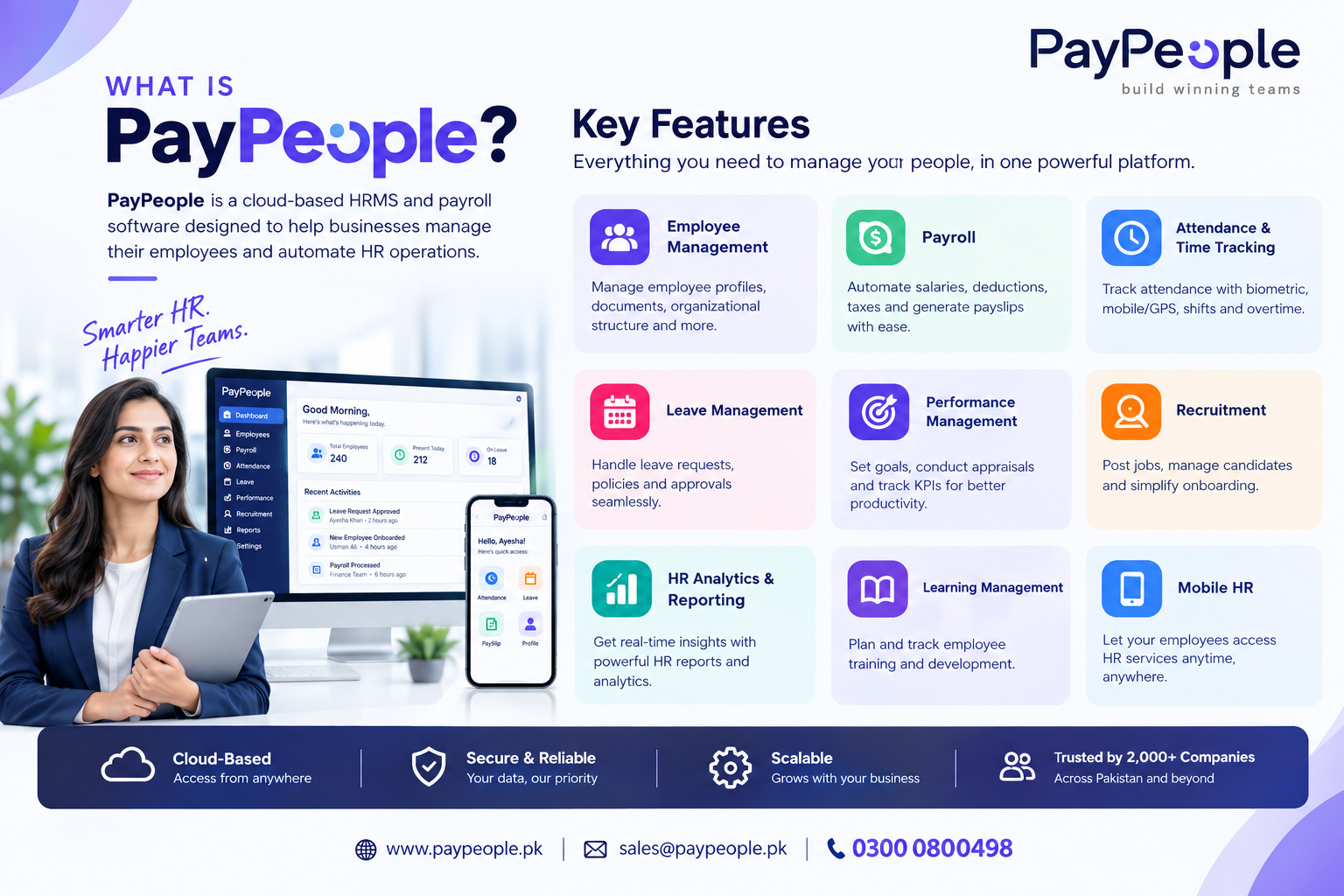
HR software in Pakistan is a digital system that helps organizations manage employee information, attendance, leave, payroll, recruitment, performance, and other human resource processes from one centralized platform. Instead of maintaining separate Excel sheets, paper records, attendance registers, and payroll files, HR teams can manage workforce information through connected workflows. Modern HRMS platforms available in Pakistan increasingly combine core HR, attendance, payroll, employee self-service, recruitment, performance management, and analytics in a single system.
For Pakistani organizations, localization is particularly important. Payroll software needs to account for local salary structures, tax calculations, and applicable statutory requirements. The Federal Board of Revenue publishes current withholding-tax rate cards, including the Tax Year 2027 rate card updated under Finance Act 2026. This means businesses should evaluate HR software not simply by its interface, but by how well it supports the rules and workflows their HR and finance teams actually use.
HR Software vs HRMS and Payroll Software
The terms HR software, HRMS, HRIS, and payroll software are often used interchangeably, but they can describe different levels of functionality. HRMS generally covers a wider range of workforce processes, while payroll software may focus primarily on salary calculation, deductions, taxes, and payslips. A complete HR platform connects these functions so information entered in one area can flow into another without repeated manual data entry.
For example, an employee's attendance can affect working days, overtime, or deductions, while approved leave can automatically feed into payroll. This connected approach reduces the need for HR staff to reconcile multiple spreadsheets every month.
Why Pakistani Businesses Need HR Software
As a company grows, managing employees manually becomes increasingly difficult. A small organization may initially handle attendance and salaries through spreadsheets, but multiple departments, branches, shifts, allowances, deductions, and leave policies can quickly turn that process into a monthly administrative burden. Current HR platforms in Pakistan commonly position integrated attendance, payroll, leave, recruitment, and employee self-service as core functions for this reason.
Common HR Challenges Solved by Automation
Manual HR processes create several recurring problems. Employee information can become scattered across different files, attendance records may require manual verification, and payroll teams can spend hours checking calculations before salary processing. Employees also frequently depend on HR staff for routine requests such as payslips, leave balances, attendance records, and profile updates.
HR automation brings these processes into a controlled workflow. Managers can approve requests digitally, employees can access information through self-service portals, and HR teams can use reports rather than manually compiling information from different sources.
Key Features of HR Software in Pakistan
A good HR software solution in Pakistan should cover the processes that consume the most administrative time while remaining flexible enough for different company structures.
Employee Management and Attendance
Employee management creates a centralized record for each worker, including personal information, employment details, documents, department, designation, and other relevant data. Attendance management can then connect with biometric devices, mobile applications, GPS, or other supported methods depending on the organization's requirements. Some Pakistani HRMS platforms currently offer biometric integration and GPS or geo-fenced attendance for field and multi-location employees.
This becomes particularly useful for organizations with multiple offices, remote workers, sales teams, factories, or employees working different shifts. Instead of asking HR to collect attendance information from several locations, management can access centralized attendance records.
Payroll and Tax Management
Payroll automation is one of the most valuable components of HR software because salary processing involves numerous calculations. Basic salary, allowances, deductions, attendance, leave, loans, overtime, and applicable taxes may all affect an employee's final salary.
The FBR states that withholding tax is deducted at prescribed rates under relevant tax provisions, making accurate salary calculations an important part of payroll administration. A localized payroll system can help organizations configure applicable tax rules and generate consistent payroll records while reducing repetitive calculations.
Leave and Employee Self-Service
Leave management allows employees to submit requests digitally while managers review and approve them according to company policies. Employees can also access leave balances and other HR information without repeatedly contacting the HR department.
Employee Self-Service (ESS) can extend this functionality to payslips, attendance records, requests, announcements, and employee profile information. This gives employees more control over routine HR tasks while allowing HR professionals to focus on higher-value activities.
Benefits of Using HR Software
Reduce Manual Work and Payroll Errors
The biggest operational advantage of HR software is the reduction of repetitive administrative work. Instead of transferring information between attendance sheets, payroll spreadsheets, and employee records, an integrated platform can connect these workflows.
For example, when attendance and leave data are connected with payroll, HR teams can process salary information using centralized records rather than manually comparing several files. Modern Pakistani HR platforms commonly promote this integrated approach to reduce reconciliation work and improve payroll processing efficiency.
Improve Employee Experience
Employees increasingly expect simple digital access to workplace information. An HR portal or mobile application can allow employees to view payslips, submit leave requests, check attendance, and track approvals without waiting for HR to respond.
This also creates greater transparency. Instead of relying on informal messages or paper forms, employees can see the status of their requests through a defined workflow.
How to Choose HR Software in Pakistan
Choosing HR software should start with your company's actual processes rather than a long list of impressive features. Consider your employee count, number of branches, attendance method, payroll complexity, existing accounting systems, reporting requirements, and future growth plans.
Local Compliance and Integration
For Pakistani companies, local payroll and compliance support should be an important evaluation criterion. Check whether the system supports relevant tax calculations, EOBI and provincial requirements where applicable, and the reports your finance team needs. Also examine whether the platform integrates with biometric attendance devices, accounting systems, banking workflows, and mobile applications.
Security is equally important because HR systems contain sensitive employee and salary information. Look for role-based access, controlled permissions, secure authentication, audit trails, backups, and clear data-management policies.
Conclusion
HR software in Pakistan has evolved from simple employee record systems into broader HRMS platforms that connect employee management, attendance, payroll, leave, recruitment, performance, analytics, and employee self-service. For organizations dealing with growing headcount and increasingly complex HR administration, centralizing these processes can reduce repetitive work and provide better workforce visibility.
The right solution should not simply have more features. It should fit the organization's payroll structure, attendance processes, compliance requirements, workforce size, and future growth. Businesses should therefore compare platforms based on functionality, localization, integrations, security, usability, implementation, and ongoing support before making a decision.
Frequently Asked Questions
1. What is HR software in Pakistan?
HR software is a digital platform used to manage employee records, attendance, leave, payroll, recruitment, performance, and other HR processes. Modern HRMS platforms can bring these functions together in one system.
2. Is HR software suitable for small businesses?
Yes. Small and growing businesses can use HR software to replace spreadsheets and manual HR processes. The required modules will depend on workforce size and operational needs.
3. Can HR software automate payroll in Pakistan?
Many HRMS platforms provide payroll automation, including salary calculations, deductions, payslips, and applicable tax workflows. Businesses should verify the vendor's current support for Pakistani tax and statutory requirements.
4. Can HR software integrate with biometric attendance?
Many HR platforms support biometric attendance integration, while some also provide mobile, GPS, or geo-fenced attendance options. Compatibility should be confirmed with the specific devices used by the organization.
5. What should businesses check before buying HR software?
Businesses should evaluate payroll functionality, local compliance support, attendance options, employee self-service, integrations, security, reporting, scalability, implementation, and customer support before selecting an HR software platform.


 English
 Arabic
 Spanish
 Portuguese
 Deutsch
 Turkish
 Dutch
Dutch
 Italiano
 Russian
 Romaian
 Portuguese (Brazil)
 Greek
Greek