
How Do Radon Mitigation Services Protect Your Home?
Radon is a naturally occurring radioactive gas that can enter buildings from the soil beneath and around them. Because it is colorless and odorless, homeowners cannot detect elevated radon levels without proper testing. When radon accumulates indoors over time, reducing exposure becomes an important part of maintaining a healthier indoor environment. This is where professional radon mitigation services can help.
Radon mitigation involves identifying how the gas enters a building and installing measures designed to reduce its concentration indoors. A properly planned system can help direct radon safely outside rather than allowing it to accumulate in occupied areas.
What Are Radon Mitigation Services?
Radon mitigation services are professional solutions designed to lower indoor radon concentrations. The process generally begins with testing to determine whether radon is present and, if so, whether the measured concentration indicates that mitigation should be considered.
A qualified professional can assess the property's foundation, basement, crawl spaces, ventilation conditions, and other potential entry points. Based on the structure, an appropriate mitigation approach can then be selected.
Mitigation is different from simply testing for radon. Testing identifies the level, while mitigation focuses on reducing the amount of radon entering or accumulating inside the building.
Why Is Radon Mitigation Important?
Radon can enter buildings through cracks in foundations, gaps around pipes, construction joints, sump areas, and other openings connected to the soil. Since the gas cannot be seen or smelled, relying on visible signs is not an effective way to determine whether a property has a radon problem.
Health Canada recommends taking action to reduce radon when concentrations exceed its guideline of 200 Bq/m³. Long-term exposure to elevated radon is associated with an increased risk of lung cancer, making testing and appropriate mitigation important considerations for homeowners.
The risk can be especially relevant in basements and lower-level rooms where people spend significant amounts of time.
How Does a Radon Mitigation System Work?
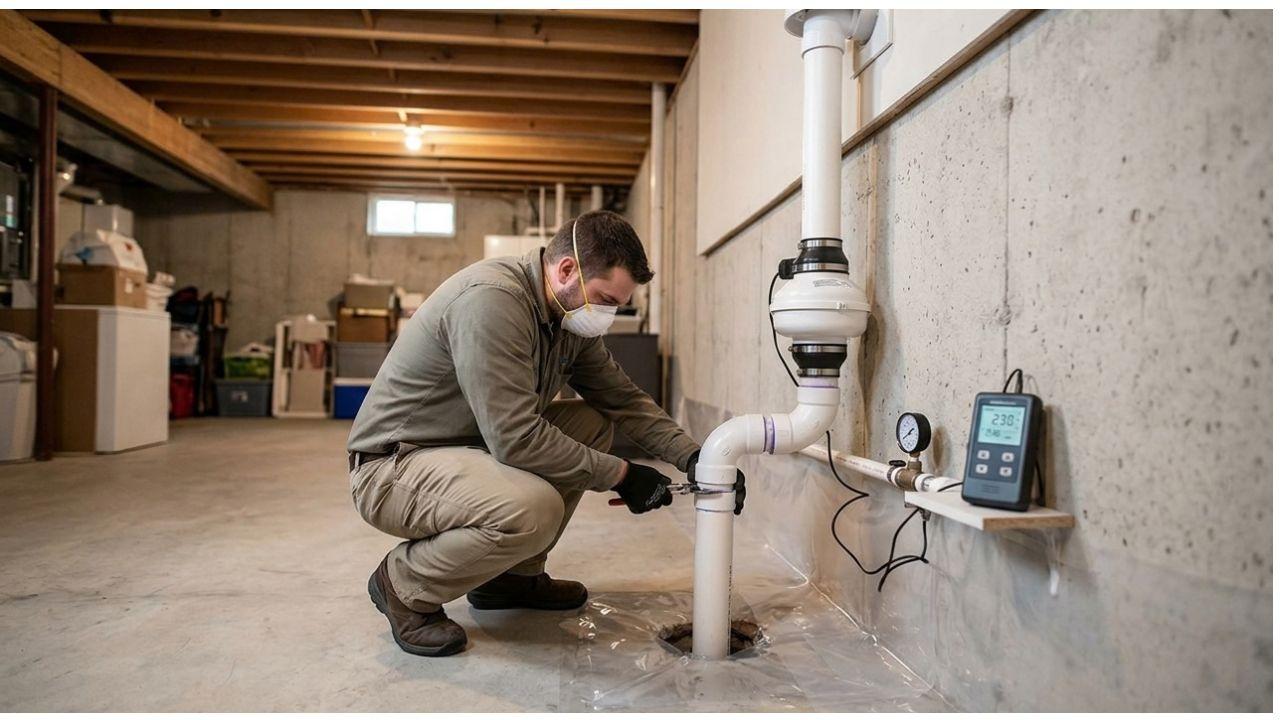
A typical mitigation system is designed to collect radon from beneath or around a building and vent it safely outdoors. The exact design depends on the property's construction and the way radon is entering the building.
Common components can include:
- Collection points beneath the foundation
- PVC or similar vent piping
- A radon fan
- Sealed openings and cracks where appropriate
- Exterior discharge points
- Monitoring or post-installation testing
For example, a sub-slab depressurization system may draw radon-containing soil gas from beneath a concrete floor and exhaust it outside. This helps reduce the amount of radon that can enter the living space.
What Happens During Professional Mitigation?
Professional radon mitigation services generally involve several stages.
1. Property Assessment
The technician examines the building to understand its structure and potential radon entry routes. Basement construction, foundation type, drainage features, and existing ventilation can all influence system design.
2. System Planning
After the assessment, the technician determines where collection points, pipes, and fans should be installed. The objective is to create an effective route for moving radon from beneath the building to the exterior.
3. Installation
The mitigation equipment is installed according to the property's requirements. Pipes may run through the basement and exit through an appropriate exterior location, while a fan creates the pressure difference needed to move soil gas.
4. Post-Mitigation Testing
Testing after installation helps determine whether the system is effectively reducing indoor radon concentrations. Continued monitoring can also help homeowners understand how radon levels change over time.
When Should You Consider Radon Mitigation?
Homeowners may consider professional mitigation after receiving elevated radon test results. It can also be useful to investigate radon before purchasing a property, during major renovations, or when finishing a basement that will become a regularly occupied living area.
New homes should not automatically be assumed to be free from radon. Radon levels can vary between neighboring properties because soil conditions, foundation construction, and building characteristics differ.
Testing provides the information needed to determine whether mitigation is appropriate.
Benefits of Professional Radon Mitigation
Working with experienced professionals can provide several practical benefits. A customized system can account for the building's construction instead of relying on a generic approach.
Professional installation can also help ensure that the exhaust route, fan location, pipe configuration, and sealing work together effectively. After installation, testing provides an additional way to evaluate system performance.
Another important benefit is ongoing awareness. Homeowners can monitor their indoor radon levels and arrange additional testing if building conditions change or if renovations alter the foundation or lower levels.
Why Choose Simon Air Quality for Radon Mitigation Services?
https://www.simonairquality.com/services/radon-mitigation-services/ provide customized radon mitigation and management for residential homes, real estate transactions, commercial properties, and other situations. According to the company, its process includes a property assessment, an estimate, system installation, and post-installation considerations. Simon Air Quality also states that its certified technicians install radon reduction systems throughout Ontario.
Conclusion
Radon is difficult to detect without testing, but homeowners have practical options when elevated levels are identified. Professional radon mitigation services can help reduce indoor radon by collecting soil gas and directing it safely outside.
The right solution depends on the building's design, foundation, entry points, and measured radon concentration. Starting with reliable testing and following it with an appropriately designed mitigation system can help homeowners make informed decisions about indoor air quality. Regular monitoring after installation can also help confirm that the system continues to perform as intended.

 English
 Arabic
 French
 Spanish
 Portuguese
 Deutsch
 Turkish
 Dutch
Dutch
 Italiano
 Romaian
 Portuguese (Brazil)
 Greek
Greek