
How to Prepare Your Manuscript for a Professional Editor and Save Time and Money
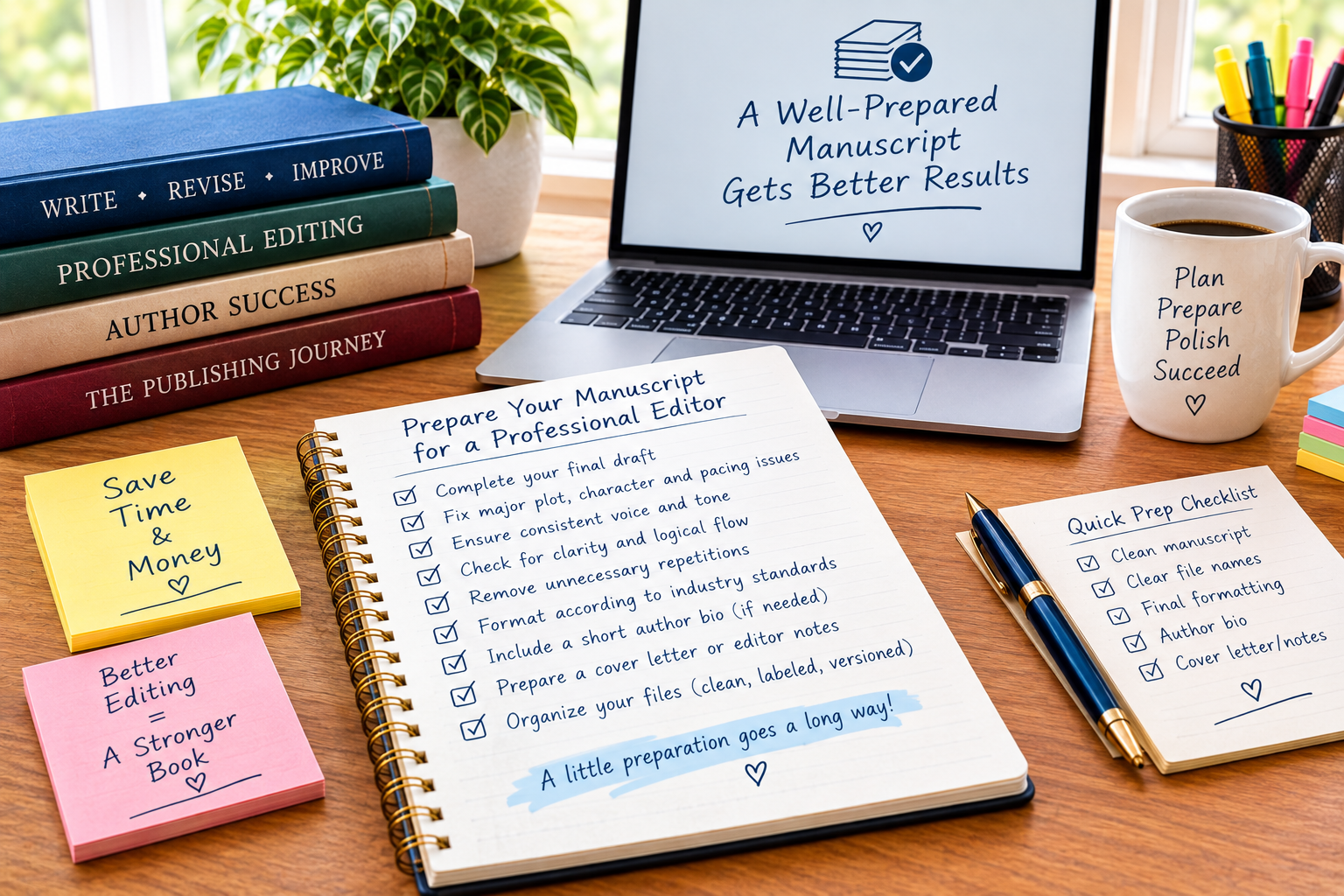
Preparing your manuscript for a professional editor is an important step toward producing a polished, engaging, and publication-ready book. Although editors can identify errors and improve your writing, the quality of your initial draft influences how efficiently they can work. By organizing your content, correcting basic mistakes, and clarifying your goals, you can reduce unnecessary revisions and make better use of your editing budget.
Many authors rush to hire an editor as soon as they finish their first draft. However, a little preparation beforehand can prevent avoidable expenses and improve communication throughout the editorial process. Whether you are writing a novel, memoir, business book, or nonfiction guide, understanding how to prepare your manuscript helps you approach professional editing with greater confidence.
1. Understand What Your Manuscript Needs Before Hiring an Editor
Before contacting an editor, determine the current condition of your manuscript and identify the type of assistance it requires. Some books need substantial structural improvements, while others require sentence-level refinement or a final review for spelling and punctuation. Understanding these differences helps you choose an appropriate service instead of paying for editing that does not address your actual needs.
Identify the Right Type of Editing
Developmental editing focuses on the manuscript's overall structure, organization, argument, pacing, and content. Copyediting addresses grammar, sentence clarity, consistency, and word usage, while proofreading identifies remaining errors in a nearly finished text. A professional book publishing company can help authors understand these editing stages and choose the appropriate level of support to prevent unnecessary costs and repeated work.
For example, a novel with inconsistent character development may benefit from developmental editing before sentence-level corrections begin. Conversely, a carefully revised business guide might need copyediting followed by proofreading. When you understand your manuscript's weaknesses, you can discuss your requirements more effectively and request a service that matches your publishing goals.
Evaluate Your Manuscript Honestly
Read your manuscript from beginning to end and consider its strengths and weaknesses. Look for confusing sections, repeated explanations, missing information, inconsistent terminology, and chapters that do not support your central message. You do not need to solve every problem yourself, but identifying major concerns helps an editor understand where your manuscript needs the most attention.
If you remain uncertain about the appropriate service, ask an experienced editor for an initial assessment. Some editors offer manuscript evaluations that identify significant concerns before a full editing project begins. This preliminary guidance can help you establish priorities, estimate the likely workload, and avoid spending money on a service that does not suit your book.
2. Complete a Thorough Self-Edit Before Professional Editing
One of the simplest ways to save money on manuscript editing is to revise your own work before submitting it. Professional editors provide valuable expertise, but they should not need to spend extensive time correcting mistakes that you can identify through careful review. A stronger draft allows them to concentrate on deeper issues and improve the manuscript more efficiently.
Correct Grammar, Spelling, and Punctuation
Start by checking common grammatical errors, misspelled words, missing punctuation, and unnecessarily complicated sentences. Use a reliable spelling and grammar checker to identify potential problems, but review every suggestion carefully. Automated tools can misunderstand context, overlook meaning-related errors, or recommend changes that weaken your intended voice.
Next, read each chapter slowly and pay attention to awkward phrasing, repeated words, and unclear transitions. Correct straightforward mistakes while preserving the personality and tone of your writing. Although a self-edit cannot replace professional expertise, it reduces avoidable distractions and gives your editor a cleaner manuscript to work with.
Remove Repetition and Unnecessary Content
Writers often repeat ideas while developing their arguments or exploring a story. During revision, identify paragraphs that communicate the same information, lengthy explanations that interrupt the flow, and scenes that contribute little to the reader's experience. Removing unnecessary content makes your manuscript more focused and may reduce the total number of words an editor needs to review.
However, avoid cutting material simply to make the manuscript shorter. Supporting examples, meaningful descriptions, and necessary explanations deserve their place. Instead, evaluate each section according to its purpose and relevance. A well-organized manuscript helps your editor concentrate on important improvements rather than spending time identifying avoidable repetition.
3. Organize Your Manuscript for a Smooth Editorial Workflow
A well-organized manuscript makes it easier for an editor to navigate the document, track changes, and communicate recommendations. Poor formatting, inconsistent chapter labels, and scattered notes can create confusion before editing even begins. Fortunately, you can prevent these problems by preparing a clean, consistent document that follows the editor's submission requirements.
Use Consistent Manuscript Formatting
Unless your editor specifies another format, prepare your manuscript in a widely used word-processing application such as Microsoft Word. Use a readable font, consistent spacing, standard margins, and clear chapter headings. Avoid manually adjusting every line or adding unnecessary decorative elements that could complicate editing and formatting.
Use heading styles to distinguish chapter titles and section headings instead of relying entirely on bold text or different font sizes. Keep paragraphs consistently formatted, and remove excessive blank spaces, accidental page breaks, and unnecessary tabs. Consistent formatting makes navigation easier and allows editors to focus on the manuscript's content rather than correcting presentation issues.
Keep Your Files Clean and Accessible
Before submitting your manuscript, save a clean working copy and give the file a clear, descriptive name. Remove outdated drafts, duplicate paragraphs, personal reminders, and comments that no longer apply. If you include tables, images, charts, or appendices, make sure each item has a clear label and appears in the appropriate section.
Also, confirm that your editor can open the file and access any supporting materials. If the project contains several documents, organize them into clearly named folders and explain what each file contains. These small steps reduce administrative delays and make collaboration easier throughout the editing process.
4. Create a Clear Editing Brief to Avoid Extra Costs
An editing brief explains what you expect from the editor, which issues deserve attention, and how you want the finished manuscript to read. Without these instructions, an editor may make assumptions about your preferences, leading to unnecessary questions or revisions. Clear expectations help both parties understand the project's scope before work begins.
Explain Your Book's Purpose and Target Audience
Describe your book's central idea, intended readership, genre, and primary objective. For example, a business guide for new entrepreneurs may require straightforward explanations and practical examples, while a literary novel may depend on distinctive language and subtle characterization. This context helps an editor make decisions that support your book rather than imposing an unsuitable style.
You should also identify any special requirements, such as preserving regional expressions, maintaining a particular narrative voice, or following an established style guide. If your manuscript includes technical terminology or industry-specific language, provide relevant references where necessary. The more clearly you communicate your priorities, the less time an editor will spend seeking clarification.
Define the Scope of Work
Discuss exactly what the editing service includes before accepting a quote. Ask whether the price covers one manuscript review, tracked changes, an editorial report, a follow-up discussion, or a limited revision round. You should also clarify whether fact-checking, reference verification, formatting, and proofreading fall outside the agreed scope.
A detailed agreement helps prevent misunderstandings about additional charges and delivery expectations. It also allows you to compare quotes fairly because different editors may include different services in their packages. Rather than choosing the lowest price immediately, evaluate the proposed work, experience, communication, and expected value.
5. Resolve Major Structural Problems Before Copyediting
Structural changes can affect entire chapters, paragraphs, and sentences. If you rearrange major sections after copyediting, previously corrected passages may require additional attention. Therefore, finalize the manuscript's overall organization before paying for detailed sentence-level editing whenever possible.
Check Your Chapters, Arguments, and Story Flow
For nonfiction books, confirm that chapters follow a logical sequence, arguments develop clearly, and examples support the central message. Check whether the introduction establishes appropriate expectations and whether the conclusion delivers a meaningful takeaway. Address missing explanations or unsupported claims before asking an editor to refine individual sentences.
For fiction and memoirs, review character development, chronology, pacing, plot consistency, and transitions between scenes. Make sure readers can follow the events without unnecessary confusion. Although an editor can help identify structural weaknesses, resolving concerns you already understand can reduce revision rounds and keep the project moving efficiently.
Verify Facts, Names, and References
Check names, dates, quotations, statistics, citations, and other factual details before submission. For academic or research-based manuscripts, confirm that references follow the required citation style and that every in-text citation corresponds to an entry in the reference list. Correcting these details early prevents avoidable questions and reduces the risk of inconsistencies remaining in the final book.
Remember that ordinary copyediting does not necessarily include comprehensive fact-checking or independent verification of every source. Ask your editor which responsibilities fall within the agreed service. Taking responsibility for the accuracy of your research helps establish a clearer division of work and prevents unexpected expenses later.
6. Prepare a Style Sheet and Reference Materials
A style sheet records important editorial decisions, including spelling preferences, capitalization, character names, terminology, and formatting conventions. It becomes particularly useful when your manuscript contains recurring names, specialized vocabulary, multiple contributors, or several installments in a series. Providing an existing style sheet helps your editor maintain consistency throughout the book.
If you do not have a style sheet, prepare a simple list of preferred spellings, abbreviations, technical terms, and recurring details. Include any reference books, brand guidelines, or previous publications that influence your writing. Authors can also benefit from publishing consulting services to receive guidance on manuscript preparation, editorial planning, and the next steps toward publication. These resources give the editor reliable guidance and reduce the need to ask the same questions repeatedly.
7. Request a Sample Edit Before Committing to a Full Project
A sample edit allows you to evaluate an editor's approach before investing in the entire manuscript. Many professionals offer a short sample, sometimes at no charge, while others charge for a more substantial assessment. Ask what the sample includes and whether the editor can demonstrate the level of intervention your manuscript requires.
Review the sample carefully rather than judging it only by the number of corrections. Consider whether the editor preserves your voice, improves clarity, explains significant changes, and understands your intended audience. A good working relationship depends on communication and compatible expectations, not simply on correcting the largest number of errors.
You can also use the sample to discuss questions about tone, terminology, and editing preferences before the full project begins. Resolving these details early reduces the likelihood of dissatisfaction and expensive revisions. However, remember that a short sample cannot guarantee identical results across every chapter, especially when the manuscript varies in complexity.
8. Communicate Effectively and Plan Your Editing Budget
Professional editing works best when authors and editors communicate clearly throughout the project. Before work begins, agree on deadlines, preferred communication methods, payment arrangements, and the process for handling questions. Responding promptly to reasonable queries prevents delays and helps the editor maintain momentum.
When comparing prices, consider the manuscript's word count, complexity, required editing level, and delivery schedule. Request a written estimate based on the actual manuscript rather than relying on a general price advertised online. If your budget is limited, discuss priorities openly and ask whether a focused editing plan would suit your needs.
Avoid requesting extensive changes after the editor has completed work according to the original agreement. Significant additions, rewritten chapters, or altered project requirements may require another paid review. Instead, finalize your content before editing begins and keep a reasonable contingency in your budget for unexpected needs.
9. Use a Final Submission Checklist
Before sending your manuscript, complete a final review to ensure that the editor receives everything needed to begin. A short checklist can prevent missing files, unnecessary emails, and avoidable delays. It also gives you confidence that your document is ready for professional attention.
-
Complete a full self-edit and correct obvious errors.
-
Finalize chapter order, structure, and major content revisions.
-
Apply consistent formatting and heading styles.
-
Verify names, dates, quotations, citations, and references.
-
Prepare an editing brief with your goals and target audience.
-
Gather supporting files, images, tables, and style references.
-
Confirm the agreed editing service, price, and deadline.
-
Save a clean manuscript copy and retain a backup.
-
Clarify how the editor will return changes and handle questions.
Once these steps are complete, submit the manuscript according to the editor's preferred procedure. A well-prepared submission allows the project to begin with fewer administrative complications and a clearer understanding of the work ahead.
Conclusion
Preparing your manuscript for a professional editor requires thoughtful revision, consistent formatting, clear communication, and realistic planning. By addressing obvious errors, resolving structural concerns, organizing supporting materials, and defining your editing goals, you can reduce unnecessary work and make your budget go further.
Most importantly, remember that preparation does not mean making your manuscript perfect before seeking help. Professional editors bring specialized skills that authors cannot always replicate independently. Your goal is to provide the strongest, clearest draft you reasonably can, enabling your editor to focus on meaningful improvements and helping your book move toward publication with greater efficiency and confidence.

 English
 Arabic
 French
 Spanish
 Portuguese
 Deutsch
 Turkish
 Dutch
Dutch
 Italiano
 Romaian
 Portuguese (Brazil)
 Greek
Greek