
Treadmill Test Bangalore: Patient Guide to Exercise Testing
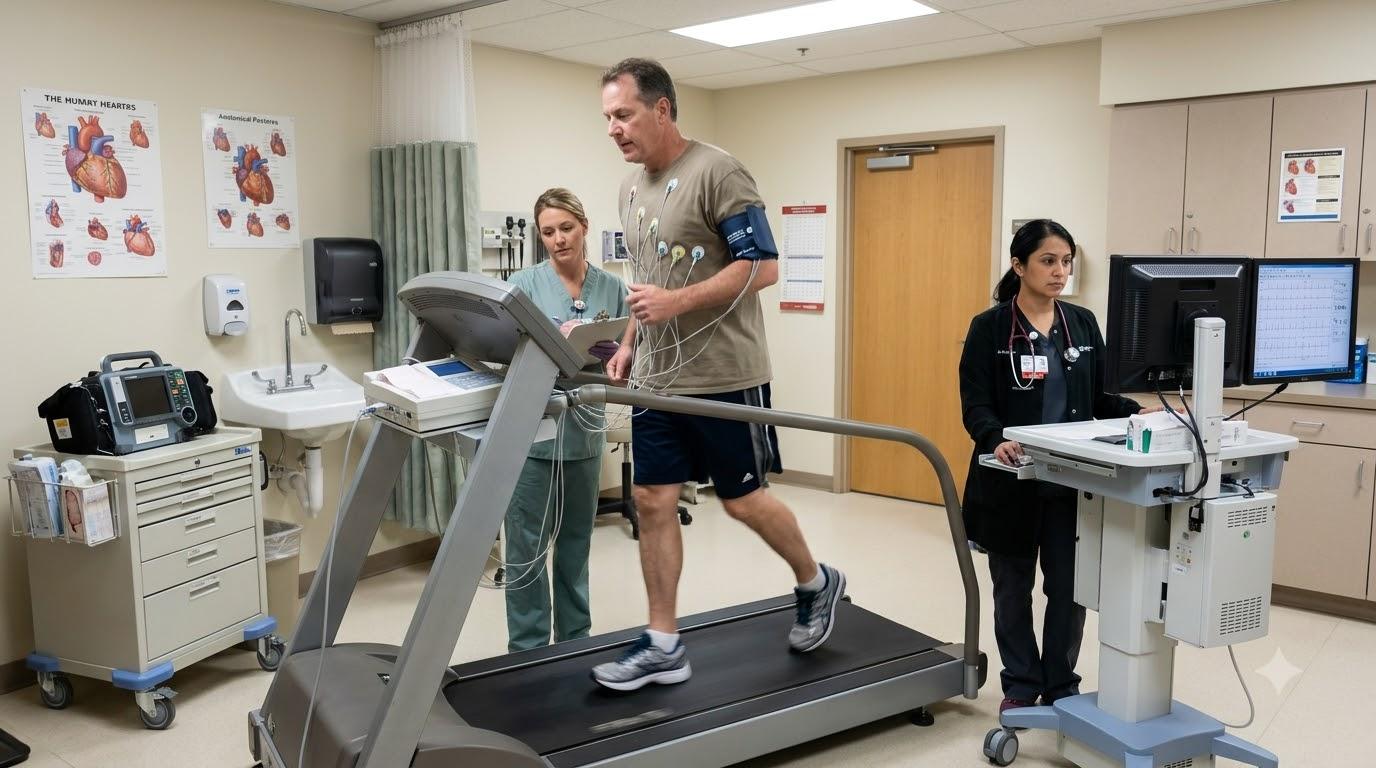
Treadmill Stress Testing: How to Prepare and Know What to Expect
A treadmill stress test evaluates how the heart responds to controlled physical activity while healthcare professionals monitor relevant measurements. If you are arranging a treadmill test in Bangalore and want to prepare for the appointment, understanding the procedure, its limitations, and the questions to ask beforehand can help you make a more informed decision.
During the test, the patient walks on a treadmill while the clinical team monitors heart rate, blood pressure, ECG activity, and symptoms. The exercise intensity usually increases according to a defined protocol, subject to the patient's condition and the team's assessment.
The test can help investigate selected cardiac concerns, but it is not appropriate for everyone. The clinician should establish the reason for testing and determine whether exercise testing is the right investigation.
What Is the Purpose of a Treadmill Stress Test?
The heart must respond to changing demands when a person exercises. A stress test allows the clinical team to observe selected measurements as physical activity increases and during recovery.
Depending on the clinical circumstances, a clinician may recommend exercise testing to investigate certain symptoms, assess exercise tolerance, or evaluate the heart's response to exertion.
The test generally includes:
-
Electrodes that record the heart's electrical activity.
-
Periodic or continuous heart-rate monitoring.
-
Blood pressure measurements.
-
Observation of symptoms and exercise tolerance.
-
A recovery period after the exercise portion.
The findings are interpreted alongside the patient's history and other clinical information. A treadmill test does not provide a complete picture of every aspect of heart health.
Who Might Need the Test?
A clinician may consider an exercise stress test when the information it provides is relevant to a patient's symptoms or care plan.
For example, selected patients with exercise-related symptoms may need further assessment of how the heart responds to activity. Exercise testing can also help evaluate functional capacity in appropriate clinical settings.
However, a treadmill test is not a universal screening requirement for every healthy adult. It may also be unsuitable for patients with certain acute conditions, unstable symptoms, significant mobility limitations, or other contraindications.
The treating clinician determines whether the benefits of the investigation outweigh its risks and whether another test would provide more useful information.
What Happens at the Testing Centre?
Knowing the sequence of events can make the appointment more predictable.
Initial assessment: The healthcare team reviews the referral, relevant medical history, medicines, and current symptoms. They assess whether the patient can safely undertake the planned exercise protocol.
Equipment setup: Electrodes are attached to the skin to record ECG activity. Blood pressure is measured, and the team explains how to walk on the treadmill.
Exercise phase: The patient starts at a controlled workload. The speed or incline typically increases in stages, depending on the protocol and the patient's response.
Monitoring: The team observes the heart's electrical activity, heart rate, blood pressure, and symptoms. Patients should report discomfort, dizziness, unusual breathlessness, or other concerning sensations immediately.
Recovery: Exercise ends when the planned endpoint is reached or the team decides that stopping is appropriate. Monitoring continues during recovery as needed.
The goal is to obtain clinically useful information under controlled conditions. Patients should never try to complete the protocol despite concerning symptoms.
How to Choose a Diagnostic Provider in Bangalore
Finding a suitable treadmill test in Bangalore requires more than checking the nearest address or earliest appointment. The provider must be able to perform the requested investigation with appropriate monitoring and reporting arrangements.
Before booking, check the following:
-
Test availability: Confirm that the provider offers the exact exercise test requested by your clinician.
-
Clinical supervision: Ask how patients are assessed and monitored during the procedure.
-
Report arrangements: Establish who interprets the findings and how the report is delivered.
-
Preparation guidance: Request instructions on medication, meals, clothing, and arrival time.
-
Total charges: Confirm whether the quotation includes the recording, supervision, and report.
-
Accessibility: Consider transport, mobility, and any assistance you may need.
-
Follow-up arrangements: Know which clinician will explain the findings and advise you about further investigations.
EcoTown Diagnostics is associated with the supplied treadmill stress testing page. You can visit the EcoTown Diagnostics website to review its information and contact the provider about available services, appointment options, and current charges. Verify the details directly rather than assuming that every service is available at every location.
Preparing for Exercise Testing
Preparation should be based on instructions from the provider and treating clinician. Different patients may require different arrangements.
-
Medicines: Some medicines influence heart rate or blood pressure. Never stop or change prescribed medication without explicit clinical guidance.
-
Meals and drinks: Ask whether any restrictions apply before the test. Do not assume that fasting is always required.
-
Clothing: Wear comfortable clothing and suitable footwear for walking.
-
Medical records: Bring the referral, medication list, and relevant previous cardiac reports.
-
Current symptoms: Report recent chest discomfort, fainting, unusual breathlessness, or changes in your ability to exercise.
-
Transport: Plan how you will reach the facility and whether you may need assistance afterwards.
-
Timing: Confirm the appointment and expected duration so you can allow enough time for preparation and recovery.
If new or severe symptoms develop before the appointment, contact a healthcare professional or seek urgent medical care as appropriate.
Understanding the Results
The report may describe the exercise protocol, duration, heart-rate response, blood pressure, symptoms, ECG changes, and the reason the test was stopped.
The clinician evaluates these observations in the context of the patient's health and the purpose of the investigation. An abnormal result may prompt further assessment, but it does not automatically confirm a particular diagnosis.
A reassuring result also has limitations. The test may not exclude every cardiac condition, and its usefulness depends on the patient's ability to exercise, the quality of the recording, and the clinical question being investigated.
Ask the treating clinician to explain the main findings and whether further investigations are necessary. Do not use a single report as a guarantee that all forms of heart disease have been excluded.
Comparing Exercise Testing With Other Cardiac Investigations
|
Investigation |
What it evaluates |
When it may be considered |
|
Resting ECG |
Electrical activity at rest |
Assessment of rhythm and selected electrical abnormalities |
|
Treadmill stress test |
Cardiac response to controlled exercise |
Selected exercise-related symptoms or functional assessment |
|
Echocardiogram |
Heart structure and movement using ultrasound |
Assessment of chambers, valves, and pumping function |
|
Ambulatory rhythm monitoring |
Electrical activity over an extended period |
Investigation of intermittent rhythm symptoms |
|
Stress imaging |
Cardiac function or other findings during stress, using an imaging method |
Selected clinical questions requiring additional information |
These tests answer different questions. The clinician selects the appropriate investigation based on symptoms, risk factors, examination findings, and the information needed to guide treatment.
Two Practical Examples
Example 1: Exercise-related discomfort
A patient notices recurring discomfort while walking uphill. Rather than assuming the symptom is caused by poor fitness, the patient seeks medical assessment.
The clinician reviews the symptoms and risk factors before deciding which investigation is appropriate. Exercise testing may be considered if the clinical circumstances support it, but the patient may require a different test depending on the assessment.
The key lesson is that the test should follow clinical evaluation, not replace it.
Example 2: A patient with mobility limitations
A patient has been referred for cardiac evaluation but cannot walk comfortably because of a musculoskeletal problem.
The patient explains the limitation before booking. The clinician considers whether a treadmill test can provide useful information safely or whether another investigation would be more suitable.
The lesson is to disclose practical limitations early so the testing plan can be adapted appropriately.
Illustrative Case Study: Matching the Investigation to the Clinical Question
Initial problem: A patient receives a referral for cardiac testing and assumes that a treadmill test is the best option.
Circumstances: The patient has limited exercise tolerance and is uncertain whether the test can be completed safely.
Solution: The patient discusses the limitation with the treating clinician before booking. The clinician reviews the reason for testing, assesses suitability, and determines whether exercise testing or another investigation is appropriate.
Expected outcome: The patient follows a diagnostic plan that better matches the clinical question and personal circumstances.
Practical lesson: A commonly used investigation is not necessarily the right test for every patient. Clinical suitability must be established before the appointment.
Common Mistakes to Avoid
-
Booking without a clear referral: Confirm why the test is needed.
-
Ignoring preparation instructions: Follow the clinical team's guidance.
-
Changing medicines independently: Discuss medication changes with the prescribing clinician.
-
Exercising through warning symptoms: Report concerning symptoms immediately during testing.
-
Assuming the test diagnoses every heart condition: Further investigation may be necessary.
-
Delaying emergency assessment: Serious or rapidly worsening cardiac symptoms require urgent attention.
Frequently Asked Questions
Is a treadmill stress test safe?
It is generally performed under clinical supervision after assessing whether the patient is suitable. Risks depend on individual circumstances, which is why appropriate screening and monitoring are important.
How long does a treadmill test take?
The exercise phase varies according to the protocol and patient response. Allow additional time for registration, preparation, and recovery, and confirm the expected duration with the provider.
Can I eat before the test?
Instructions vary. Ask the provider or treating clinician whether you should adjust meal timing or follow any other preparation requirements.
Can I take my usual medication?
Follow the specific instructions from your treating clinician. Do not stop or alter prescribed medication independently.
Does a normal treadmill test mean my heart is completely healthy?
No. A reassuring result may be useful, but it cannot exclude every cardiac condition. Persistent or new symptoms still require appropriate clinical assessment.
What should I do if I experience chest pain before my appointment?
Do not wait for a routine test if the pain is severe, persistent, or accompanied by concerning symptoms such as breathlessness, sweating, or faintness. Seek an emergency medical assessment.
Conclusion
A treadmill stress test provides information about the heart's response to controlled exercise, but the investigation must be appropriate for the patient's clinical circumstances. Before booking, confirm the referral, preparation instructions, supervision, reporting process, and total charges.
A suitable diagnostic provider should help connect the test to the next stage of care. The priority is not simply completing an exercise test; it is obtaining useful information safely and ensuring that the results are interpreted appropriately.

 English
 Arabic
 French
 Spanish
 Portuguese
 Turkish
 Dutch
 Italiano
 Russian
 Romaian
 Portuguese (Brazil)
 Greek