
Pulmonary Function Test Near Me: How to Choose a Testing Centre
How to Choose the Right Pulmonary Function Testing Centre for Your Breathing Concerns
Finding a suitable centre for a pulmonary function test near me starts with understanding your symptoms, your doctor's recommendation, and the type of lung assessment you may need. A convenient location matters, but test availability, appropriate equipment, clear preparation instructions, and timely reporting also influence your experience. Before booking, review local pulmonary function testing services and appointment options so you can make an informed decision.
Breathing difficulties can develop gradually or appear during specific activities, such as climbing stairs, exercising, or spending time around dust. Wheezing, persistent coughing, chest tightness, and shortness of breath can have several causes. Pulmonary function testing helps healthcare professionals assess how well the lungs move air and, depending on the test, how effectively they transfer oxygen into the bloodstream.
Choosing a centre should not mean diagnosing yourself or selecting the cheapest test without considering your symptoms. The goal is to access the appropriate assessment and ensure that the results reach the healthcare professional responsible for your care.
What Does a Pulmonary Function Test Measure?
Pulmonary function tests, commonly called PFTs, are a group of breathing assessments used to evaluate lung function. The specific measurements depend on the test prescribed and the equipment available.
Spirometry is one of the most frequently used assessments. During the procedure, a person breathes into a mouthpiece connected to a measuring device. The instrument records how much air can be exhaled and how quickly it moves out of the lungs.
Other pulmonary assessments may measure lung volumes or evaluate how efficiently gases move from the lungs into the blood. Not every patient requires every test. A clinician chooses the assessment based on the person's symptoms, medical history, examination findings, and diagnostic question.
PFTs can help clinicians investigate or monitor conditions such as asthma and chronic obstructive pulmonary disease (COPD). They may also be used when evaluating unexplained breathing symptoms or monitoring lung health in selected clinical situations.
However, a test result is only one part of a medical assessment. A healthcare professional interprets it alongside symptoms, examination findings, and other relevant investigations.
When Should You Consider Lung Function Testing?
The decision to arrange testing should be guided by a qualified healthcare professional, particularly when symptoms are persistent, recurrent, or affecting everyday activities.
Common reasons for a clinician to recommend pulmonary assessment include:
-
Repeated wheezing: Noisy breathing can occur when airways narrow, including during asthma episodes.
-
Ongoing cough: A persistent cough may require investigation, especially when accompanied by wheezing or breathlessness.
-
Shortness of breath during activity: Difficulty keeping up with normal activities may justify a clinical evaluation.
-
Monitoring a known respiratory condition: Testing can help assess lung function over time when clinically appropriate.
-
Evaluating treatment response: A clinician may use repeat measurements to understand changes after treatment.
-
Selected occupational assessments: Some people require lung function evaluation because of workplace exposure or specific job-related medical requirements.
These symptoms do not automatically mean that a PFT is necessary. Heart conditions, anaemia, infections, physical deconditioning, and other issues can also cause breathlessness. A clinician can help determine which investigations are appropriate.
Severe or sudden breathing difficulty, blue or grey lips, fainting, or significant chest pain requires urgent medical assessment rather than a routine diagnostic appointment.
How to Evaluate a Centre Before Booking
Searching for a pulmonary function test near me can return multiple diagnostic facilities, but the closest option is not necessarily the most suitable. Compare the following factors before choosing.
1. Confirm that the required test is available
Ask whether the centre performs the specific test written on your prescription. Basic spirometry and a broader pulmonary function assessment are not interchangeable in every situation.
If your clinician has requested additional testing, confirm that the facility can perform it or explain where it can be arranged. This avoids arriving for an appointment only to discover that the required procedure is unavailable.
2. Check staff guidance and testing procedures
Correct technique is essential for many breathing tests. The person conducting the assessment should explain how to use the mouthpiece, when to inhale, and how forcefully to exhale.
Ask whether instructions are provided before testing and whether the procedure can be repeated if an initial effort does not produce an acceptable measurement. The precise quality-control process depends on the test and facility.
3. Understand the reporting process
Before confirming an appointment, ask when the report is expected and how it will be delivered. Find out whether the report includes the measurements needed by your referring clinician.
Also clarify whether the appointment includes interpretation by a qualified healthcare professional or whether you must arrange a separate consultation. A diagnostic report should not be treated as a complete diagnosis without appropriate clinical context.
4. Compare the complete cost
The quoted fee may cover only a basic test. Additional assessments, consultations, or repeat procedures may have separate charges.
Request a clear explanation of what the price includes. This is especially important when a clinician has prescribed a specific combination of tests.
5. Consider accessibility and travel
A nearby facility can make appointments easier to manage, particularly when repeat testing is required. However, also consider traffic, parking, public transport, appointment availability, and whether the location is accessible for someone who becomes breathless while walking.
A slightly longer journey may be worthwhile if the centre offers the required test and appropriate procedural support.
Comparison Table: What Matters When Selecting a Facility?
|
Selection factor |
What to check |
Why it matters |
|
Test availability |
Whether the prescribed assessment is offered |
Helps avoid booking the wrong procedure |
|
Staff instructions |
Clear guidance on breathing technique |
Supports appropriate test performance |
|
Reporting |
Expected delivery time and report format |
Helps coordinate follow-up care |
|
Pricing |
Included procedures and additional fees |
Reduces unexpected expenses |
|
Accessibility |
Travel time, parking, and physical access |
Makes attending the appointment easier |
|
Clinical follow-up |
How results are shared and interpreted |
Helps connect measurements with medical decisions |
A good choice balances clinical suitability, convenience, transparent costs, and reliable communication rather than relying on online ratings alone.
How to Prepare for Your Appointment
Preparation requirements vary according to the test, your health, and the instructions of the healthcare professional arranging it. Follow the centre's specific guidance rather than relying on general advice found online.
Use this practical process to organise your visit.
-
Confirm the prescription. Check the exact test name and whether any additional assessment has been requested. If the instructions are unclear, contact the referring clinician or diagnostic centre.
-
Ask about medication. Some medicines can influence breathing measurements. Do not stop inhalers or other prescribed medicines independently. Ask the clinician or testing team whether any adjustment is necessary for your particular appointment.
-
Choose comfortable clothing. Tight garments can make deep breathing less comfortable. Wear clothing that allows your chest and abdomen to move freely.
-
Discuss recent illness. Tell the centre if you have recently had a respiratory infection or are experiencing an acute worsening of symptoms. The team can advise whether the appointment should proceed or be rescheduled.
-
Follow food and activity instructions. Requirements may differ between procedures. Ask whether you should avoid a heavy meal, strenuous exercise, smoking, or other activities before the test.
-
Bring relevant medical information. Carry your prescription, previous reports if available, medication list, and details of important respiratory symptoms.
-
Arrive with enough time. Allow time for registration and the explanation of the procedure. Inform the staff if you feel unwell before testing begins.
These steps help prevent avoidable delays and make it easier for the testing team to understand your circumstances.
What Happens During the Test?
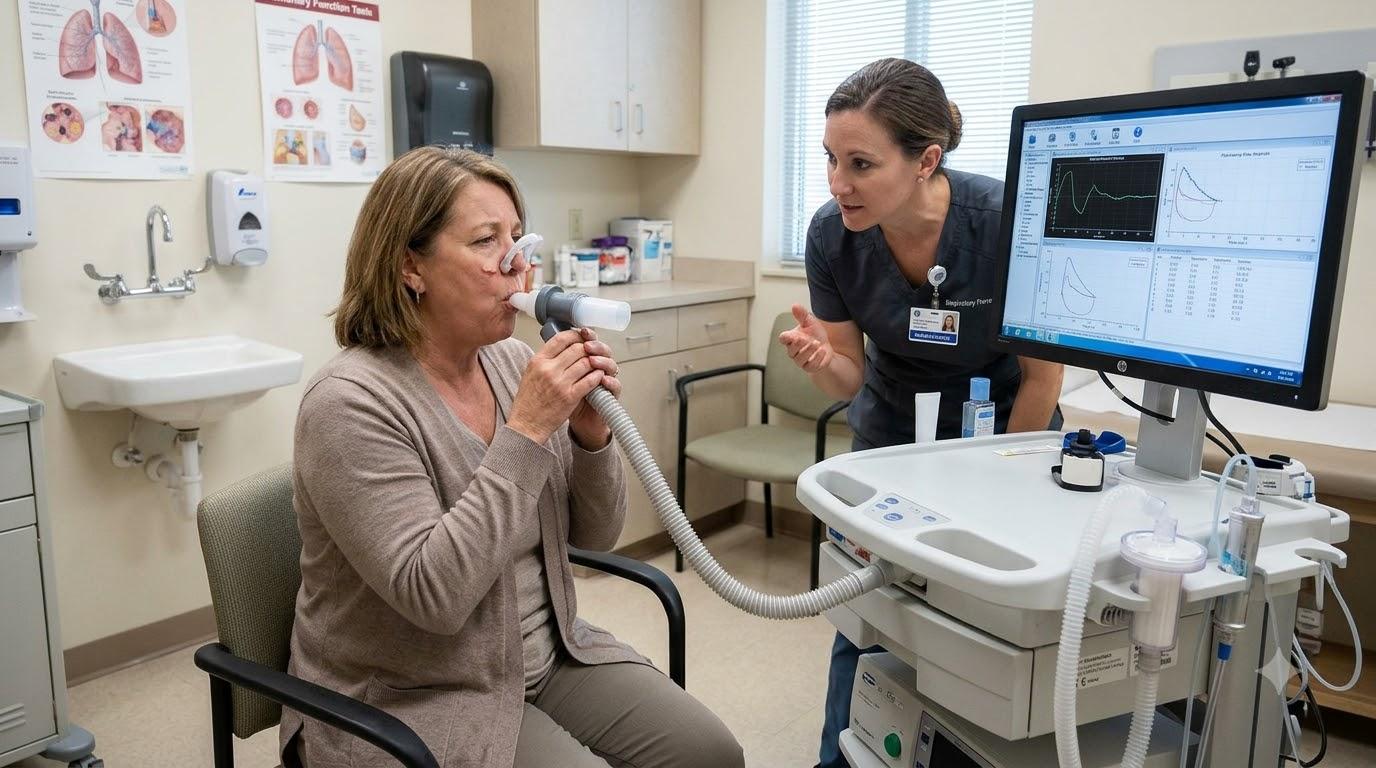
For spirometry, you will usually sit upright and breathe through a mouthpiece while wearing a nose clip if required. The technician will explain how to take a deep breath and exhale forcefully according to the procedure.
Several attempts may be needed to obtain measurements of acceptable quality. The effort can cause temporary coughing, light-headedness, or fatigue in some people. Tell the technician if you feel uncomfortable, dizzy, or unable to continue.
Some assessments include measurements before and after a bronchodilator medicine. This can help clinicians evaluate whether airflow changes after the medicine is administered. Whether this step is appropriate depends on the clinical question and the testing protocol.
Other pulmonary function procedures may require different equipment or take longer than basic spirometry. When booking, ask how much time to allow and whether there are any additional instructions.
Understanding Your Report Without Self-Diagnosing
Pulmonary reports can contain unfamiliar terms and numerical values. Their meaning depends on the particular test, the reference standards used, and your clinical circumstances.
In spirometry, two commonly reported measurements are:
-
Forced vital capacity (FVC): The amount of air a person can forcibly exhale after taking a deep breath.
-
Forced expiratory volume in one second (FEV1): The amount of air exhaled during the first second of a forced breath.
The relationship between measurements can help clinicians assess airflow limitation. Other values may be used to investigate lung restriction or gas-transfer problems, depending on the tests performed.
Do not interpret one number in isolation. Results can be influenced by test technique, effort, age, height, and other factors. A normal result does not necessarily explain every breathing symptom or exclude every respiratory condition.
If your report is marked abnormal, ask the referring clinician what it means in your case, whether further testing is needed, and what follow-up is appropriate. If the report is normal but your symptoms continue, arrange a medical review rather than assuming that nothing is wrong.
Two Practical Examples
Example 1: Breathlessness During Everyday Activities
A person notices that climbing one flight of stairs has become more difficult over several weeks. They search for a nearby diagnostic centre and find several options.
Instead of booking the first available procedure, they arrange a clinical assessment. The clinician reviews their symptoms and decides whether pulmonary testing is appropriate. The person then confirms the prescribed test, preparation requirements, reporting time, and total fee with the selected centre.
Practical lesson: Start with the clinical question, then select a facility capable of answering it.
Example 2: Repeated Wheezing Despite Previous Treatment
Someone with a history of wheezing experiences symptoms during certain activities. They assume that repeating a basic breathing test will automatically identify the cause.
A better approach is to speak with their healthcare professional, explain when the symptoms occur, and share details of current treatment. The clinician can decide whether spirometry, testing after a bronchodilator, or another assessment would be useful.
Practical lesson: The appropriate test depends on the clinical circumstances, not simply on the presence of a familiar symptom.
Illustrative Case Study: Choosing Based on Suitability, Not Distance Alone
Initial problem: A hypothetical patient experiences recurring breathlessness and wants a convenient diagnostic appointment near home.
Circumstances: Several centres appear in the search results, but their listed services and preparation instructions are not equally clear.
Solution: The patient first consults a healthcare professional, who recommends a specific pulmonary function assessment.
Steps taken: The patient contacts two facilities, confirms test availability, asks about medication instructions, checks the total cost, and establishes when the report will be available. One centre provides clearer answers and can perform the requested procedure within a suitable timeframe.
Expected outcome: The patient attends a more appropriate appointment and receives a report that can be reviewed by the referring clinician. The test itself does not guarantee a diagnosis, but it provides relevant information for the next clinical decision.
Key lesson: A reliable booking decision combines medical suitability, clear communication, and practical convenience.
Where Can You Explore Testing Options in Bangalore?
Ecotown Diagnostics lists pulmonary function testing among its diagnostic services and provides information about booking, test preparation, and reporting. Readers can visit the Ecotown Diagnostics official website to explore its broader services and contact information. <Cite refs={["turn771238search0","turn771238search1"]}/>
Before scheduling, confirm the current availability of the specific procedure, the relevant centre location, the applicable fee, and the instructions for your appointment. Website information can help you begin your search, but confirmation directly with the facility is important.
Common Mistakes to Avoid
-
Booking a test without checking whether it matches the clinician's prescription.
-
Stopping prescribed inhalers or other medicines without professional advice.
-
Choosing solely on the basis of the lowest advertised price.
-
Assuming that a diagnostic report automatically provides a complete diagnosis.
-
Ignoring persistent symptoms after receiving a normal result.
-
Comparing facilities without asking about report delivery and follow-up arrangements.
Avoiding these mistakes makes the testing process more organised and helps ensure that the results are used appropriately.
Conclusion
Choosing a pulmonary function testing centre involves more than finding the nearest address. Confirm the required procedure, review preparation instructions, compare costs, ask about reporting, and make sure your healthcare professional can use the results to guide further care.
When searching for a pulmonary function test near me, prioritise a suitable assessment and clear communication over convenience alone. If you are experiencing persistent breathing symptoms, arrange a medical evaluation and follow the testing recommendations you receive.
Frequently Asked Questions
1. Do I need a doctor's prescription for a pulmonary function test?
Requirements vary by facility and the particular assessment. A clinician's recommendation is useful because it helps identify the correct test and provides context for interpreting the results. Ask the centre about its booking requirements.
2. Is pulmonary function testing painful?
Most standard breathing tests are non-invasive and do not involve needles. Forceful breathing can cause temporary coughing, fatigue, or light-headedness, so inform the technician if you feel uncomfortable.
3. How long does a pulmonary function test take?
The duration depends on the procedure, the number of measurements required, and whether additional testing is performed. Ask the centre how much time to allow when making your appointment.
4. Can I take my inhaler before the test?
Follow the instructions provided by your clinician or testing team. Some medicines can affect results, but you should never stop or change prescribed treatment without professional guidance.
5. Does a normal result mean my lungs are healthy?
Not necessarily. A normal measurement may be reassuring, but it does not exclude every respiratory condition or explain every symptom. Persistent or worsening symptoms deserve clinical review.
6. How should I choose between two nearby centres?
Compare whether each centre offers the prescribed test, provides clear preparation instructions, explains its pricing, and delivers a report suitable for clinical follow-up. Travel time and appointment availability can then help you make the final decision.

 English
 Arabic
 French
 Spanish
 Portuguese
 Deutsch
 Turkish
 Dutch
 Italiano
 Russian
 Romaian
 Portuguese (Brazil)