
AI Vehicle Inspection: Complete Guide to How It Works and Benefits
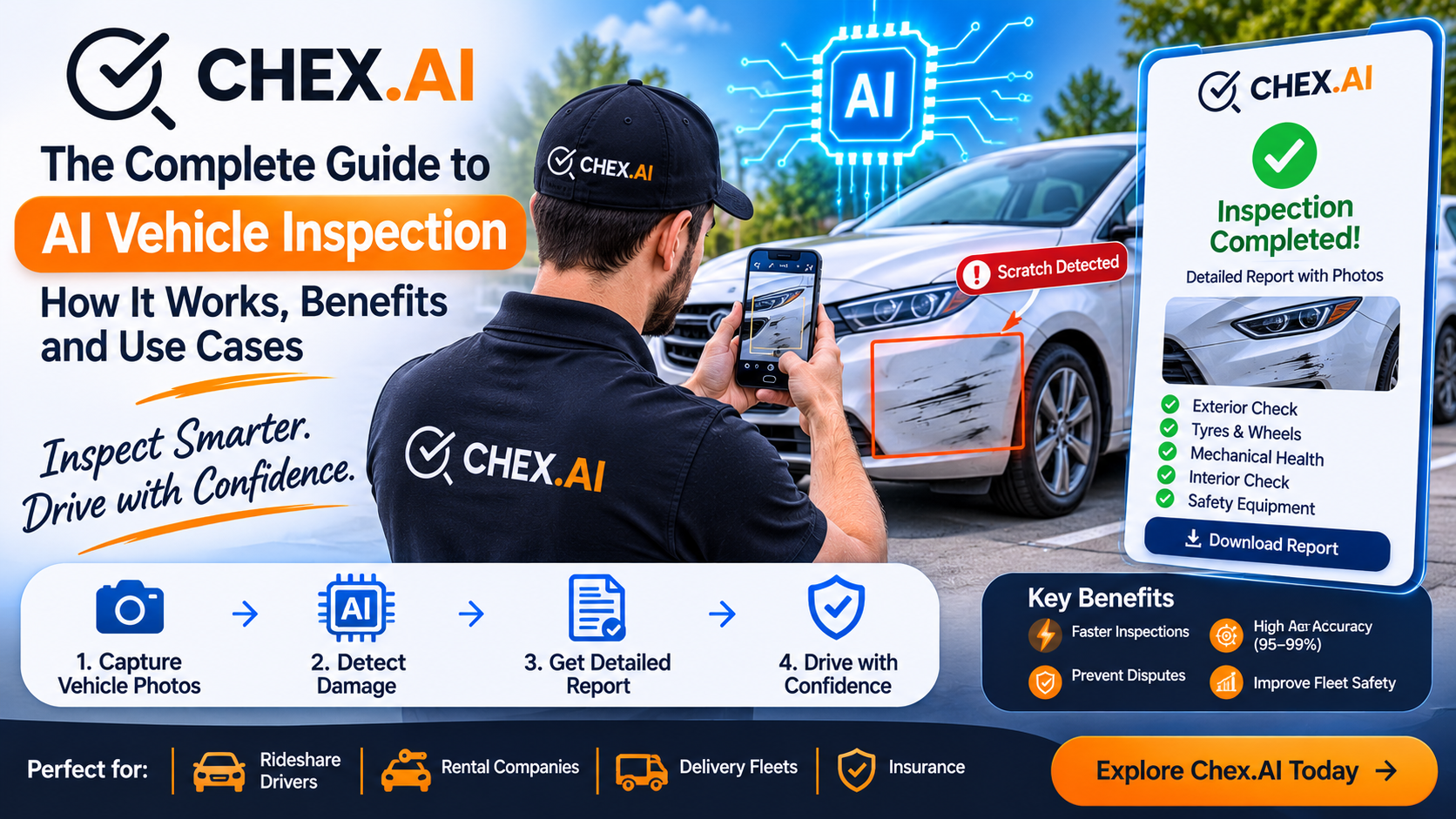
AI vehicle inspection replaces clipboards, guesswork and long handover queues with a few guided photos and an automatic damage report. It is already changing how rideshare drivers, rental companies, delivery fleets and insurers record the condition of a vehicle, and it is quickly becoming the standard way to prove what a car looked like and when.
For decades, vehicle inspection has depended on a person walking around a car with a form. That approach works, but it is slow, it varies from one inspector to the next, and the evidence it produces is often weak. When a dispute arises over a scratch, a cracked light or a dented panel, a handwritten note rarely settles the argument. Missed defects can also turn into safety problems, repair bills and lost working days.
AI changes the equation. Computer vision models can look at a photo, spot damage, name the affected part and write the result into a structured report within minutes. Platforms such as Chex.AI apply this approach to detect 21 damage types across 163 vehicle parts, with reported accuracy of 95 to 99 percent. The result is a faster, more consistent and far better documented inspection.
This guide explains how AI vehicle inspection works, how it compares with manual checks, what benefits to expect and where it fits across different industries. You will also find a universal inspection checklist, a feature table for choosing a platform, a nine-step rollout plan, a list of common mistakes and answers to the questions buyers ask most often. Whether you manage a handful of cars or a fleet of hundreds, you can use it as a practical starting point.
What Is AI Vehicle Inspection and How Does It Work?
AI vehicle inspection is the use of computer vision and machine learning to examine photos or video of a vehicle, identify damage and generate a report without a human having to inspect every panel by eye. The person on site, whether a driver, a customer or a branch agent, simply captures the images. The software does the analysis.
The process follows a simple sequence.
1. Guided capture. The user opens the inspection tool and follows prompts to photograph each side of the vehicle, plus close-ups of key areas such as bumpers, wheels and glass. Guidance matters because clear, well-lit images are what make accurate detection possible.
2. Image analysis. The AI compares each image with what it has learned about vehicle shapes and damage patterns. It looks for dents, scratches, cracks, broken parts and other defects.
3. Part and damage labelling. Rather than just flagging that something looks wrong, the system names the damage type and the part affected, for example a scratch on a rear bumper or a crack on a windshield.
4. Report generation. Findings are compiled into a structured, time-stamped digital report that can be stored, searched and shared.
5. Review and action. A manager, adjuster or agent reviews the report, confirms the result and decides what happens next, whether that is a repair order, a claim or a simple sign-off.
The value is not only speed. Because every vehicle is checked with the same detection logic, the output is consistent. Two inspectors might describe the same scratch in different words, or miss it entirely. An AI model applies the same rules each time and records its findings in the same format.
One point is worth stating clearly: AI supports people, it does not replace them. The best programmes use AI to capture and document, then rely on trained staff for judgement calls, exceptions and customer conversations. You can read a deeper comparison in our article on AI vehicle inspection vs manual inspection.
Manual vs AI Vehicle Inspection
Manual inspection is not wrong, and it still has a place. The question is where it falls short and whether AI closes those gaps. The table compares the two across the factors that matter most in daily operations.
|
Factor |
Manual inspection |
AI vehicle inspection |
|
Speed |
Depends on inspector availability and form length |
Guided photo capture and a report within minutes |
|
Consistency |
Varies between people and shifts |
Same detection logic on every vehicle |
|
Damage detail |
Short notes, easy to miss small marks |
Damage type and affected part labelled |
|
Evidence quality |
Handwritten notes, loose photos |
Time-stamped, structured digital record |
|
Audit trail |
Paper that is lost or hard to search |
Reports stored and easy to retrieve |
|
Comparison over time |
Manual and slow |
Easier before-and-after review |
|
Training needed |
Inspectors need experience to spot defects |
Users follow guided capture prompts |
|
Scalability |
More vehicles mean more inspector hours |
Handles larger volumes without extra forms |
|
Dispute handling |
Often one person's word against another's |
Records that both parties can review |
Three differences stand out. First, evidence: a time-stamped digital record carries far more weight than a signature on a form. Second, consistency: when every vehicle is judged by the same rules, there are fewer arguments about what counts as damage. Third, scale: a business adding vehicles does not need to add inspectors at the same rate.
Manual checks still matter for things a camera cannot see, such as the feel of a brake pedal, an unusual noise or a smell of fuel. The strongest approach combines both: AI for visible condition and documentation, and a mechanic or trained driver for functional checks.
Key Benefits of AI Vehicle Inspection
Businesses that move from paper to AI inspection usually notice the same handful of improvements.
Faster inspections. A guided capture takes a few minutes, and the report is generated automatically. Drivers spend less time at the counter or the depot, and customers spend less time waiting. Over hundreds of handovers a week, those minutes add up to real operational capacity.
Consistent, objective results. Human inspectors have good days and bad days. They get tired at the end of a shift, rush at busy times and apply standards differently. An AI model applies one standard to every image, so a scratch on Monday morning is judged the same way as a scratch on Friday night.
Stronger evidence. A report with time-stamped images and labelled damage is far harder to dispute than a handwritten note. That protects the business when it needs to recover repair costs and protects the customer or driver from being blamed for damage they did not cause.
Earlier detection of problems. Small defects are cheaper to fix than large ones. When every vehicle is recorded regularly, issues such as a cracked light or a damaged tyre are flagged before they cause a breakdown, a failed roadside check or a safety incident.
Better records for audits and claims. Digital reports can be searched by vehicle, date or damage type. That makes it easier to answer questions from insurers, regulators, partners and customers, and to spot repeat problems with a specific vehicle or location.
Lower administrative effort. No more scanning forms, typing notes into spreadsheets or chasing missing paperwork. Information is captured once, at source, and available to everyone who needs it.
A smoother customer experience. Whether the customer is a renter, a policyholder or a rideshare driver, a quick, transparent inspection builds trust. People are more comfortable when they can see exactly what was recorded.
None of these benefits depends on replacing your team. They come from giving your team better tools, so that skilled people spend their time on decisions rather than data entry.
AI Vehicle Inspection Use Cases by Industry
The same technology serves very different businesses. Here is how it applies in the five most common settings.
Rideshare drivers
Uber and Lyft drivers must keep their vehicles in an acceptable condition to stay on the road. A clear, documented inspection helps a driver confirm the car is ready and keep a record to show if questions come up. Digital inspections are quicker to complete than a shop visit and easy to repeat. Our rideshare inspection service is built around this need, and our guide to Lyft vehicle inspection requirements explains what drivers typically need to prepare.
Rental car companies
Rental businesses live and die by damage records. A guided inspection at pickup and again at return creates a before-and-after comparison, which makes it easier to settle disputes and recover costs when damage really did happen during the rental. Read more in our guide to AI inspection software for rental car companies.
Commercial and delivery fleets
Fleets run vehicles hard and need to know which ones are ready for the next shift. Pre-trip and post-trip checks recorded digitally show who inspected what, and when. Delivery service partners in particular benefit from a standard routine across many vans. See our commercial fleet inspection service for more.
Insurance and claims
Insurers use damage assessment to decide how quickly and fairly a claim moves. Photo-based AI reports can support first notice of loss, underwriting baselines and fraud checks, while leaving final decisions to human adjusters. Time-stamped, part-level records reduce back-and-forth between claimants and claims teams.
Dealerships and used car sellers
Dealers need accurate condition reports for trade-ins, auctions and listings. A consistent AI report gives buyers confidence and gives the dealer a record of the vehicle's condition at intake, which helps avoid arguments later about damage found after sale.
Across all five settings, the pattern is the same: capture condition once, record it clearly and make it easy to compare later.
How to Choose an AI Vehicle Inspection Platform
Not every inspection tool is built the same way. Before you commit, test a few options on your own vehicles and compare them against the criteria below.
|
Feature |
What to look for |
Why it matters |
|
Detection range |
Many damage types and vehicle parts covered |
Narrow detection misses real defects |
|
Accuracy |
Clearly stated accuracy, ideally tested on your vehicles |
Weak detection creates rework |
|
Ease of capture |
Simple guided steps for drivers and customers |
Poor capture means poor results |
|
Report quality |
Clear, time-stamped, shareable reports |
Reports are your evidence |
|
Speed |
Results within minutes |
Slow tools get abandoned |
|
Integration |
Works with your booking, claims or fleet tools |
Avoids double entry |
|
Support for your use case |
Rideshare, rental, fleet or insurance workflows |
Generic tools may not fit |
|
Pricing clarity |
Transparent plans for your fleet size |
Avoids surprise costs |
|
Human review options |
Ability to confirm or override results |
Keeps people in control |
|
Data handling |
Clear approach to storing and sharing images |
Protects customers and the business |
Start with detection range and accuracy, because they decide whether the tool is useful at all. Chex.AI reports coverage of 21 damage types across 163 vehicle parts, and accuracy of 95 to 99 percent. Treat any accuracy figure as a starting point and run your own pilot, since lighting, camera quality and vehicle type all affect results.
Next, look closely at the capture experience. The best detection model in the world cannot fix blurry, badly framed photos. Ask to try the capture flow yourself and watch how a first-time user copes.
Finally, check pricing early. Plans can differ by use case, so review the pages that match your situation, such as rideshare pricing or DSP fleet pricing, and ask for a demo if you want to see the product with your own vehicles.
A Universal Vehicle Inspection Checklist
Whatever tool you use, the same areas need checking. Use this list as a base and adapt it to your vehicle type. AI can cover most of the visible items, while a human check covers the rest.
Exterior body
• Front and rear bumpers: scratches, dents, cracks, loose trim
• Doors, fenders and quarter panels: dents, paint damage, rust
• Hood, trunk and roof: dents, scratches, hail marks
• Door handles, trim and badges: broken or missing parts
Glass, mirrors and lights
• Windshield: chips, cracks, wiper damage
• Side and rear windows: cracks, tint damage
• Mirrors: cracked glass, loose housings
• Headlights, brake lights and indicators: broken lenses, moisture, failed bulbs
Wheels and tyres
• Tyre tread depth and visible wear
• Sidewall cuts, bulges or flat spots
• Rim damage, kerb scuffs and loose wheel nuts
• Spare tyre and tools where supplied
Underbody and mechanical (visual)
• Fluid leaks under the vehicle
• Hanging or damaged components
• Exhaust condition and unusual noise at start-up
• Brake feel and warning lights on the dashboard
Interior and cabin
• Seats and upholstery: stains, tears, burns
• Dashboard, screens and controls: cracks, faults
• Seat belts working and undamaged
• Cleanliness, odours and loose items
Safety equipment
• Horn, wipers and washers
• First aid kit and fire extinguisher where required
• Child locks and door locks working
Record and sign-off
• Time-stamped photos of all four sides and each damaged area
• Odometer reading and fuel or charge level
• Note of any new defect with its location
• Confirmation from the driver, customer or agent
If you want more detail on a specific use case, our rideshare vehicle inspection guide and blog library cover individual checklists in depth.
9 Steps to Roll Out AI Vehicle Inspection
A good rollout is small, measured and boring. Follow these steps to avoid the common stumbles.
1. Define the problem. Write down what you want to fix: slow handovers, damage disputes, missed defects, claim delays or all of them. A clear goal makes it easy to judge success later.
2. Map the current process. Walk through a real inspection from start to finish. Note who does what, how long it takes, where records are stored and where information gets lost.
3. Agree on a standard checklist. Use the universal list above and adapt it. Decide which angles, close-ups and details every inspection must capture.
4. Shortlist platforms. Use the feature table to compare two or three options. Check detection range, accuracy, report quality, integrations and pricing.
5. Run a pilot. Choose one location, one team or one vehicle type. Test with real vehicles in real conditions, not only a demo environment. You can request a Chex.AI demo to see how it handles your vehicles.
6. Train the people who capture the photos. Short, practical guidance on lighting, distance and angles gives better results than any long manual. Make it easy for a new driver or customer to get it right the first time.
7. Set review and escalation rules. Decide who confirms reports, which findings need a human decision and how quickly defects must be fixed. Keep high-value or unclear cases with a person.
8. Measure the pilot. Track inspection time, disputes, repair costs, re-inspection rates and user feedback. Compare them with your starting point.
9. Expand in stages. Add locations or vehicle groups gradually, and keep collecting feedback. Review results monthly and refine the checklist as you learn.
The goal is not to launch everywhere at once. It is to prove value in one place, learn what works and then repeat it with confidence.
Common Mistakes to Avoid
Most failed rollouts trace back to a few predictable errors.
• Treating AI as a magic fix. Software cannot repair a broken process. If nobody owns inspections or acts on findings, even perfect reports will sit unread.
• Ignoring photo quality. Dim light, dirty lenses and cropped angles lead to missed damage. Build simple capture rules into training.
• Skipping the pilot. A demo on clean cars in perfect light says little about a rainy depot at 6 a.m. Test in your real conditions.
• Removing human review. Complex, high-value or unclear cases still need a trained person. Keep a clear route for escalation.
• Using different checklists at each site. Inconsistent standards defeat the purpose. One checklist, applied everywhere, keeps results comparable.
• Not comparing pickup and return. The biggest value of a digital record is the before-and-after view. Make sure both inspections happen every time.
• Forgetting the customer or driver. If the process feels confusing or intrusive, people will rush it. Explain why it matters and keep it quick.
• Failing to measure results. Without a baseline, you cannot show savings or improvement. Record inspection time, disputes and repair costs from day one.
Avoiding these mistakes matters more than which platform you pick. A well-run process with a decent tool beats a poor process with the best tool.
Where AI Vehicle Inspection Is Heading
Vehicle inspection is still early in its shift from paper to software, and several trends are likely to shape the next few years.
Inspection becomes continuous. Today most inspections happen at set moments, such as pickup, return or the start of a shift. As tools get faster and easier, more businesses will inspect more often, building a running history of each vehicle's condition.
Records follow the vehicle. A shared, time-stamped history makes it simpler to answer who caused damage, when it happened and what it cost to fix. That is useful for rental companies, fleets, insurers and used car buyers alike.
Tighter links to claims and maintenance. Inspection results will connect more directly to claims systems, repair orders and fleet maintenance schedules, so a flagged defect triggers action rather than sitting in a report.
Higher expectations from customers. People are used to doing things from a phone. Drivers and renters will increasingly expect a quick, self-service inspection rather than a long wait at a counter.
Humans move to higher-value work. As detection and documentation are automated, inspectors and adjusters spend more time on judgement, repairs and customer service.
No one can predict exactly how fast any of this will happen, but the direction is clear. Businesses that build good inspection habits now will be better placed as the technology matures.
Frequently Asked Questions
What is AI vehicle inspection? It is the use of computer vision to analyse vehicle photos, detect damage, identify the affected part and produce a structured report.
How long does an AI inspection take? Capture usually takes a few minutes, and the report is generated automatically. Exact timing depends on the platform and how many images are required.
How accurate is AI damage detection? Accuracy depends on photo quality, vehicle type and the platform. Chex.AI reports 95 to 99 percent accuracy, but you should confirm results in a pilot on your own vehicles.
Does AI replace human inspectors? No. AI handles routine capture and documentation, while people handle judgement calls, functional checks and customer conversations.
Can AI inspect the mechanical condition of a car? AI works from images, so it is strongest on visible condition such as body damage, glass, lights and tyres. Engine, brakes and other mechanical systems still need a mechanic or a trained driver.
Who can use AI vehicle inspection? Rideshare drivers, rental companies, commercial and delivery fleets, insurers and dealerships all use digital inspections to record vehicle condition.
Do I need special equipment? Usually a smartphone is enough. Follow the guided prompts so photos are clear, well lit and framed correctly.
How does it help with damage disputes? Time-stamped, part-level reports give both sides a shared record. Comparing pickup and return inspections makes it clear what changed.
Is it suitable for small fleets? Yes. Any business that hands vehicles to drivers or customers benefits from consistent records, whatever the fleet size.
How do I get started? Begin with a small pilot, measure the results and expand in stages. You can request a demo to see how it works with your vehicles.
Final Thoughts
AI vehicle inspection gives every business that handles vehicles the same three things: speed, consistency and proof. It shortens handovers, reduces arguments over damage and gives managers a clear picture of their vehicles without drowning in paperwork. It does not remove the need for skilled people, but it lets them focus on the decisions that actually need their attention.
The smartest way to start is small. Pick one location or one vehicle group, agree on a checklist, run a pilot and measure the difference. If the results are good, expand with confidence.
To see how it works in practice, visit Chex.AI, explore the Chex.AI blog for guides on specific use cases, or request a demo and try it on your own vehicles.

 English
 Arabic
 French
 Spanish
 Portuguese
 Deutsch
 Dutch
 Italiano
 Russian
 Romaian
 Portuguese (Brazil)
 Greek