
AI Knowledge Base Checklist for Stores, Clinics & Schools | Offlo.ai
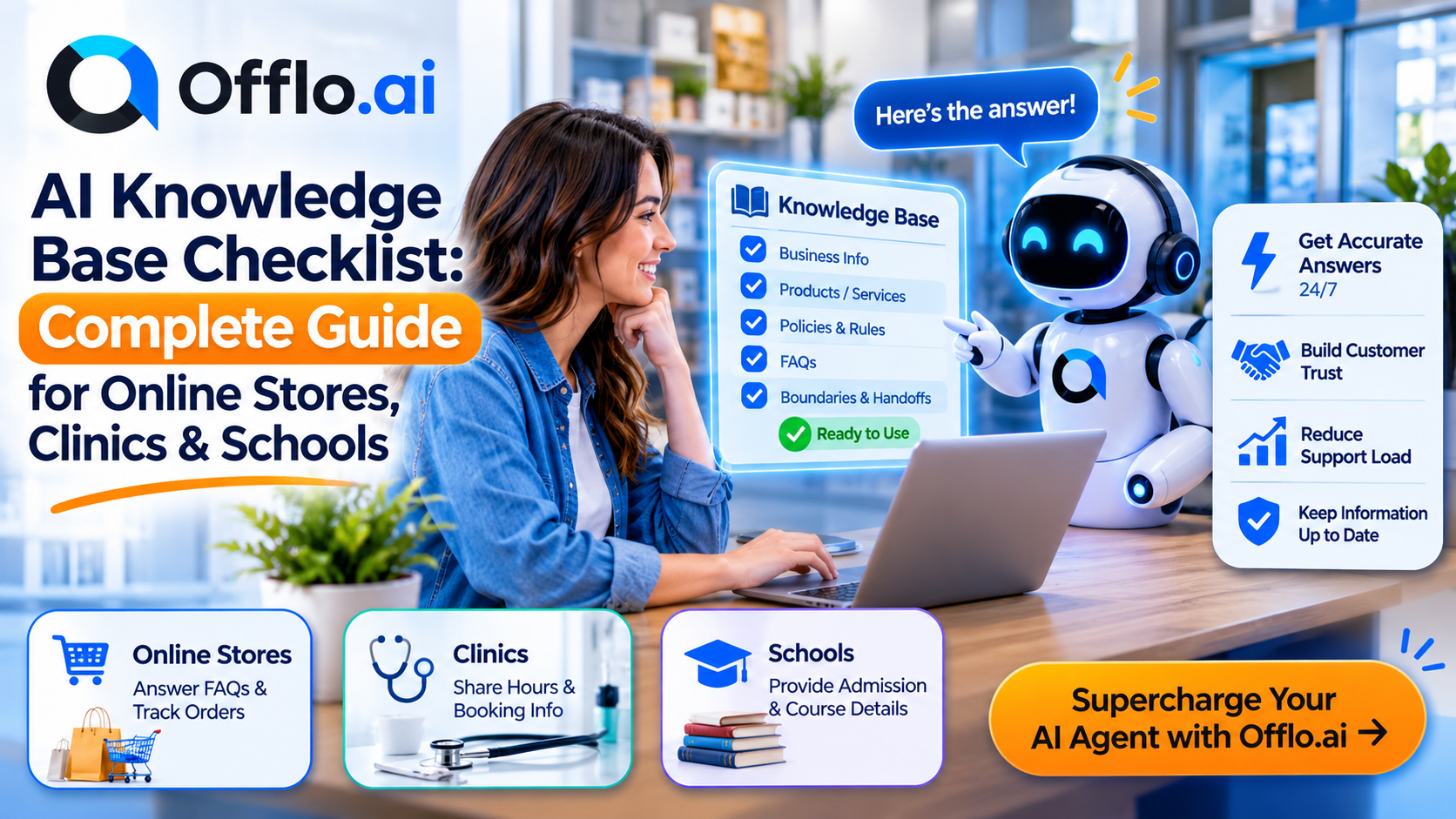
An AI agent can only answer what it knows. Give it clear, current and well-organised information about your business, and it can reply to customers quickly and accurately at any hour. Give it outdated prices, vague policies or scattered notes, and it will guess, contradict your team or hand every question back to a human. The difference is the knowledge base.
For online stores, clinics and schools, the stakes are real. A shopper asking about delivery time wants a straight answer before they pay. A patient asking about opening hours or how to book needs the right details, not a guess. A parent asking about admission dates expects the same answer your office would give. When the AI agent gets these right, customers trust it. When it gets them wrong, they stop asking and go back to calling.
This guide gives you a practical AI knowledge base checklist. It explains what to include, how to write answers an AI agent can use, how to set handoff rules, how to test the result and how to keep it current. It also covers the specific knowledge needed in ecommerce, healthcare and education.
If you are exploring how an AI agent fits into your customer conversations, Offlo.ai is built to help businesses handle customer chats across channels such as WhatsApp and Instagram with an AI agent, shared inbox, CRM and automation working together. Whatever tool you choose, the checklist below applies. Work through it once, then review it regularly, and your AI agent will have the foundation it needs to help customers well.
What Is an AI Knowledge Base and What Should It Contain?
An AI knowledge base is the collection of business information your AI agent uses to answer customers. It is the equivalent of the briefing you would give a new team member on their first day: what you sell, how you work, what your rules are and when to ask for help.
It is not a single document. It is a set of facts, policies and examples, written so that both a person and an AI can read them without confusion. A strong knowledge base usually contains six kinds of content.
• Business basics. Who you are, where you operate, opening hours, contact methods, languages you support and how customers can reach a person.
• Products or services. What you offer, key details customers ask about, prices where you share them publicly and how to order, book or enroll.
• Policies. Delivery, returns, cancellations, payments, privacy, attendance, safety or anything else that sets rules for customers.
• Processes. Step-by-step instructions for common tasks, such as tracking an order, rescheduling an appointment or submitting an application.
• Common questions and answers. The questions your team answers every week, written as clear, direct replies.
• Boundaries and handoff rules. What the AI should not answer, what it should pass to a human and how to do so politely.
The last item is the one most businesses forget. A knowledge base is not only about what the AI can say. It is also about what it must not say. In healthcare, for example, an AI agent should help with practical questions such as hours, locations and booking, but it should not diagnose, prescribe or give clinical advice. Writing that boundary down protects patients and your team.
A good knowledge base is also current. Prices change, offers end, opening hours shift for holidays and policies get updated. If nobody owns the job of keeping it fresh, even a well-built knowledge base slowly turns into a source of wrong answers.
Why Weak Knowledge Makes AI Customer Support Fail
When an AI agent performs badly, the model is rarely the whole story. Most failures trace back to the information it was given. The table links common symptoms to their likely causes and fixes.
|
Symptom |
Likely cause |
Fix |
|
Wrong price or offer quoted |
Outdated product or promotion details |
Name an owner and update on a schedule |
|
Answers contradict each other |
Two documents say different things |
Keep one source of truth per topic |
|
Vague replies such as "please contact us" |
Answers are too general |
Write specific, direct answers |
|
Customer asks again in different words |
Only one phrasing was covered |
Add variations and examples |
|
AI answers outside its remit |
No boundaries written down |
Add clear "do not answer" rules |
|
Too many handoffs to humans |
Common questions missing |
Add answers from real chat history |
|
Wrong policy for a customer group |
Exceptions not documented |
Add edge cases and exceptions |
|
Inconsistent tone |
No style guidance |
Write a short tone guide |
|
Customers lose trust |
Errors repeat without review |
Review failed chats weekly |
A useful way to think about it: the AI is a very fast, very polite new hire who has read everything you gave it and nothing else. If the briefing is clear, it performs well. If the briefing is thin, it improvises.
The cost of weak knowledge is not only wrong answers. It also shows up as extra work for your team. Every question the AI cannot answer becomes a handoff. Every wrong answer becomes a correction. A knowledge base built carefully once saves hours every week.
The good news is that most of the fixes are simple. You already know your business. The work is writing it down clearly, organizing it and keeping it up to date.
The AI Knowledge Base Checklist, Phase by Phase
Work through these phases in order. Each one builds on the last.
Phase 1: Gather
• ☐ List the 30 to 50 questions your team answers most often
• ☐ Export or review recent chat, email and phone notes for real wording
• ☐ Collect current price lists, menus, catalogues, timetables or service lists
• ☐ Gather policies: delivery, returns, cancellations, payments, privacy, attendance
• ☐ Note seasonal changes, holiday hours and temporary offers
Phase 2: Organize
• ☐ Group content by topic: products, orders, bookings, billing, policies, contact
• ☐ Choose one source of truth for each topic
• ☐ Remove duplicates and contradictions
• ☐ Name an owner for each topic who is responsible for accuracy
Phase 3: Write
• ☐ Write each answer in plain, direct language
• ☐ Put the key fact in the first sentence
• ☐ Add two- or three-ways customers might phrase the same question
• ☐ Include examples, such as a sample order or a sample booking
• ☐ Write a short tone guide: friendly, formal, brief, warm
Phase 4: Set boundaries
• ☐ List topics the AI must not answer
• ☐ Define what triggers a handoff to a person
• ☐ Write the polite handoff message customers will see
• ☐ Add privacy rules: what the AI must never ask for or repeat
Phase 5: Connect
• ☐ Link the knowledge base to the channels you use, such as WhatsApp and Instagram
• ☐ Make sure handoffs land in your shared inbox
• ☐ Check customer details flow into your CRM
• ☐ Set up follow-up automations for common outcomes
Phase 6: Test
• ☐ Ask the AI 50 real questions and score each answer
• ☐ Test tricky cases: refunds, exceptions, angry customers, unclear requests
• ☐ Have a colleague who did not write the content try to break it
• ☐ Fix gaps and test again
Phase 7: Launch and maintain
• ☐ Launch on one channel first
• ☐ Review failed or escalated chats every week
• ☐ Update after every price, policy or schedule change
• ☐ Run a full review every quarter
Ecommerce Knowledge Checklist for Online Stores
Online shoppers decide fast. If they message you before buying, they usually have one specific doubt. Answer it well, and the sale moves forward. The knowledge your AI agent needs for ecommerce falls into a few clear groups.
Products
• Product names, sizes, colors, materials and variants
• Which items are in stock, and how stock status is communicated
• Care instructions, compatibility and usage tips
• Bundles, gift options and personalization
Pricing and offers
• Current prices and any public discounts
• Rules for promo codes and sale items
• Payment methods you accept and when payment is taken
Delivery
• Delivery areas, methods and typical timeframes
• How shipping costs are shown
• How customers can track an order
• What happens if a parcel is delayed or lost
Returns and refunds
• Return window and conditions
• How to start a return and who pays for shipping
• How long refunds take and how they are issued
• Items that cannot be returned
Order help
• Changing an address or item after ordering
• Cancelling an order
• Missing or damaged items
• What information the AI needs to look up an order
Sales moments
• Questions that usually come before purchase, such as fit, size or delivery date
• Abandoned cart follow-ups and how to phrase them
• Links to the right product pages
Online stores also get a lot of conversations from social channels. Customers often message on WhatsApp or Instagram after seeing an ad or a post, so make sure your answers match what your ads and posts promise. If a promotion ends on Friday, your AI agent should know that by Friday.
For a wider view of how conversations connect to sales, see our guides on AI customer support and the omnichannel inbox.
Healthcare Knowledge Checklist for Clinics
Clinics and healthcare providers can use an AI agent to answer practical questions and ease pressure on reception. The knowledge base for healthcare must be written with extra care, because mistakes here can affect people's wellbeing.
A clear boundary comes first. The AI agent should help with administrative and practical questions. It should not diagnose conditions, recommend treatments, prescribe medicines or give clinical advice. Write this into the knowledge base in plain words, along with the message customers see when they ask a medical question.
Practical information the AI can safely share
• Clinic name, address, parking and directions
• Opening hours, holiday closures and emergency contact guidance
• Services offered and which practitioners provide them
• How to book, change or cancel an appointment
• What to bring to a first visit, such as ID or referral documents
• Accepted payment methods and general fee information you choose to publish
• Language support and accessibility information
Policies to document
• Cancellation and late-arrival rules
• Privacy and how patient information is handled
• Consent for messages and reminders
• Rules for sharing documents or results, if any
Handoff triggers
• Any question about symptoms, medication, test results or treatment
• Any mention of an emergency or urgent concern
• Any request that involves identity checks or sensitive records
• Any customer who asks for a person
Emergency wording. Include a short, clear message for urgent situations that tells the person to contact local emergency services or the clinic's urgent line, and make sure the AI uses it whenever someone describes an urgent concern.
Privacy rules. Decide in advance what the AI should never ask for or repeat in a chat. Keep sensitive details out of casual messaging wherever possible, and follow the rules that apply in your region. This guide is general information, not legal advice, so check your obligations with a qualified adviser.
The goal is a helpful front desk, not a digital doctor. When the knowledge base is clear about that line, patients get fast answers to everyday questions and your clinical team keeps control of anything medical.
Education Knowledge Checklist for Schools and Training Providers
Schools, colleges and training providers receive waves of similar questions at predictable times: before admissions open, around fee deadlines, before exams and at the start of each term. An AI agent with the right knowledge can answer these quickly and leave staff free for conversations that need a person. The knowledge base for education should cover the following.
Admissions and enrolment
• Programs, courses and age or entry requirements
• Application steps, forms and documents needed
• Key dates: open days, deadlines, interviews, start dates
• Who to contact for special cases
Fees and payments
• Published fee structures and what they include
• Payment methods, instalment options and due dates
• Policies for late payment, refunds and withdrawals
Academic calendar
• Term dates, holidays and exam periods
• Timetable access and how changes are communicated
• Closure or weather notices
Student and parent services
• Uniform, equipment or book lists
• Transport, meals and extracurricular activities
• Attendance and absence reporting rules
• Support services and how to ask for them
Policies
• Behavior, safeguarding and conduct policies, in summary and with links to the full text
• Privacy rules for student and parent information
• Complaints and appeals process
Handoff triggers
• Questions about an individual student's grades, behavior or welfare
• Safeguarding or wellbeing concerns, which must go to a trained person at once
• Complaints or disputes
• Requests that need identity verification
The tone matters as much as the facts. Parents and students may be anxious, particularly around admissions and results. A warm, clear and patient voice makes a big difference, so include a short tone guide with sample replies.
Also plan for peaks. If thousands of messages arrive on results day or the day applications open, the AI agent should already know the answers, and your team should know exactly which questions will reach them. You can read how automation supports these busy periods on our automation features page.
How to Write Answers an AI Agent Can Use
The best knowledge base entries are short, specific and written for a real customer. Use these principles.
Lead with the answer. Put the key fact in the first sentence, then add detail. "We deliver within 3 to 5 working days in most areas" beats a long paragraph that reaches the point in the fourth line. Replace the example with your own real figures.
Write one topic per entry. An entry about returns should not also cover delivery. Separate topics are easier to update and less likely to contradict each other.
Use the customer's words. Look at real chats. If customers write "where is my parcel" rather than "order tracking status", include that phrasing. Add three to five variations of each common question.
Be specific about numbers, dates and conditions. Avoid phrases such as "soon", "shortly" or "usually" without context. If something depends on a condition, state the condition.
Include examples. A sample return, a sample booking or a sample application helps the AI explain steps clearly.
State exceptions. If a rule has exceptions, write them next to the rule. For example, "Returns are accepted within 14 days, except for personalized items."
Define tone once. Add a short guide, such as: friendly, clear, short sentences, no jargon, no pressure. Include two or three sample replies that show the voice.
Write handoff lines. Give the AI polite wording for passing a conversation to a person, such as: "I'm going to bring in a member of our team who can help with this. They'll reply as soon as they can."
Avoid promises the business cannot keep. Do not write that replies are "instant" or that a result is "guaranteed" unless it really is.
Mark what is not public. If some information is internal, label it clearly so it is never shared with customers.
Here is a before-and-after example for a store.
Before: "Our return policy is flexible and we will do our best to help."
After: "You can return unworn items within 14 days of delivery for a refund to your original payment method. Start a return by sending your order number. Refunds usually arrive within 5 to 7 working days after we receive the parcel."
The second version gives the AI everything it needs: who, what, when, how and what happens next. That is the standard to aim for in every entry.
Connecting Your Knowledge Base to Channels, Inbox, CRM and Automation
A knowledge base is only useful when it reaches customers where they already are. For most businesses, that means messaging channels, a shared inbox for the team and a CRM that remembers who customers are.
Channels. Customers message on WhatsApp, Instagram and other channels, and they expect the same answers on each. Keep one knowledge base behind all of them so a price quoted on Instagram matches the one on WhatsApp. Start with the channel that carries most of your conversations and add others once results are stable.
Shared inbox. When the AI agent hands a conversation to a person, the team needs the whole chat, not just the last message. A shared inbox keeps every conversation in one place, shows who is handling it and avoids two people answering the same customer. Learn more on the omnichannel inbox page.
CRM. Every conversation holds useful details: what a customer asked, what they bought or booked and what they said they would do next. Saving this in a CRM means the AI and your team can personalize replies and follow up at the right time.
Automation. Many questions have predictable next steps. After an order is placed, send a confirmation. After a booking, send a reminder. After a quiet cart, send a gentle nudge. Automation turns your knowledge into timely action without extra manual work.
Integrations. Your store, booking system or student platform holds live information such as stock, appointment slots or fee status. Where possible, connect it so the AI uses current data rather than copied text. See the integration page for what can be connected.
Marketing and click-to-chat entry points. Ads and campaigns that open a chat should lead to answers that match the promise. Review the marketing features and make sure each campaign has matching knowledge ready before it goes live.
Think of these pieces as a single flow: a customer asks, the AI answers from the knowledge base, the conversation is saved, a person steps in when needed and automation handles the follow-up. If you want to see how Offlo.ai puts this together, you can book a demo or read the FAQ.
Human Handoff Rules and Knowledge Gaps
No knowledge base covers everything. What matters is that the AI knows when it has reached the edge and what to do next. Write handoff rules as clearly as you write answers.
|
Situation |
What the AI should do |
Why |
|
Question not in the knowledge base |
Say it will check with the team and hand off |
Avoids guessing |
|
Customer asks for a person |
Hand off at once, politely |
Respects the customer's choice |
|
Complaint or angry message |
Acknowledge, then hand off |
Needs empathy and authority |
|
Refund, exception or discount request |
Hand off to someone with authority |
Policy decisions belong to people |
|
Sensitive personal or financial details |
Do not collect in chat, hand off to a secure route |
Protects privacy |
|
Medical question (clinics) |
Share the boundary message and hand off |
The AI must not give clinical advice |
|
Safeguarding or welfare concern (schools) |
Hand off immediately to a trained person |
Needs urgent human attention |
|
Repeated misunderstanding |
Offer a person after two failed tries |
Prevents frustration |
|
Out-of-hours message |
Give hours and next steps, queue for the team |
Sets honest expectations |
Every handoff should include three things: a short polite message to the customer, a summary for the team so nobody has to ask the customer to repeat themselves, and a clear owner so the conversation does not sit unanswered.
Treat each handoff as data. When the AI cannot answer, ask why. If the topic comes up often, write a new entry. If the topic is sensitive, keep it with a person. A weekly review of handoffs is the fastest way to improve the knowledge base, because it shows exactly what customers ask and what you have not yet covered.
Do not aim for zero handoffs. Some conversations should always reach a human. The aim is the

 English
 Arabic
 French
 Spanish
 Portuguese
 Deutsch
 Turkish
 Dutch
 Italiano
 Romaian
 Portuguese (Brazil)
 Greek