
Cubic Yard Calculator: A Complete Guide to Measuring Volume Accurately
Introduction
A cubic yard calculator is a useful tool for measuring the volume of materials needed for construction, landscaping, gardening, and home improvement projects. Whether someone is ordering soil, mulch, gravel, sand, concrete, or other bulk materials, calculating the correct quantity is important. Buying too little material can delay a project, while ordering too much can increase expenses and create unnecessary waste.
A cubic yard calculator makes these calculations easier by converting measurements into cubic yards. Instead of performing complicated mathematical calculations manually, users can enter the length, width, and depth of an area to determine its total volume. This simple process saves time and helps people make better purchasing decisions.
Understanding how cubic yards work can also improve project planning. With accurate measurements, homeowners, contractors, landscapers, and construction workers can estimate material requirements more confidently.
What Is a Cubic Yard Calculator?
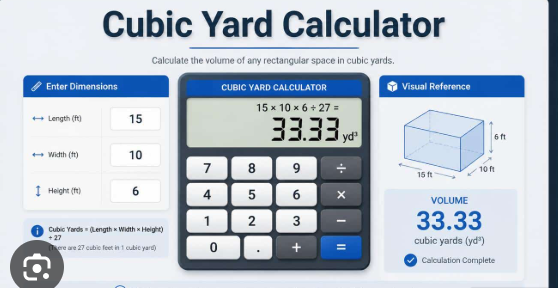
A cubic yard calculator is an online calculation tool designed to determine the volume of a specific space in cubic yards. It uses three basic measurements: length, width, and depth. After receiving these values, the calculator multiplies them to find the total volume.
One cubic yard represents a space measuring three feet in length, three feet in width, and three feet in height. It contains 27 cubic feet of material.
This measurement is commonly used in the United States because many construction and landscaping materials are sold by the cubic yard. For example, suppliers often use cubic yards when selling topsoil, decorative stones, gravel, sand, mulch, and ready-mix concrete.
A cubic yard calculator is especially helpful for people who need quick and accurate volume estimates without using complicated formulas.
How Does a Cubic Yard Calculator Work?
A cubic yard calculator works by applying a simple volume formula. Users provide the dimensions of the area they want to fill, and the calculator converts the resulting volume into cubic yards.
The basic formula is:
Cubic Yards = Length × Width × Depth ÷ 27
All measurements must be in feet when using this formula.
For example, imagine someone wants to cover a garden area that measures 12 feet long, 10 feet wide, and 6 inches deep.
First, convert the depth into feet. Six inches equals 0.5 feet.
Next, multiply the measurements:
12 × 10 × 0.5 = 60 cubic feet.
Finally, divide 60 by 27.
The result is approximately 2.22 cubic yards.
Therefore, the garden requires around 2.22 cubic yards of material.
This calculation works for many rectangular areas and makes estimating bulk materials much easier.
Why Is a Cubic Yard Calculator Important?
Accurate volume calculations are essential for successful construction and landscaping projects. A cubic yard calculator helps users avoid common measurement mistakes and control their material budgets.
One major advantage is saving time. Manual calculations can become confusing when measurements involve different units. An online calculator handles the mathematical process within seconds.
Another benefit is reducing material waste. When people order materials without calculating their actual requirements, they may purchase more than necessary. Extra materials can increase transportation costs and create storage problems.
The calculator also supports better budgeting. Once users know how many cubic yards they need, they can estimate the total material cost by multiplying the required quantity by the supplier's price per cubic yard.
Furthermore, contractors can use these calculations to prepare estimates, organize deliveries, and manage construction schedules more effectively.
Common Uses of a Cubic Yard Calculator
A cubic yard calculator is useful for many residential, commercial, and outdoor projects. Different materials require volume measurements, making this tool valuable across several industries.
1. Landscaping Projects
Landscaping is one of the most common applications. Homeowners and professionals use cubic yard calculations to estimate mulch, soil, compost, and decorative stones.
For example, someone creating a new flower bed can calculate the required soil volume before purchasing materials. This helps maintain consistent coverage throughout the garden.
2. Construction Work
Construction projects frequently require sand, gravel, concrete, and crushed stone. Contractors use cubic yard measurements to determine material quantities for foundations, driveways, walkways, and other structures.
3. Gardening
Gardeners often need specific quantities of compost and topsoil to improve growing conditions. A cubic yard calculator helps them estimate the correct amount according to the size and depth of their planting areas.
4. Driveway Installation
Installing a gravel driveway requires careful volume planning. Users can calculate the driveway's length, width, and desired gravel depth to estimate the total quantity needed.
5. Concrete Projects
Concrete is commonly ordered by the cubic yard. Calculating the required volume before placing an order helps prevent shortages and unnecessary expenses.
Cubic Yard Conversion Table
Understanding the relationship between different volume measurements makes material calculations easier. The following table provides useful conversions.
|
Measurement |
Equivalent |
|
1 cubic yard |
27 cubic feet |
|
1 cubic yard |
46,656 cubic inches |
|
1 cubic foot |
0.037 cubic yards |
|
2 cubic yards |
54 cubic feet |
|
3 cubic yards |
81 cubic feet |
|
5 cubic yards |
135 cubic feet |
|
10 cubic yards |
270 cubic feet |
|
1 cubic yard |
0.7646 cubic meters |
These conversions are helpful when measurements come from different tools or suppliers. They also make it easier to compare material quantities.
How to Calculate Cubic Yards Manually
Although an online calculator provides quick results, learning the manual calculation method is useful.
Follow these steps:
Step 1: Measure the Length
Measure the total length of the area using a measuring tape. Record the measurement in feet.
Step 2: Measure the Width
Measure the width of the area. Make sure the measurement covers the entire space that needs filling.
Step 3: Determine the Depth
Measure how deep the material should be. If the measurement is in inches, divide it by 12 to convert it into feet.
Step 4: Calculate Cubic Feet
Multiply the length, width, and depth together to determine the volume in cubic feet.
Step 5: Convert Into Cubic Yards
Divide the cubic feet by 27. The final result represents the required cubic yards.
Following these steps provides a reliable estimate for rectangular spaces.
Benefits of Using an Online Cubic Yard Calculator
Online calculation tools provide several advantages for people working on projects of different sizes.
|
Benefit |
Explanation |
|
Time-saving |
Produces results within seconds |
|
Accuracy |
Reduces common mathematical mistakes |
|
Easy operation |
Requires only basic measurements |
|
Budget planning |
Helps estimate material expenses |
|
Material management |
Reduces overordering and shortages |
|
Convenience |
Can be accessed from different devices |
|
Better preparation |
Supports project planning and scheduling |
Another important benefit is accessibility. Most online calculators work on smartphones, tablets, and computers. Users can calculate material quantities while shopping, visiting a construction site, or planning a home improvement project.
Common Mistakes to Avoid When Calculating Cubic Yards
Even simple calculations can produce incorrect results when measurements are inaccurate. Users should understand several common mistakes before estimating material requirements.
One frequent mistake is mixing measurement units. For example, entering the length in feet and the depth in inches without converting them can produce an incorrect result.
Another mistake is forgetting to divide cubic feet by 27. The initial multiplication provides cubic feet, not cubic yards.
People sometimes measure only part of an area or overlook uneven sections. This can result in ordering insufficient material.
It is also important to remember that different materials have different weights. A cubic yard of gravel does not weigh the same as a cubic yard of mulch or topsoil.
For materials that settle or compact, such as gravel and soil, additional material may be necessary. The required allowance depends on the project and material conditions.
Tips for Getting Accurate Results
Getting reliable results begins with careful measurement. Always measure the entire area and double-check the dimensions before entering them into a calculator.
If the area has an irregular shape, divide it into smaller rectangular or triangular sections. Calculate each section separately and add the results together.
For example, an L-shaped garden can be divided into two rectangles. Calculate the cubic yards for each rectangle and combine the answers.
Always consider the recommended installation depth for the selected material. Different applications require different depths, so using an appropriate measurement improves the final estimate.
Finally, discuss your calculation with the material supplier when ordering large quantities. Suppliers can help account for material density, moisture, settling, and delivery requirements.
Frequently Asked Questions (FAQs)
1. What is a cubic yard calculator used for?
A cubic yard calculator determines the volume of materials required for construction, gardening, landscaping, and other projects.
2. How many cubic feet are in one cubic yard?
One cubic yard contains exactly 27 cubic feet.
3. How do I calculate cubic yards manually?
Multiply the length, width, and depth in feet, then divide the answer by 27.
4. Can I use a cubic yard calculator for concrete?
Yes. It helps estimate the concrete volume needed for foundations, slabs, sidewalks, and other construction projects.
5. Can this calculator measure soil and mulch?
Yes. It can calculate the volume of soil, mulch, compost, gravel, sand, and many other bulk materials.
6. Why should I calculate cubic yards before ordering materials?
Calculating beforehand helps prevent overordering, reduce waste, control expenses, and avoid project delays.
7. Can I calculate irregular areas?
Yes. Divide irregular spaces into smaller sections, calculate each section separately, and add the results together.
Conclusion
A cubic yard calculator is a practical tool for anyone involved in construction, gardening, landscaping, or home improvement. It simplifies volume calculations and helps users determine how much material they need for different projects. By entering accurate length, width, and depth measurements, users can quickly convert cubic feet into cubic yards.
Whether calculating soil for a garden, gravel for a driveway, mulch for landscaping, or concrete for a foundation, understanding cubic yard measurements makes planning easier. Using an online calculator also reduces mathematical errors, improves budgeting, and helps prevent unnecessary material waste. With proper measurements and careful planning, anyone can manage material requirements more efficiently and complete projects with greater confidence.

 English
 Arabic
 French
 Spanish
 Portuguese
 Deutsch
 Turkish
 Dutch
 Italiano
 Russian
 Romaian
 Portuguese (Brazil)