
Test vs ODI vs T20: Key Differences Explained
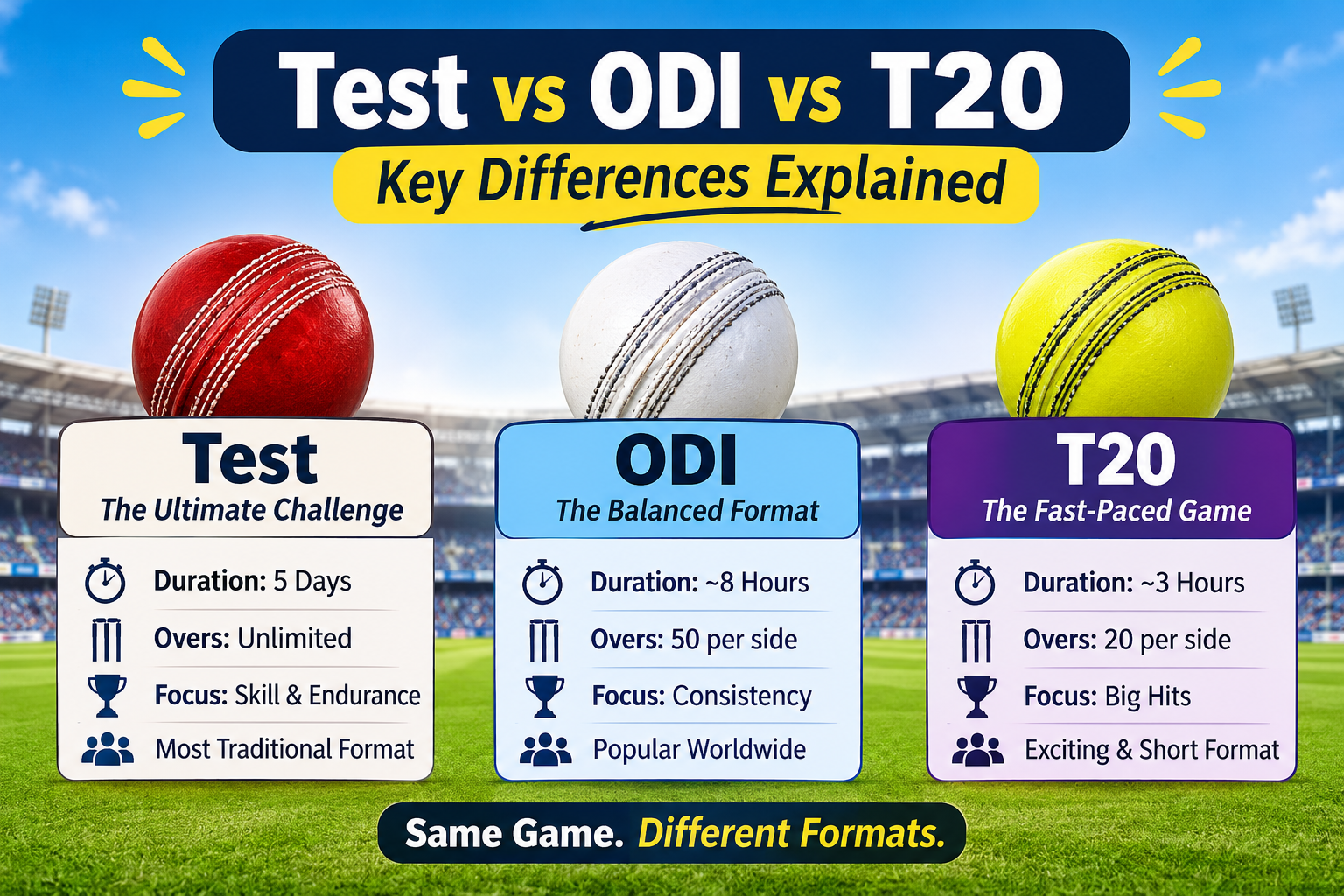
New fans often find cricket confusing because the same sport is played in three very different formats. A Test match can last five days, an ODI takes about a full day, and a T20 game finishes in roughly three hours. Each format rewards different skills, tactics and temperaments.
This guide explains how the three formats differ so you can follow any match with confidence and decide which one suits you best.
Why Understanding the Formats Matters
A batter who scores 50 off 150 balls could be a hero in a Test and a liability in a T20. Without knowing the format, a scorecard can be misleading.
Knowing the rules of each format helps you:
- Judge player performances fairly
- Understand why captains make certain decisions
- Follow tournaments such as the Test Championship, the ODI World Cup and the T20 World Cup
Quick Comparison Table
| Feature | Test cricket | ODI | T20 |
|---|---|---|---|
| Overs per side | Unlimited (within the match time) | 50 | 20 |
| Innings per side | Up to 2 | 1 | 1 |
| Match length | Up to 5 days | About 7–8 hours | About 3 hours |
| Ball colour | Red (pink in day-night Tests) | White | White |
| Clothing | White | Coloured | Coloured |
| Possible results | Win, loss, draw or tie | Win, loss, tie or no result | Win, loss, tie or no result |
| Main skill tested | Patience, technique, endurance | Balance of pace and planning | Power hitting, variation, speed |
Exact playing conditions can change, so always check the current ICC regulations.
Test Cricket: The Ultimate Examination
Test cricket is the oldest and longest format. Each team bats and bowls twice, and the side that scores more runs and takes all 20 opposition wickets wins.
Key features
- There is no limit on how many overs a bowler can bowl.
- Matches can end in a draw if time runs out, which adds a unique strategic layer.
- Weather, pitch wear and fatigue matter far more than in shorter formats.
What it rewards: concentration, defensive technique, swing and spin bowling, and the ability to adapt over several days.
Best for: fans who enjoy slow-building tension and tactical depth.
ODI Cricket: The Balanced Format
One Day Internationals give each team a single innings of 50 overs. The format sits between Test and T20, so batters must balance caution with aggression.
Key features
- Each bowler is limited to 10 overs.
- Fielding restrictions apply in the early overs (the powerplay) and later phases.
- Teams often build the innings in stages: settle, accelerate, then finish strongly.
What it rewards: all-round teams, smart partnerships and bowlers who can take wickets in the middle overs.
Best for: fans who want a full match story without committing several days.
T20 Cricket: The Fast, Explosive Format
T20 gives each side 20 overs. With only 120 legal balls to bat, every delivery counts.
Key features
- Bowlers can bowl a maximum of 4 overs each.
- The first six overs are a powerplay with fielding restrictions.
- Franchise leagues around the world have made T20 the most commercially popular format.
What it rewards: power hitting, innovative shots, yorkers, slower balls and sharp fielding.
Best for: newcomers, casual viewers and anyone who prefers quick results.
Common Mistakes When Comparing the Formats
Mistake 1: Judging every batter by strike rate alone
A high strike rate matters in T20, but in Test cricket, surviving difficult sessions can be more valuable than scoring quickly.
Mistake 2: Assuming the best T20 player is the best Test player
The skills overlap, but they are not identical. Test batting demands patience against the new ball and long spells of disciplined bowling. T20 rewards risk-taking.
Mistake 3: Believing a draw means nothing happened
In Test cricket, a team batting out the final day to save a match can be a heroic effort. Draws are part of the format’s identity.
How Strategy Changes Across Formats
| Strategy element | Test | ODI | T20 |
|---|---|---|---|
| Batting approach | Build slowly, avoid risk early | Build then accelerate | Attack from early on |
| Bowling approach | Attack with the new ball, then build pressure | Mix of attack and containment | Variations and death-over execution |
| Role of spinners | Crucial on worn pitches | Important in the middle overs | Used to slow scoring or take wickets |
| Captain’s focus | Long-term planning | Phase management | Quick, match-up based decisions |
Illustrative Example: One Player, Three Formats
This is a hypothetical example.
Imagine a batter who faces 100 balls in each format.
- In a Test, scoring 40 off 100 balls could be useful if it blunts the new ball and helps the team survive a tough session.
- In an ODI, scoring 70 off 100 balls could provide a strong platform.
- In a T20, scoring 40 off 100 balls is impossible, since the innings is only 120 balls long. A batter would be expected to score at a much higher rate.
The same batter has to change approach, risk level and shot selection in each format.
Which Format Should You Follow First?
- New to cricket: start with T20. It’s short and easy to follow.
- Want a complete match experience: try an ODI.
- Enjoy strategy and long contests: give Test cricket time. It rewards patience.
Many fans end up following all three, and each format shows a different side of the game.
Quick Checklist for Watching a Match
- Check which format is being played and how many overs are available.
- Note the powerplay overs and fielding restrictions.
- Watch the pitch and weather conditions, especially in Tests.
- Compare run rate with the required rate in limited-overs games.
- Pay attention to bowling changes and field placements.
Conclusion
Test, ODI and T20 cricket share the same basic skills, but each format changes how those skills are used. Test cricket tests endurance and technique, ODIs reward balance and planning, and T20 values speed and power. Once you understand the differences, the scorecard tells a much clearer story.
Frequently Asked Questions
What is the main difference between Test, ODI and T20 cricket?
The main difference is the length of the match and the number of overs. Tests last up to five days, ODIs allow 50 overs per side, and T20s allow 20.
Which cricket format is the oldest?
Test cricket is the oldest format, with the first official Test played in 1877.
Can a Test match end in a draw?
Yes. If neither team can complete a result before time runs out, the match is drawn.
Why do players wear white in Tests but coloured kits in ODIs and T20s?
Test cricket follows the traditional dress code and uses a red ball. Limited-overs formats use white balls, so coloured kits make play easier to see, especially in day-night matches.
Which format is hardest for batters?
It depends on the player. Test cricket demands long-term concentration, while T20 requires immediate power and risk management.
Are the rules the same in every country?
Core laws are the same, but playing conditions can vary slightly by tournament, so check the current ICC and board regulations.
you can read more blogs on kheloexch

 English
 Arabic
 French
 Spanish
 Portuguese
 Deutsch
 Turkish
 Dutch
 Italiano
 Russian
 Romaian
 Portuguese (Brazil)