
AI Customer Segmentation for Ecommerce: WhatsApp, Instagram & Email
Sending the same message to every customer is the fastest way to be ignored. A first-time visitor, a loyal repeat buyer and a shopper who abandoned a cart last night all need different things. When they receive the same offer, most of them feel it was not written for them.
Customer segmentation fixes this by grouping people according to who they are, what they have done and what they are likely to need next. Instead of one broadcast, you send a few well-aimed messages. Each one is shorter, more relevant and more likely to get a reply.
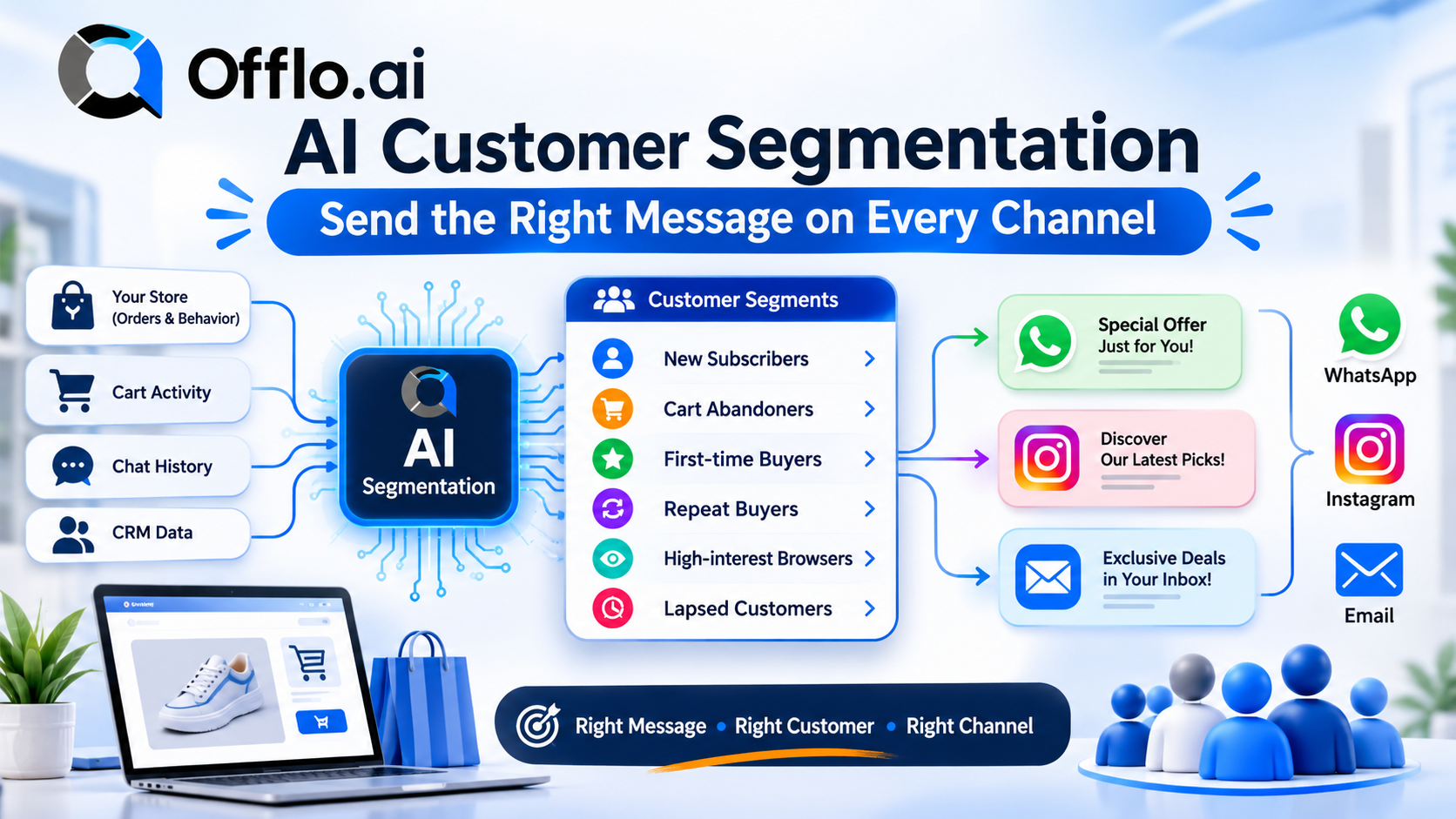
The challenge is doing this at scale. A growing store can have thousands of customers across WhatsApp, Instagram, email and its website, and sorting them by hand is slow. AI helps by reading store and chat data, spotting patterns and keeping segments up to date automatically.
Offlo.ai describes itself as an AI revenue OS for ecommerce. Its homepage lists AI marketing agents, omnichannel journeys and AI segmentation among its tools, working across WhatsApp, Instagram, email and web. This guide uses those ideas as a framework, whatever tool you choose.
You will learn what segmentation is, which data you need, how AI segmentation works, which segments to start with, how to match channel and timing, how to stay within consent rules and which metrics to watch. You will also find message ideas, a setup checklist and a list of mistakes to avoid.
What Is Customer Segmentation?
Customer segmentation means dividing your audience into groups that share something useful, so each group can receive messages that fit them. The group might share a behaviour, a purchase history, an interest or a stage in the buying journey.
The best segments are simple, stable and actionable. If you cannot say what you would do differently for a segment, it is not worth creating. The table shows common segment types for an online store.
|
Segment type |
Based on |
Example group |
|
Behaviour |
What customers do on your store or in chat |
Browsed a product three times, added to cart, no purchase |
|
Purchase history |
What and how often they buy |
First-time buyers, repeat buyers, big spenders |
|
Recency |
How long since their last action |
Bought in the last 30 days, no activity in 90 days |
|
Interest |
Categories or products they engage with |
Skincare, running shoes, home decor |
|
Lifecycle stage |
Where they are in the journey |
New lead, active customer, at-risk, lapsed |
|
Channel preference |
Where they like to talk |
Mostly WhatsApp, mostly Instagram, mostly email |
|
Support history |
Past questions and issues |
Asked about sizing, reported a late delivery |
|
Location |
Where they live |
Region, delivery zone, time zone |
Most stores start with three or four segments and grow from there. A common first set is new customers, repeat customers, cart abandoners and lapsed customers. Each one has a clear goal: welcome, reward, recover and win back.
Two cautions apply. First, avoid over-slicing. Dozens of tiny segments are hard to manage and often too small to learn from. Second, remember that people move between segments. A first-time buyer becomes a repeat buyer, and a loyal customer can go quiet. Good segmentation updates as customers change.
Why Segmentation Matters for Chat and Omnichannel Marketing
Chat channels raise the stakes. A message on WhatsApp or Instagram lands in a personal space, so irrelevant messages feel more intrusive than the same message in a crowded email inbox. Relevance is not only a performance lever. It is also a courtesy.
Higher relevance. When a message mentions the right product, at the right moment, in the right tone, shoppers are more likely to read it and respond. They also feel understood.
Fewer opt-outs. People leave when messages are repetitive or off-target. Sending fewer, better-aimed messages protects your list.
Better use of discounts. Not every shopper needs a code. Segments let you offer one to those who might need it, and keep margin on those who would buy anyway.
Cleaner conversations. Segment data gives your AI agent and your team context. If a shopper is a repeat buyer who asked about sizing last month, the next chat can start from there.
Smarter channel choices. Some customers reply fast on WhatsApp and ignore email. Others prefer Instagram. Segments that include channel preference stop you from guessing.
More efficient teams. Instead of building every campaign from scratch, your team can reuse well-defined segments and focus on creative ideas.
The Offlo.ai homepage describes omnichannel journeys that run across WhatsApp, Instagram, email and web. The principle is that a customer is one person across channels, not four separate contacts. Segmentation is what lets you treat them that way. If you want to see how conversations from different channels sit together, read about the omnichannel inbox.
The Data You Need and Where It Comes From
Good segments depend on good data. You do not need everything, but you do need it to be accurate and collected with permission.
Store data
• Orders, products bought, order value and dates
• Cart and checkout activity
• Returns and refunds
• Discount codes used
Chat data
• Questions asked and topics raised
• Products or categories discussed
• Preferred channel and typical reply time
• Satisfaction signals, such as thanks or complaints
Customer details
• Name, contact details and language
• Location and time zone
• Consent status and the date it was given
Marketing data
• Which campaigns a customer saw or opened
• Which messages got replies
• Opt-outs and how they happened
Where it lives
Most of this sits in your store platform, your messaging channels and your CRM. The problem is usually that it is scattered. Segmentation works best when these sources are connected, so one customer record reflects what the store, the chat and the campaigns know.
The Offlo.ai homepage lists integrations with Shopify, WhatsApp, Instagram, Messenger, Gmail, Outlook, Meta Ads and a range of ecommerce apps such as Klaviyo, Judge Me and Yotpo. You can check what is supported on the integration page, and see how customer records are kept together on the CRM features page.
A few data rules
• Collect only what you will use.
• Keep records accurate, and fix duplicates.
• Store consent alongside the contact, with date and source.
• Limit who on your team can see personal data.
Before you build segments, spend an hour looking at your data. Missing fields and messy duplicates are the most common reasons segments disappoint.
How AI Segmentation Works
AI segmentation does not replace your judgement. It does the sorting work, so you can focus on what to say. The usual flow looks like this.
1. Collect and connect data. Store, chat and campaign data flow into one customer record.
2. Clean the data. Duplicates are merged, gaps are flagged and consent status is attached.
3. Find patterns. The AI looks for groups of customers who behave in similar ways, such as people who buy skincare every six weeks or shoppers who always ask about delivery before buying.
4. Suggest or build segments. You review the groups and name the useful ones. Some tools also let you describe a group in plain words and build it for you.
5. Keep segments live. As customers act, they move in and out of segments automatically. A shopper who buys leaves the "cart abandoners" group and joins "new customers".
6. Trigger the right message. A campaign or journey sends the right content to the right group, on the right channel, at the right time.
7. Learn from results. Replies, purchases and opt-outs feed back into the data, so segments get sharper.
The benefit of the "live" part is easy to miss. Manual lists go stale the moment you export them. Dynamic segments stay current, so you never send a welcome message to someone who has already bought three times.
Keep a human in the loop. AI can find a pattern, but it cannot know your brand or your customers' context. Review suggested segments, and ask a simple question: would I be comfortable explaining to a customer why they received this message?
The Offlo.ai homepage lists AI segmentation next to omnichannel journeys and marketing agents, which reflects this idea of segments, journeys and content working together. You can read more on the marketing features page and see how automation can run the follow-ups.
Six Starter Segments With Message Ideas
You do not need a long list. These six segments cover most of the customer lifecycle and give you a clear message for each. Replace the examples with your own products and tone.
|
Segment |
How to spot them |
Goal |
Message idea |
|
New subscribers |
Just opted in, no purchase yet |
Welcome and guide |
A short hello, who you are and how to get help |
|
Cart abandoners |
Added to cart, no checkout |
Help finish the order |
Offer help with sizing, delivery or returns |
|
First-time buyers |
One purchase, recent |
Confirm and delight |
Order update, care tips and a way to reach you |
|
Repeat buyers |
Two or more purchases |
Reward and retain |
Early access to new products or a thank-you |
|
High-interest browsers |
Viewed the same category often |
Recommend |
Suggest items from the category they like |
|
Lapsed customers |
No activity for a long time |
Win back |
A friendly check-in and what is new |
Example for new subscribers
Hi Maya, welcome to Green Leaf Store. We are glad you are here. If you ever need help with sizing, delivery or returns, just reply to this message and we will help.
Example for lapsed customers
Hi Maya, it has been a while. We have added some new arrivals in the category you liked last time. Would you like to take a look, or would you rather we pause messages? Just reply either way.
Tips for using segments
• Give each segment one clear goal and one main message.
• Test a small group first, then widen.
• Do not message a segment just because you can. If you have nothing useful to say, wait.
• Allow a customer to be in only one active campaign at a time, so they are not flooded.
• Review each segment's size. A tiny segment may not be worth a separate message.
If you are exploring cart abandonment in more depth, you can read about how AI agents handle ecommerce conversations and how a WhatsApp agent can help with product recommendations, order tracking and discount codes.
Omnichannel Journeys: Choosing the Right Channel and Timing
A journey is a planned sequence of messages that guides a customer from one step to the next. Omnichannel means the journey can use more than one channel and treat the customer as one person throughout. The Offlo.ai homepage describes a customer thread that runs from acquire to converse, retain and attribute, which is a helpful way to think about it.
Acquire. Bring people into a conversation, for example through an ad or a post that opens a chat. Make sure the first reply matches what the ad promised.
Converse. Answer questions, recommend products and help with the purchase. Speed matters here, and so does a clear route to a person.
Retain. After the sale, confirm the order, share tracking, ask for feedback and offer help. Retention messages should feel like service, not advertising.
Attribute. Track which messages and channels led to results, so you can learn what works.
Choosing a channel
• Use the channel the customer already used to talk to you, unless they have asked for another.
• Respect stated preferences. If someone asked for email, do not move them to chat.
• Match the message to the channel. Short and conversational works in chat. Longer content suits email.
• Do not send the same message on every channel at once. Pick one, and fall back to another only if it is appropriate and permitted.
Choosing timing
• Send during sensible hours in the customer's time zone.
• Leave gaps between messages. Two or three days is common for non-urgent follow-ups.
• Stop a journey when its goal is met, such as after a purchase.
• Keep holidays, sales and delivery cut-offs in your calendar.
Keep one view of the customer
When a customer replies on one channel to a message sent on another, your team should see the full history. A shared inbox helps here, and the AI agent can carry the context so the customer never repeats themselves.
The aim is not to be everywhere. It is to be in the right place, at the right moment, with the right message.
Research, Campaign and Creative Agents Working Together
Segments only create value when someone writes the message and sends it. The Offlo.ai homepage lists several AI marketing agents, including a Research Agent, a Campaign Agent and a Creative Agent. Whatever tool you use, this three-part split is a useful way to organise the work.
Research. Before you write a word, you need to know who you are talking to and what they care about. A research step reads store and chat data, spots trends and suggests which segments or topics deserve attention. Examples: which questions come up most, which products get repeat interest, which customers are going quiet.
Campaign. A campaign step decides who gets what and when. It picks the segment, the channel, the timing and the goal, and it sets the rules: how many messages, when to stop, which customers to exclude.
Creative. A creative step writes the messages, offers and content. The Offlo.ai homepage describes its Creative Agent as writing ready-to-use messages, offers and content in a brand's voice. Whichever tool drafts your copy, review it before it goes live.
A simple workflow
1. Research finds a group, for example repeat buyers who have not purchased in 60 days.
2. You approve the segment and set the goal: bring them back with something useful.
3. Campaign picks the channel and timing based on past behaviour.
4. Creative drafts a short message in your brand voice.
5. You review and approve, and the message goes out.
6. Replies reach your shared inbox, and the results feed back into research.
Where people stay in charge
• Approve segments before they go live.
• Review messages for tone, accuracy and compliance.
• Set limits on frequency and discounts.
• Decide what the AI must never say or promise.
This way of working saves hours, and it keeps your brand in your hands. You can see the wider platform on the Offlo.ai homepage or look at the marketing features.
Setup Checklist: From First Segment to Live Journey
Work through these phases in order.
Phase 1: Goals
• ☐ Pick one goal for the first month, such as recovering carts or winning back lapsed customers
• ☐ Record a baseline: reply rate, repeat purchase rate and opt-out rate
• ☐ Choose the one or two channels you will start with
Phase 2: Data
• ☐ Connect your store, messaging channels and CRM
• ☐ Clean duplicates and fill missing fields
• ☐ Attach consent status and source to every contact
• ☐ List which fields you will actually use for segments
Phase 3: Segments
• ☐ Create four to six starter segments from the table above
• ☐ Give each segment a name, a goal and an owner
• ☐ Set exclusion rules, such as customers who bought in the last 7 days
• ☐ Check segment sizes before building campaigns
Phase 4: Messages
• ☐ Write one short message per segment, in your brand voice
• ☐ Add a clear way to reply and a clear way to stop
• ☐ Review wording for accuracy, tone and compliance
• ☐ Prepare handoff wording for questions the AI cannot answer
Phase 5: Journey rules
• ☐ Set the order, timing and maximum number of messages
• ☐ Define the stop condition, such as purchase or opt-out
• ☐ Choose quiet hours by time zone
• ☐ Make sure replies reach the shared inbox with context
Phase 6: Test
• ☐ Send test messages to your own team
• ☐ Check that segments update as customers act
• ☐ Confirm that stop conditions work
Phase 7: Launch and review
• ☐ Launch to a small group first
• ☐ Read real replies every day in week one
• ☐ Review results weekly and adjust
If you would like help setting this up, you can book a demo, look at pricing or read the FAQ.
Privacy and Consent: Segmenting Responsibly
Segmentation uses personal data, so it carries responsibility. Rules differ by country, channel and sector, so this section is general guidance, not legal advice. Check your own obligations with a qualified adviser.
Get permission first. Only message people who have agreed to hear from you, and keep a record of how and when they agreed. State what kinds of messages they will receive.
Respect channel rules. WhatsApp, Instagram and other Meta channels have their own policies about who can be messaged, when and with what content. Read the current rules in the official WhatsApp Business documentation, and check them again from time to time because they change.
Use only what you need. Do not build segments from data you have no good reason to use. Avoid sensitive categories unless you have a clear basis and the right safeguards.
Be transparent. Tell customers when they are talking to an AI agent, and make it easy to reach a person. Explain in plain words why they are receiving a message.
Make opting out easy. A clear instruction such as "reply STOP" should work every time, and the request should be honoured quickly across channels.
Protect the data. Limit who can see customer records, keep them accurate and delete them when they are no longer needed or when a customer asks.
Avoid unfair treatment. Be careful that segments do not lead to unfair prices or unequal service. If a segment decides who sees an offer, ask whether you would be comfortable explaining it.
A good test is simple: would the customer be surprised to learn how you chose to message them? If yes, rethink the segment. Trust takes years to build and moments to lose.
Metrics to Track
Measure each segment separately, and compare against the baseline you recorded before launch.
|
Metric |
What it tells you |
How to use it |
|
Reply rate by segment |
Whether the message felt relevant |
Rewrite messages that get few replies |
|
Opt-out rate by segment |
Whether messages feel pushy |
Reduce frequency where it rises |
|
Conversion rate |
Share of messaged customers who buy |
Compare segments and timings |
|
Repeat purchase rate |
Whether retention is improving |
Judge loyalty and win-back messages |
|
Revenue per message |
Value created by each send |
Spot messages that are not worth sending |
|
Time to first reply |
How fast your team or AI responds |
Keep it low, especially in busy periods |
|
Handoff rate |
Share of chats passed to a person |
Find gaps in your information |
|
Segment size over time |
Whether groups grow, shrink or stall |
Retire segments that no longer help |
|
Customer satisfaction |
How people rate the chat |
Protect trust while you scale |
Two habits turn these numbers

 English
 Arabic
 French
 Spanish
 Deutsch
 Turkish
 Dutch
 Italiano
 Russian
 Romaian
 Portuguese (Brazil)
 Greek