
Free Vital Signs Simulator Students Actually Use
Healthcare students need more than textbooks and classroom explanations to understand patient monitoring.
They need opportunities to observe changing readings, recognize important patterns, and become familiar with the information displayed on medical monitors.
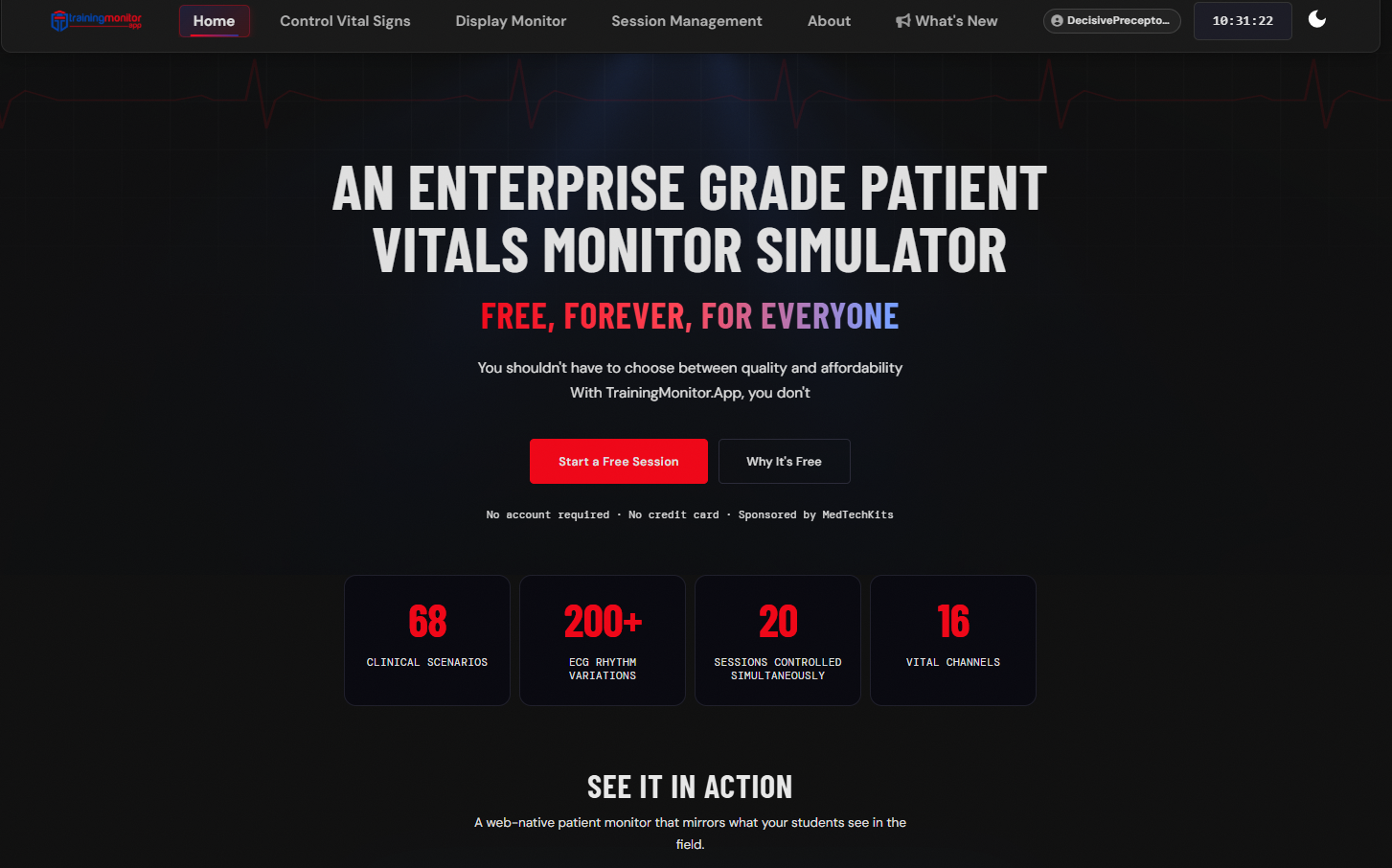
TrainingMonitor.App is a free, web-based vital signs simulator that allows nursing students, EMS learners, and healthcare trainees to explore patient monitoring concepts through interactive online practice.
Instead of only memorizing vital sign values, students can experiment with different readings and understand how patient conditions are represented on a monitor.
Why Students Need Practical Vital Signs Monitoring Experience
Patient monitoring involves more than looking at numbers on a screen. Students must understand heart rate, blood pressure, respiratory rate, oxygen saturation, and ECG information together.
Without practical exposure, it can be difficult to recognize how these measurements change and what those changes mean.
An online simulator provides a convenient learning environment where students can repeat exercises, explore different readings, and develop familiarity with patient monitoring without requiring access to physical monitoring equipment.
Practice Patient Changes Through the Control Vital Signs Page
Understanding how patient measurements change is an important part of monitoring education. The control vital signs page gives learners an opportunity to interact with patient readings and explore different monitoring conditions.
Students can use this functionality to:
-
Experiment with different vital sign values.
-
Observe how changing measurements affect the simulated patient.
-
Explore heart rate, blood pressure, and other monitoring parameters.
-
Understand the relationship between patient conditions and monitor readings.
This interactive approach helps learners move beyond passive observation and become more involved in understanding patient monitoring.
Understand Patient Readings With the Display Monitor
Learning how information appears on a medical screen is equally important. The display monitor page allows students to explore the visual side of patient monitoring.
A patient monitor brings several measurements together, making it important to understand how different values and waveforms are presented.
Students can become more familiar with:
-
Heart rate and ECG waveforms.
-
Blood pressure readings.
-
Respiratory rate.
-
Oxygen saturation (SpO2).
-
Changes in displayed patient information.
Regular exposure to monitor displays can help students become more comfortable interpreting the information they may encounter during clinical training.
Learn How to Read Vital Signs Monitor Information
Knowing how to read vital signs monitor information is an essential skill for nursing and EMS students. A monitor displays multiple measurements, and each provides a different piece of information about the patient's condition.
Students should learn to identify individual readings, understand their relationships, and recognize changes that may require further assessment.
Using a simulator alongside classroom learning provides an opportunity to practice identifying these measurements in a visual environment.
Understand Normal Vital Signs by Age
Vital sign interpretation also requires an understanding of age-related differences. Normal vital signs by age are important because expected heart rates, respiratory rates, and other measurements can vary between infants, children, and adults.
Students should become familiar with appropriate reference ranges while remembering that individual patient assessments and clinical context matter.
A simulator can complement this learning by allowing students to explore different readings and understand how values appear during patient monitoring practice.
Improve Cardiac Rhythm Practice With Online Simulation
Cardiac rhythm practice helps students become more familiar with ECG waveforms and heart rate patterns.
For EMS and nursing learners, recognizing basic cardiac rhythms is an important part of developing patient monitoring knowledge.
Repeated exposure to ECG displays can help students become more comfortable identifying waveform patterns and connecting them with other vital sign measurements.
TrainingMonitor.App provides an accessible environment for exploring monitor displays and practicing related monitoring concepts.
Build Confidence Before Real Clinical Experiences
Students benefit from having a place to revisit monitoring concepts whenever they need additional practice. Online simulation makes this possible without depending entirely on classroom equipment or scheduled laboratory sessions.
TrainingMonitor.App brings interactive patient monitoring practice into a browser-based environment.
With its Control Vital Signs and Display Monitor pages, students can explore patient readings, understand monitor displays, and strengthen their familiarity with vital sign monitoring.
For nursing students, EMTs, paramedic trainees, and other healthcare learners, it offers a practical starting point for building confidence before working with real patient monitoring equipment.

 English
 Arabic
 French
 Spanish
 Portuguese
 Deutsch
 Turkish
 Dutch
 Italiano
 Russian
 Romaian
 Portuguese (Brazil)