
How to Choose Between Tudor vs. Rolex for Your One Watch
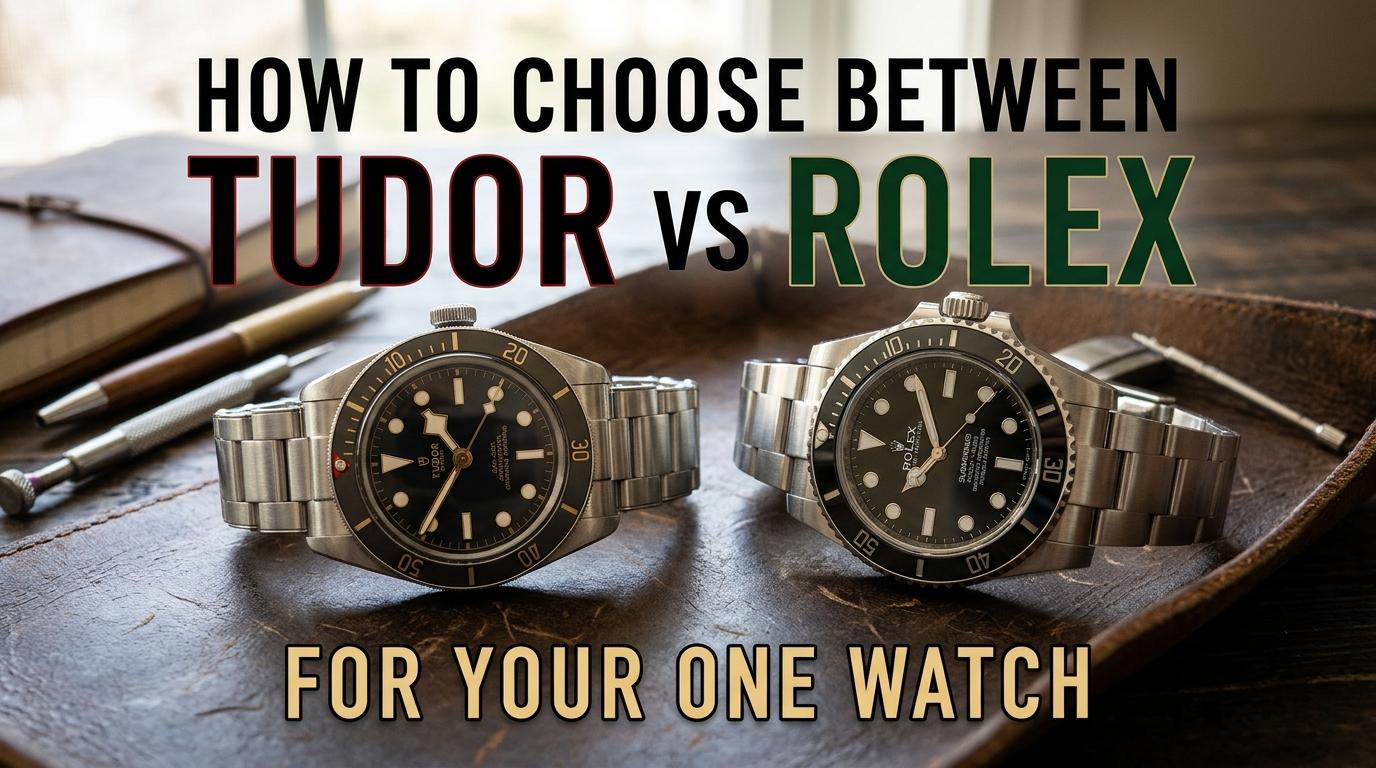
Settling on a single watch to wear every day is the kind of decision that feels bigger than it probably should. You know both options are excellent. You know you will not be unhappy with either. And yet here you are, going back and forth, because the gap between them is real even if it is hard to pin down in a sentence. Tudor and Rolex share the same founder, the same Swiss address, and the same fundamental obsession with accuracy and durability. What they do not share is a philosophy—and that difference matters more than price when you are choosing the one watch that will ride on your wrist for the next thirty years. Breaking down the comparison between Tudor vs. Rolex in terms of build quality, movement specifications, brand identity, and the day-to-day experience of ownership is essential for making a decision you will be satisfied with.
A Shared Origin, Two Separate Identities in the Tudor vs. Rolex Debate
Hans Wilsdorf founded Tudor in 1926 with a stated aim: produce a watch that could be sold at a more modest price than a Rolex while still meeting Rolex’s reliability standards. For most of its history, that is exactly what the Tudor was—a quieter option for buyers who wanted a Rolex-level build without the Rolex price. Then, in 2010, something shifted. Tudor relaunched with real conviction, introduced the Black Bay collection, and stopped pretending it was a budget workaround. The brand moved into its own dedicated facility in Le Locle and began developing in-house movements through the Kenissi manufacture. Today it operates as a fully independent brand that happens to share a parent company with the most famous watch name in the world. Rolex, meanwhile, runs out of Geneva, is owned by the Hans Wilsdorf Foundation, and produces close to a million watches annually. They are related, but they are no longer telling the same story.
Movement, Accuracy, and What You Actually Get Inside
The Tudor used to run on third-party movements. It mostly does not anymore. The MT series calibers, developed through Kenissi, deliver around 70 hours of power reserve and carry COSC chronometer certification—the same independent accuracy benchmark Rolex movements hold. The gap worth knowing about is in tolerances: Rolex rates its calibers to -2/+2 seconds per day, while Tudor movements run closer to -4/+6 seconds per day. That is an auditable difference, not a marketing one, and over decades of wearing it adds up to a few minutes at most. For the overwhelming majority of people buying a one-watch collection, it is not the reason to choose or rule out either brand. Both watches will keep accurate time, handle daily abuse, and run reliably for decades with reasonable servicing. The movement question matters less than the watch community sometimes makes it sound.
Case Materials, Finishing, and the Feel on the Wrist
Rolex uses a proprietary steel alloy called Oystersteel—904L grade, which polishes more brilliantly and holds its mirror finish longer than the 316L found in most of the industry. The case finishing on a Rolex is exacting. Polished and brushed surfaces meet at precise angles that require serious hand-finishing hours. It reads as luxury even in photographs. Tudor goes a different direction. Matte finishes, robust proportions, and in certain references—the Pelagos specifically—grade 2 titanium that weighs almost nothing on the wrist. The Black Bay 58 Bronze develops a warm, organic patina over time that makes each watch unique by the second year of wear. Neither approach is a compromise. If you need a watch that looks right under a dress shirt at a client dinner and again at a Saturday morning coffee shop, Rolex handles that transition almost invisibly. If you want something that absorbs life rather than resisting it, Tudor is not the second choice. It is the right choice.
Price, Availability, and the Real Cost of Entry
A new Rolex Oyster Perpetual starts above $6,100 at retail. The Submariner opens above $9,100. Those are authorized dealer prices, which many buyers never actually see because demand consistently outpaces supply and waitlists at reputable dealers can stretch for years. The secondary market fills the gap—at a premium. Tudor’s Black Bay 58, which genuinely competes with the Submariner on wearability and character, starts around $3,700 and sits on authorized dealer shelves without a waitlist. The Pelagos FXD comes in around $4,300. The practical effect of that gap is not just about spending less money. It is about how you will actually treat your one watch. A watch that cost you a year’s worth of patience and a significant premium over retail becomes an object you manage rather than wear. That can undermine the entire point of a one-watch life. Tudor goes everywhere and comes back looking like it meant to.
Resale Value, Status, and the Long View
Rolex holds value in a way almost nothing else in the watch industry matches. References like the Submariner and Daytona have historically traded well above retail, and while that market fluctuates, the brand’s resale floor remains unusually high. Tudor’s secondary market is healthy but functions differently. You are unlikely to see the same appreciation curves, and that is a reasonable fact to hold alongside the lower entry cost rather than a mark against the brand. On status: a Rolex communicates something to almost everyone. The crown logo does not require explanation. Tudor communicates something too, but to a narrower audience. It tends to appeal to people who have done enough reading to know what they are looking at without needing external confirmation. Both are legitimate things to want from a watch. Only you know which one you actually want.
How to Actually Decide
There are three questions worth sitting with before you buy. The first is whether the name on the dial matters to you in the environments you move through. That is not a shallow question. If it does, Rolex earns that recognition and delivers it consistently. The second question to consider is what your one watch will realistically do on a daily basis. A watch that sees airports, hiking trails, job sites, and cocktail parties is a watch that benefits from Tudor’s indifference to scratches and hard wear. The third is budget honesty. Stretching past a comfortable ceiling for a Rolex often produces a watch that lives in a box rather than on a wrist, which solves nothing. At its core, the Tudor vs. Rolex decision comes down to what you are actually optimizing for. Rolex is the watch you aspire to. Tudor is the one you wear without thinking twice. For a one-watch life, that second quality tends to matter more than collectors like to admit.

 English
 Arabic
 French
 Spanish
 Portuguese
 Deutsch
 Turkish
 Dutch
 Italiano
 Russian
 Romaian
 Greek