
AI Video Annotation Services in USA: Key Steps in the Annotation Process
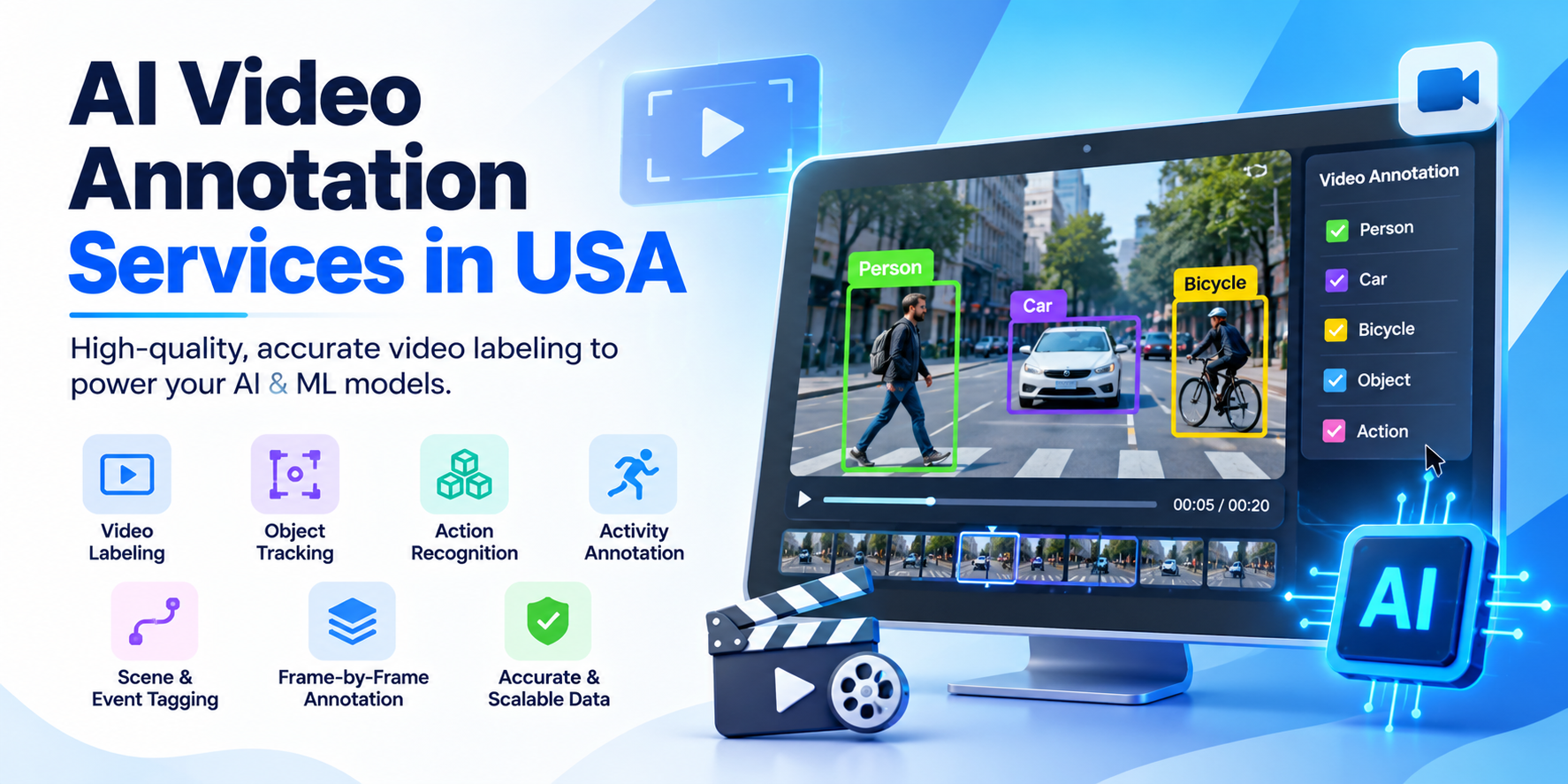
Video data plays an important role in developing modern artificial intelligence applications. From self-driving vehicles and security surveillance to healthcare systems and retail analytics, AI models rely on video data to understand movements, identify objects, and recognize activities. However, raw video footage cannot directly provide all the information an AI model needs. It must first be organized, labeled, and prepared for model training.
This is where AI Video Annotation Services in USA become important. Video annotation involves adding meaningful labels, tags, and descriptions to video frames so that machine learning and computer vision models can understand what is happening in a video. The process helps AI systems recognize objects, track movements, identify human activities, and understand interactions between different elements.
Understanding how video annotation works helps businesses make better decisions about their AI training requirements. In this guide, we will explain the key steps involved in the video annotation process, common challenges, quality control practices, and how Vision Infotech supports businesses with reliable annotation solutions.
What Are AI Video Annotation Services?
AI video annotation is the process of labeling objects, people, actions, and other relevant elements within video footage. These labels provide structured information that helps AI and machine learning models learn from visual data.
For example, consider a video recorded at a busy road intersection. An AI model designed for traffic monitoring needs to identify:
-
Cars, buses, trucks, bicycles, and motorcycles.
-
Pedestrians crossing the road.
-
Traffic signals and road signs.
-
Vehicle movements and direction.
-
Interactions between pedestrians and vehicles.
Annotators label these elements across relevant video frames. The resulting dataset helps the AI model learn to recognize and track different objects in real-world situations.
Professional AI Video Annotation Services in USA help businesses prepare structured training datasets for applications that depend on accurate visual recognition and movement analysis.
Why Is the Video Annotation Process Important for AI Development?
The quality of training data directly affects how effectively an AI model learns. Even a well-developed machine learning algorithm can produce unreliable results when trained using incomplete or incorrectly labeled data.
A properly managed video annotation process offers several benefits.
1. Improves Object Detection Accuracy
Object detection allows AI systems to identify and locate different objects within video footage. Accurate bounding boxes and labels help models recognize objects under different conditions, including changing backgrounds, lighting, and camera angles.
For example, an autonomous vehicle system must distinguish between pedestrians, parked cars, moving vehicles, and road obstacles.
2. Helps AI Understand Human Activities
Video annotation makes it possible to identify different human actions, such as walking, running, sitting, lifting objects, or falling.
These labels are useful for healthcare monitoring, workplace safety, sports analytics, and smart surveillance applications.
3. Supports Object Tracking
Tracking objects across multiple frames helps AI systems understand how objects move over time.
For example, a retail analytics system can track customer movement throughout a store. This information can help businesses understand customer behavior and improve store layouts.
4. Creates Consistent Training Datasets
Consistent annotation guidelines help ensure that similar objects and activities receive the same labels across different videos.
This reduces confusion during model training and supports more reliable predictions.
Key Steps in the AI Video Annotation Process
A successful video annotation project requires a structured workflow. Every stage contributes to the quality and usability of the final dataset.
Let's understand the major steps involved in professional AI Video Annotation Services in USA.
Step 1: Understanding Project Requirements
The first step is understanding the purpose of the AI project and identifying what information needs to be extracted from video footage.
Different AI applications require different annotation approaches. For example, a traffic monitoring system may focus on vehicle detection, while a healthcare application may need to identify patient movements and physical activities.
Before starting annotation, the project team should define:
-
The purpose of the AI model.
-
Types of objects or activities that need labeling.
-
Required annotation formats.
-
Expected dataset size.
-
Accuracy and quality requirements.
-
Project timelines and delivery expectations.
Example:
Suppose a company is developing an AI-powered workplace safety system. The system needs to identify workers who are not wearing helmets or safety jackets.
The annotation requirements may include identifying workers, drawing bounding boxes around safety equipment, and labeling whether the required protective gear is present.
Clearly defined requirements help prevent unnecessary corrections later.
Step 2: Video Data Collection
Once the requirements are finalized, the next step is collecting suitable video data.
The quality and variety of source videos play an important role in training AI models. If a dataset contains only similar videos recorded under identical conditions, the model may struggle when exposed to different real-world environments.
Video data can come from several sources, including:
-
Security and surveillance cameras.
-
Traffic monitoring systems.
-
Industrial cameras.
-
Medical video recordings.
-
Sports footage.
-
Retail monitoring systems.
-
Drones and mobile recording devices.
During data collection, businesses should consider video resolution, frame rate, lighting conditions, camera angles, and recording quality.
It is also important to verify that the organization has the necessary rights and permissions to use the footage. Personal information and sensitive recordings should be handled according to applicable privacy and security requirements.
A diverse dataset gives AI models a better opportunity to learn how objects and activities appear in different situations.
Step 3: Video Preprocessing and Frame Extraction
Raw video files can contain thousands of frames. Processing every frame manually may require significant time and resources.
Video preprocessing helps organize footage before annotation begins.
One important activity at this stage is frame extraction. It involves selecting individual frames from a video at specific intervals or based on important events.
For example, a 60-second video recorded at 30 frames per second contains 1,800 frames. Depending on the project requirements, the annotation team may select relevant frames or use automated sampling techniques to prepare the footage.
Preprocessing activities may include:
Removing unnecessary footage: Blurry, duplicated, corrupted, or irrelevant video segments can be identified and excluded when appropriate.
Frame selection: Important frames are selected based on the required annotation approach.
Video standardization: Videos may be converted into suitable formats, resolutions, or frame rates.
Data organization: Files are arranged into categories to make annotation and review easier.
Careful preprocessing reduces unnecessary work and helps maintain consistency throughout the project.
Step 4: Selecting the Right Annotation Method
Not every AI project requires the same labeling technique. The annotation method depends on the objects, activities, and level of detail required.
Some commonly used video annotation methods include:
Bounding Box Annotation
Bounding box annotation involves drawing rectangular boxes around objects in video frames.
It is commonly used for identifying vehicles, pedestrians, animals, products, and other visible objects.
For example, an AI traffic monitoring system may use bounding boxes to identify different vehicles on a road.
Polygon Annotation
Polygon annotation outlines the boundaries of objects using multiple connected points.
It provides more detailed object boundaries than rectangular bounding boxes and is useful when object shapes are irregular.
Applications include autonomous driving, medical imaging, and environmental monitoring.
Semantic Segmentation
Semantic segmentation assigns a category to each relevant pixel in an image or video frame.
For example, an autonomous driving dataset may classify pixels into categories such as roads, buildings, vehicles, pedestrians, sidewalks, and vegetation.
This method helps AI systems understand the visual structure of their surroundings.
Object Tracking
Object tracking involves identifying the same object across multiple video frames.
Each object receives a consistent tracking identifier so that the AI model can understand its movement over time.
For example, a surveillance system can follow a particular vehicle as it moves through different camera frames.
Keypoint Annotation
Keypoint annotation identifies important points on objects or human bodies.
For human pose estimation, annotators may label shoulders, elbows, wrists, knees, and ankles.
This method is useful for fitness applications, sports analytics, healthcare monitoring, and human activity recognition.
Selecting the correct method is essential because the annotation format determines what the AI model can learn from the dataset.
Step 5: Frame-by-Frame Annotation and Labeling
After selecting the appropriate method, the actual annotation process begins.
Annotators examine video frames and apply labels according to the project guidelines. They identify objects, mark boundaries, assign categories, and add relevant information.
For example, in a video recorded inside a manufacturing facility, annotators may need to identify:
-
Workers and their movements.
-
Industrial machines.
-
Safety equipment.
-
Moving materials.
-
Restricted working areas.
Each relevant object or activity receives an appropriate label.
During this stage, annotators must follow consistent instructions. If one person labels a particular object as a vehicle while another uses a different category, the resulting dataset may become inconsistent.
Professional AI Video Annotation Services in USA focus on maintaining labeling accuracy and following clearly defined annotation guidelines throughout the process.
Step 6: Object Tracking Across Video Frames
Object detection identifies objects in individual frames, but many AI applications also need to understand how those objects move.
This is where object tracking becomes important.
Annotators assign tracking IDs to objects so that the same object can be recognized across multiple frames.
Example:
Imagine a video showing three cars moving through a traffic intersection.
The annotation team identifies each car and assigns a unique tracking ID. As the vehicles move through subsequent frames, their IDs remain consistent.
This helps an AI model understand:
-
Object movement.
-
Direction and speed patterns.
-
Changes in object position.
-
Interactions between multiple objects.
-
Movement across different video scenes.
Accurate tracking is especially important for autonomous vehicles, security monitoring, sports analytics, and smart city applications.
Step 7: Quality Assurance and Annotation Review
Quality assurance is one of the most important stages of video annotation.
Even small labeling mistakes can affect the training process. Missing objects, incorrect categories, inaccurate boundaries, and inconsistent tracking IDs may reduce dataset reliability.
A proper quality assurance process involves reviewing completed annotations against predefined project guidelines.
Important quality checks include:
Label accuracy: Verify that every object or activity has the correct category.
Bounding box accuracy: Check whether the boxes properly cover the intended objects.
Frame consistency: Ensure that labels remain consistent across relevant frames.
Tracking accuracy: Confirm that object IDs are maintained correctly throughout the video.
Missing annotations: Identify objects or activities that were overlooked.
Format validation: Check whether the final annotations follow the required structure and file format.
For example, if an annotation team labels a person carrying a bag, the reviewer should confirm that the person and bag have been labeled correctly according to the project's requirements.
Quality checks should happen throughout the project rather than only at the final delivery stage.
This is one reason businesses look for dependable AI Video Annotation Services in USA when preparing datasets for complex AI applications.
Step 8: Final Dataset Validation and Delivery
Once annotation and quality checks are completed, the final dataset is prepared for delivery.
Before sharing the files, the project team should verify that all required annotations are available and that the dataset meets the agreed specifications.
Final validation may include:
-
Checking annotation completeness.
-
Verifying label consistency.
-
Reviewing tracking information.
-
Confirming file naming conventions.
-
Validating JSON, XML, CSV, or other required formats.
-
Checking whether the dataset meets project requirements.
The final annotated data can then be integrated into the machine learning workflow.
Depending on the project, the dataset may be divided into training, validation, and testing sets. This helps developers evaluate how well their AI models perform on both familiar and unseen data.
Common Challenges in Video Annotation Projects
Although video annotation provides valuable training data, the process also involves several challenges.
1. Large Video Data Volumes
Video datasets can contain thousands or millions of frames. Managing such large volumes requires proper organization, annotation tools, and project planning.
2. Changing Lighting and Camera Angles
Objects may appear different depending on lighting, distance, camera position, and environmental conditions. Annotators must identify the same objects accurately despite these changes.
3. Fast-Moving Objects
Fast movements can make it difficult to identify object boundaries and maintain consistent tracking across frames.
4. Occlusion
Sometimes objects are partially or completely hidden behind other objects.
For example, a pedestrian may be temporarily hidden behind a moving vehicle. Annotation guidelines should explain how such situations must be handled.
5. Inconsistent Labeling
When multiple annotators work on the same project, differences in interpretation can create inconsistent labels.
Detailed guidelines, training, and regular quality reviews help reduce this problem.
Industries That Benefit from AI Video Annotation Services
Video annotation supports several industries where AI systems need to understand visual information.
Autonomous Vehicles and Transportation
AI models use annotated videos to identify vehicles, pedestrians, traffic signs, road markings, and unexpected obstacles.
Healthcare
Video annotation can support AI research involving human movement, rehabilitation activities, surgical footage, and patient monitoring, subject to appropriate data protection and clinical requirements.
Retail and E-commerce
Retail businesses can use annotated video datasets to develop systems for customer movement analysis, shelf monitoring, and store activity recognition.
Manufacturing
Industrial AI applications use video annotation to recognize machine operations, monitor production activities, and identify potential safety issues.
Sports and Fitness
Sports analytics systems use annotated footage to track athletes, recognize movements, analyze player positions, and understand game activities.
How to Choose the Right AI Video Annotation Partner
Selecting an annotation partner is an important decision for businesses developing AI-powered products.
Before choosing a service provider, consider the following factors:
Technical expertise: Check whether the team understands computer vision, object detection, segmentation, tracking, and other annotation methods.
Quality assurance process: Ask how annotations are reviewed and how labeling errors are handled.
Data security: Understand how video files are stored, accessed, transferred, and protected.
Scalability: Make sure the provider can manage changing dataset volumes and project requirements.
Communication: Choose a team that provides clear project updates and responds to feedback.
Flexible workflows: Different projects need different annotation formats and labeling guidelines. The provider should be able to work according to your requirements.
The right partner should focus on more than completing labels. It should help businesses prepare useful, consistent, and well-organized training datasets.
Why Choose Vision Infotech for AI Video Annotation Services in USA?
Choosing the right technology partner can make a significant difference in the quality of your AI training data. Vision Infotech understands the importance of structured data, accurate labeling, and reliable project execution for AI and machine learning development.
Since 2012, Vision Infotech has been providing software outsourcing and technology solutions to businesses. The company focuses on helping organizations adopt practical technology solutions that support their business and development goals.
Here are some reasons to consider Vision Infotech for your video annotation requirements.
1. Focus on Data Quality
Reliable AI development starts with properly prepared data. Vision Infotech emphasizes structured workflows and quality-focused execution to help businesses prepare datasets according to their project requirements.
2. Project-Specific Annotation Requirements
Every AI project has different objectives. The annotation approach should match the type of objects, activities, and information that the model needs to recognize.
Vision Infotech can work around defined project requirements and annotation guidelines to support the development process.
3. Technology and Software Development Experience
Vision Infotech has experience in custom software development, AI development, AI consulting, Zoho CRM customization, and AWS consulting services.
This broader technology background helps the company understand how data preparation fits into the larger software and AI development process.
4. Business-Focused Approach
The goal of data annotation is not simply to label videos. It is to prepare useful information that supports real business applications.
Vision Infotech focuses on understanding project objectives and identifying suitable technology approaches for business requirements.
5. Support for Growing AI Projects
As AI projects develop, their data requirements may change. Businesses need workflows that can accommodate new datasets, additional labeling categories, and evolving project specifications.
Vision Infotech aims to support businesses as their technology requirements grow.
If your organization is developing computer vision applications and needs structured video training data, Vision Infotech can help you explore suitable annotation solutions based on your project needs.
Conclusion
Video annotation is an essential part of developing reliable computer vision and machine learning applications. From understanding project requirements and collecting video footage to frame extraction, object labeling, tracking, quality assurance, and final dataset delivery, every step contributes to the quality of the training data.
A structured annotation process helps AI models recognize objects, understand human activities, track movements, and interpret visual information more effectively. However, achieving reliable results requires clear guidelines, suitable annotation techniques, consistent labeling, and regular quality checks.
Businesses should carefully evaluate their data requirements and choose an annotation partner that understands their technical objectives.
With its experience in software outsourcing and technology solutions, Vision Infotech aims to help businesses move forward with their AI development requirements. Choosing the right approach to AI Video Annotation Services in USA can help organizations build better-prepared datasets and create a stronger foundation for their AI projects.

 English
 Arabic
 French
 Spanish
 Portuguese
 Deutsch
 Turkish
 Dutch
 Italiano
 Russian
 Portuguese (Brazil)
 Greek