
FuRong, a Party Printed Paper Napkins Manufacturer, at Work
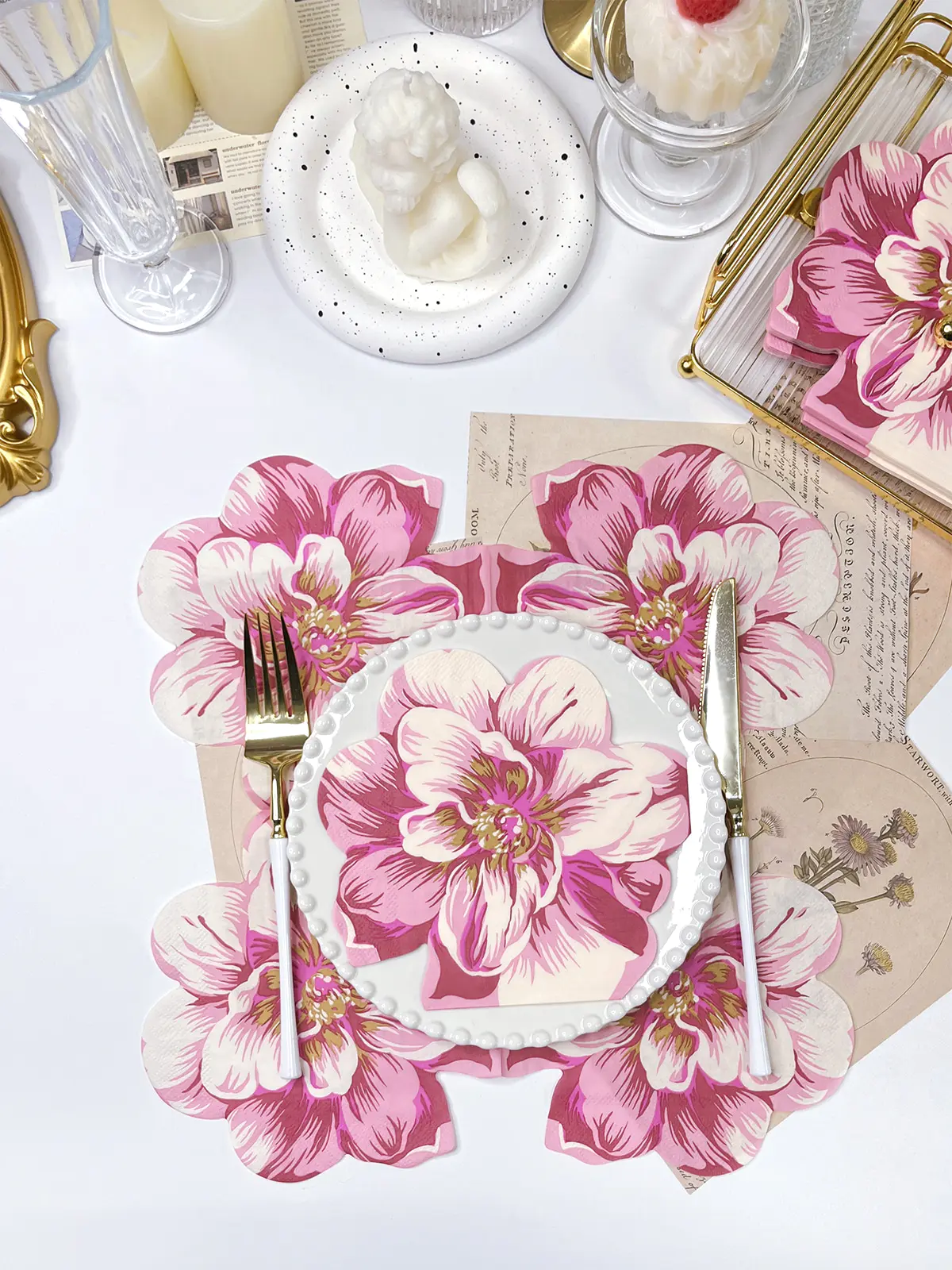
Pressing a serviette flat with a thumbnail, the way I do while waiting for food to arrive, makes it feel scratchy and tear the moment I tug at it, whereas a crumpled one stretches a little before it gives, and that small surprise pushed me to read about how a Party Printed Paper Napkins Manufacturer turns a wide roll of pulp into the soft, stretchy squares that sit in a holder on a table. The crumpling I had always taken for damage is built in on purpose, and once I understood that, much of the machinery made sense.
The ripples come from a step called creping, in which the damp web is pressed against a large heated drum, dried there, and then scraped off by a steel blade that pushes the sheet into tiny folds as it peels away. Those folds work like slack in a rope, so the tissue can stretch before its fibres part, and the surface takes on the soft, slightly fuzzy hand people expect, whereas a web dried flat would feel like writing stock and snap along the first line you pulled.
Several of these thin ribbons are brought together before cutting, and what binds them is largely pressure, sometimes with a trace of adhesive: the pile runs between a steel roller carrying a raised pattern and a roller with a yielding surface, and the pattern squeezes the plies together at countless tiny spots. The dotted outline around the margin of a napkin is the easiest place to see it, since each dot is one of those bonding points, and a stack that parts at the corner with a faint crackle tells me the points were pressed lightly.
A sample stack from FuRong, a Zhuji manufacturer that also makes paper straws, paper cups and custom printed products for global markets, sat beside my notes while I worked through this, and the corner of its first square showed the dotted bonding points clearly when I tilted it under the desk lamp, a row of small dents that I could feel with a fingertip before I could really see them.
Colour goes on while the web is still a long ribbon, usually through flexographic printing, in which a flexible plate carrying the artwork picks up a thin film of water-based ink from a finely engraved roller and presses it onto the tissue as it runs past. Each shade needs its own station, and a short blast of hot air between stations dries the film so that the next colour does not smear into it. Because the stock is so absorbent the formulation has to be thin, which is why the tints on a napkin look soft-edged beside a poster.
Keeping the colours aligned is the fussy part, because small marks along the margin of the ribbon are read by a sensor, and whenever one drifts the machine nudges the plate cylinder back into position, a correction that happens constantly and that nobody on the floor remarks on. Cutting has to respect the same marks, since a flower or a stripe is meant to land at a chosen spot on every square, and a blade that wanders a little pushes the whole design toward one side.
After slitting, a folding unit draws each strip over a guide, chops it into lengths and turns the edges over in a quick run of creases, so the output looks like a tidy brick that a counter divides into bundles of equal size, and a machine wraps each bundle in film before it drops into a carton. I have stood beside a line of that kind and the noise was a steady rhythmic slap, broken whenever a sensor halted the belt to clear a jammed piece.
As for what the finished serviette does, the job is simple and physical: the crinkled tissue wicks liquid along its fibres, trapped air lets it hold a good deal before it slumps, and the bonded plies keep it from splitting when it is wiped over a dinner dish. A tint laid over the face changes how liquid travels a little, and I have seen a dense solid area beside a pale margin behave differently under a damp finger, though I cannot say how any given design was set up, and a wet fingertip dabbed on a sample spread the dampness in an uneven ring that followed the ripples.
Nothing here says how any particular Party Printed Paper Napkins Manufacturer sets its speeds, drying temperatures or roller widths, since those vary from one plant to the next. The website at https://www.papernapkinfactory.com describes straws, cups and custom printed goods without listing such settings, so what I know about a specific design comes from handling it, and when a stack turns up on a table now my eye goes to the dotted outline near a corner to see whether it runs straight through the crease or wanders off to one side.

 English
 Arabic
 French
 Spanish
 Portuguese
 Deutsch
 Turkish
 Dutch
 Italiano
 Russian
 Romaian
 Greek