
Teaching Children Patience and Perseverance Through Taekwondo Training
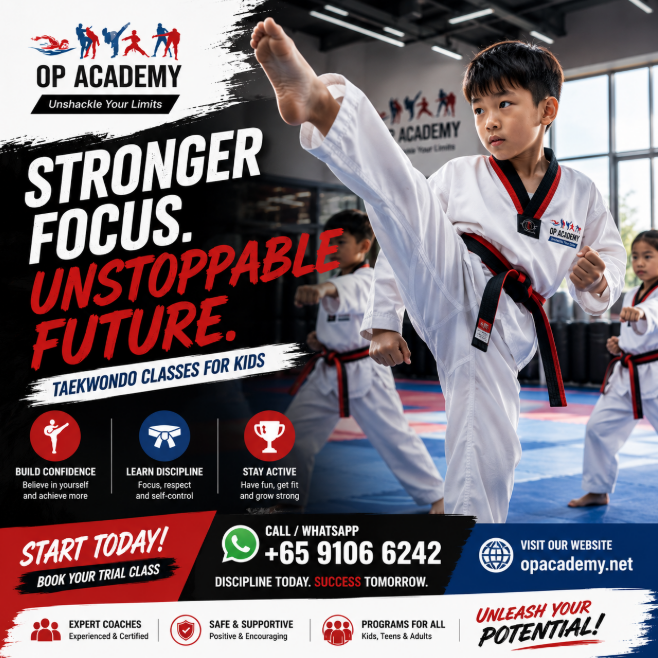
Children naturally want to learn new things, enjoy exciting experiences and see immediate results. However, not every skill can be mastered quickly. Some activities require repeated practice, careful attention and the willingness to continue even when progress feels slow. Learning how to handle these moments is an important part of growing up.
For parents in Singapore, finding an activity that supports both physical development and positive personal habits can be a valuable part of a child's routine. Taekwondo classes for kids introduce young learners to a structured environment where they can practise techniques, follow instructions and gradually improve through consistent effort.
While martial arts training is often associated with physical movements and self-defence, its learning process can also introduce children to patience, perseverance and respect for their own progress.
Why Children Need to Learn Patience Early
Patience is an important life skill. Children use it when waiting for their turn, listening to others, completing school assignments and learning something unfamiliar. Without patience, they may become frustrated when a task takes longer than expected.
In a world where entertainment and information are readily available, children may become accustomed to receiving immediate responses and quick results. This makes it important for parents to introduce activities that encourage steady effort and realistic expectations.
Taekwondo provides an opportunity to experience a gradual learning process. A child may need several sessions to become comfortable with a particular movement. Rather than moving ahead immediately, they are encouraged to practise the fundamentals and improve their technique over time.
This experience can help children understand that meaningful progress is often built through small, repeated steps.
Learning That Improvement Takes Time
One of the most valuable lessons in martial arts is that progress does not happen instantly. Children begin with basic movements and gradually become familiar with more challenging techniques as their abilities develop.
At first, a movement may feel unfamiliar. Children might struggle with balance, coordination or remembering the correct sequence. With guidance and practice, they can become more comfortable and confident.
The important lesson is not whether a child masters a technique quickly. It is whether they learn to remain engaged, accept guidance and make an effort to improve.
Parents can reinforce this mindset by recognising the process rather than focusing only on the final result. Praising a child for practising carefully or showing determination can be more meaningful than praising performance alone.
How Repetition Helps Build Perseverance
Repetition is a natural part of learning physical skills. Children often need to practise the same movement several times before they become familiar with it.
Although repetition may sometimes feel challenging, it gives children an opportunity to understand how small adjustments can improve their performance. They may learn to correct their posture, improve their balance or follow instructions more accurately.
This process introduces the idea of perseverance. Instead of giving up when something feels difficult, children can learn to approach the challenge one step at a time.
Perseverance is useful beyond martial arts. It can support children when they are learning a new subject, developing a musical skill or participating in a team activity. The ability to continue making an effort after an initial difficulty is valuable throughout life.
Understanding Respect and Self-Control
Taekwondo places importance on discipline and respect. Children are introduced to structured routines and learn that training involves listening, following instructions and treating others appropriately.
Respect is not limited to how children behave towards instructors. It also includes how they interact with classmates, respond to feedback and manage their own behaviour.
Self-control is another important area of development. Children need to understand that martial arts techniques should be practised responsibly and according to their instructor's guidance. Physical ability should be accompanied by awareness and consideration for others.
These principles can help children recognise that strength is not simply about physical power. It also involves knowing when to act, when to wait and how to behave responsibly.
Building a Positive Attitude Towards Challenges
Every child experiences challenges differently. Some may become discouraged when they cannot perform a movement correctly, while others may feel nervous when trying something unfamiliar.
A supportive training environment can help children approach these experiences with a more positive attitude. They are given opportunities to practise, receive guidance and try again when they are ready.
The goal should not be to remove every difficulty. Instead, children can learn that challenges are a normal part of improvement.
Parents can support this approach by using encouraging language. Rather than saying that a child is naturally good or bad at something, focus on the actions they can control, such as practising regularly, listening carefully and putting in consistent effort.
This helps children understand that abilities can develop through learning and practice.
Why Physical Activity Matters for Growing Children
Children need regular opportunities to move and participate in activities that support their physical development. A balanced routine can help them practise coordination, balance, flexibility and general movement skills.
Taekwondo involves different movements that require body awareness and controlled physical effort. Children may practise footwork, stances, kicks and coordinated actions under appropriate guidance.
These activities can make physical exercise more engaging because children are learning skills rather than simply repeating the same exercise routine.
However, training should be appropriate for the child's age and ability. Parents should ask about the programme structure, expected physical demands and how beginners are introduced to new techniques.
Taekwondo should complement other healthy habits, including sufficient sleep, balanced nutrition and time for rest and play.
Helping Children Manage Frustration in a Healthy Way
Frustration is a normal response when something does not go as expected. Children may feel disappointed when they cannot remember a movement or find it difficult to complete an exercise.
Learning how to respond to frustration is an important developmental experience. Instead of reacting immediately, children can gradually practise pausing, listening to feedback and trying again.
In a structured martial arts environment, instructors can guide students through the learning process. Children have opportunities to understand that making mistakes is not unusual and that improvement takes time.
Parents should also create a supportive atmosphere at home. If a child talks about a difficult training session, listen to their concerns before offering advice. Acknowledge their feelings and remind them that learning something new often involves challenges.
This approach can help children develop a healthier relationship with mistakes and personal improvement.
Choosing Suitable Taekwondo Classes for Children in Singapore
Not every martial arts programme will suit every child. Parents should take time to understand the learning environment before making an enrolment decision.
When exploring taekwondo classes for children, consider the following factors.
Suitable Lessons for the Child's Age
Young children and older children may have different learning needs. Ask whether the programme provides age-appropriate instruction and activities that match your child's experience level.
Clear Teaching and Demonstrations
Children should be able to understand the instructions and demonstrations provided during lessons. Parents can enquire how beginners are introduced to fundamental movements and how instructors support students who need more guidance.
Positive Discipline
Discipline should encourage responsibility and respect rather than create unnecessary fear or pressure. Look for a learning environment where children are guided constructively and treated appropriately.
A Balanced Approach to Physical Development
Training should be suitable for the child's physical ability. Ask how exercises are introduced and how the programme accommodates different levels of experience.
Communication With Parents
Parents should feel comfortable asking questions about class arrangements, learning expectations and their child's progress. Clear communication can make it easier to support consistent participation.
How to Encourage Consistency Without Pressuring Your Child
Consistency is important when learning a new skill, but children should not feel that every lesson is a test of their ability. Parents can help by creating realistic expectations and maintaining a balanced weekly routine.
Give your child enough time to adjust to the activity. Some children become comfortable quickly, while others need more time to settle into a new environment.
Encourage them to attend regularly where practical, but also pay attention to their wellbeing and school commitments. Rest and recovery remain important parts of a healthy routine.
You can also celebrate small milestones. Remembering a technique, showing better coordination or demonstrating improved listening can all represent meaningful progress.
When children feel supported rather than pressured, they may become more willing to continue learning and take pride in their efforts.
Give Your Child the Opportunity to Grow Through Consistent Practice
Patience, perseverance and self-control are not qualities children develop simply by being told to behave well. They need opportunities to practise these habits in everyday situations.
A structured martial arts programme can provide one such opportunity. Through guided movement, repetition and positive instruction, children can experience the value of effort and gradual improvement.
If you are considering taekwondo classes for children in Singapore, contact OP Academy to enquire about its children's taekwondo programme. Find out more about the learning approach, class suitability and training arrangements so you can make an informed decision about whether OP Academy is the right next step for your child.

 English
 Arabic
 French
 Portuguese
 Deutsch
 Turkish
 Dutch
 Italiano
 Russian
 Romaian
 Portuguese (Brazil)
 Greek