
Acid Wash vs Garment Dye vs Sun-Fade: What Each Finish Actually Does
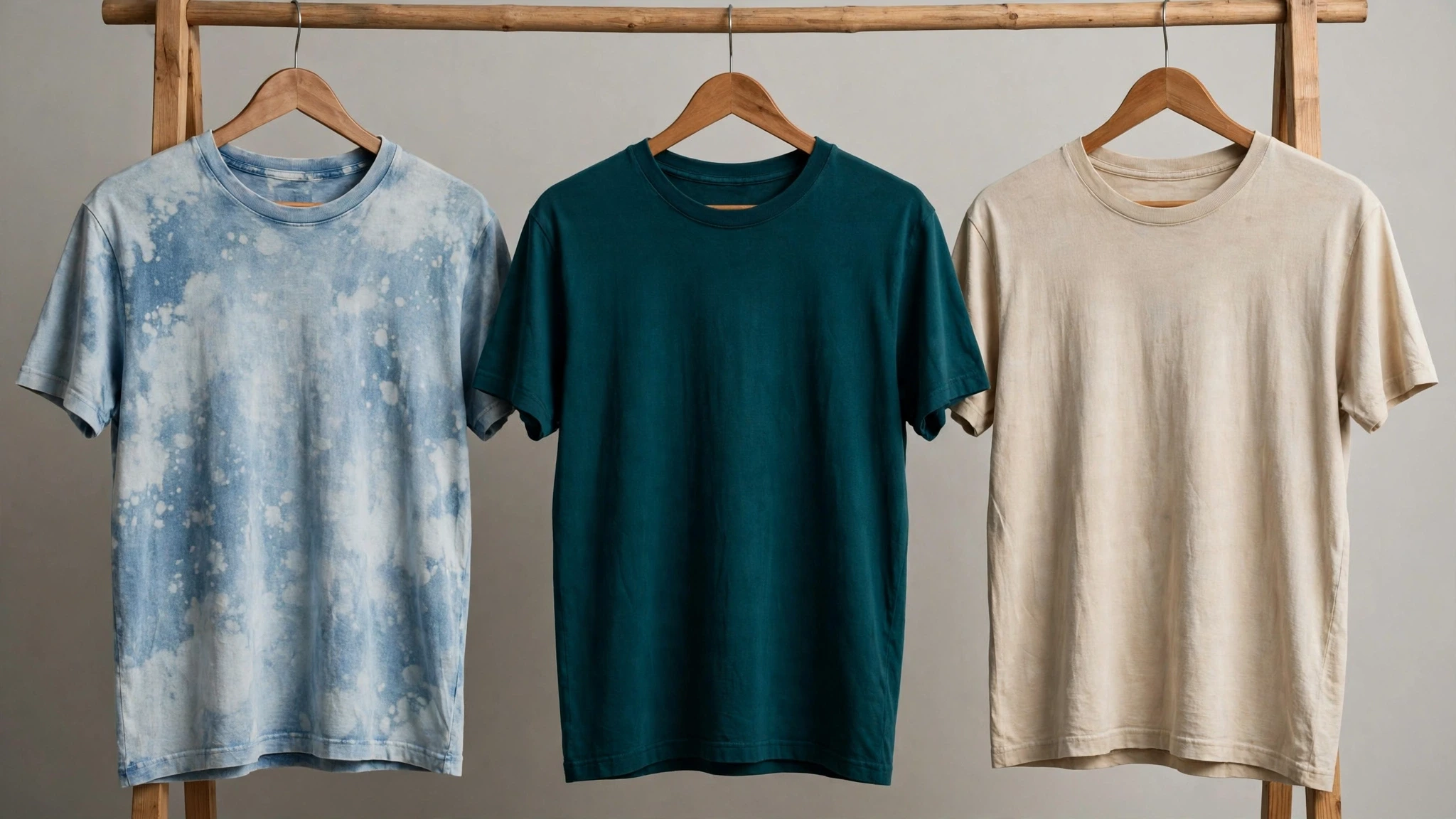
Acid wash, garment dye and sun-fade are three different processes applied at three different stages of production. Garment dye adds colour after the piece is sewn. Acid wash removes colour from a garment that is already dyed. Sun-fade degrades colour through UV exposure. Garment dye produces off-tone seams, acid wash produces hard-edged marbling, and sun-fade produces soft gradients that shift warm.
Open ten product pages and you will find acid wash, garment dye and sun-fade used as if they mean roughly the same thing. They do not.
Each one happens at a different point in making the garment. Each one leaves a different physical signature. And each one ages in a different direction, which matters more than how it looks on the shelf.
This guide covers what each process involves, how to identify it without reading a label, and which one suits what you actually want from a garment.
The Short Version
| Finish | What happens to colour | When in production |
|---|---|---|
| Garment dye | Added | After cutting and sewing |
| Acid wash | Stripped | After dyeing |
| Sun-fade | Degraded | Last, after dye and wash |
One is additive. Two are subtractive. That single distinction explains almost everything that follows.
What Is Garment Dye?
Garment dye means the piece is cut and sewn from undyed fabric, then dyed as a finished garment.
The raw material is greige fabric, which is cloth straight off the loom with no colour or chemical finishing applied. It gets cut, sewn, and only then goes into the dye bath as a complete garment.
This is the opposite of the industry default. Most clothing uses piece dye, where fabric is coloured on the roll before anyone cuts it. Earlier still are yarn dye and fibre dye, which colour the thread or raw fibre before weaving. Those produce flat, repeatable, highly colourfast results, which is why they dominate mass production.
How to Spot Garment Dye
Look at the shoulder seam in daylight.
Sewing thread is usually a different fibre from the body fabric, often with a polyester core for tensile strength. Polyester and cotton accept dye at different rates, so after a garment dye the stitching sits a shade or two off the body colour. On navy the seams read lighter. On black they often read faintly brown.
That tonal mismatch at the seam is the single most reliable identifier.
Two secondary tells:
- Batch variation. Dye lots differ, so two garments from the same production run will be close but not matched
- Interior hardware. Snaps, zips and labels dyed alongside the garment often show colour cast that a piece-dyed garment would not have
How Garment Dye Ages
It settles rather than fades.
The dye penetrates the full thickness of the fibre rather than sitting on its surface, so as the garment wears, the colour being exposed is the colour that was always there. It softens evenly. It does not patch.
One practical benefit: most of the shrinkage happens in the dye bath at full garment size, before sale. A garment-dyed tee that fits in the shop will generally still fit after ten washes.
What Is Acid Wash?
Acid wash means colour is stripped unevenly from a garment that has already been dyed.
Despite the name, there is usually no acid involved. The traditional process uses pumice stones soaked in a bleaching agent, normally chlorine or potassium permanganate. Stones and garment tumble together in an industrial drum. Where a stone strikes the fabric, it deposits bleach and abrades the surface simultaneously. Where it does not strike, the colour stays.
The technique emerged in denim manufacturing in the 1980s and spread into jersey and fleece from there. Stone washing remains the umbrella term for the family of processes.
Modern Alternatives
Traditional stone washing is water-intensive and hard on fabric. Two methods have largely replaced it at scale:
- Enzyme wash uses cellulase, an enzyme that breaks down surface cellulose fibres. Gentler on the garment, far less chemical load
- Ozone wash strips colour using ozone gas in a sealed chamber, cutting water use dramatically. Companies like Jeanologia have built this into standard finishing equipment
Much of what is marketed as acid wash today is closer to a heavy enzyme finish. The visual result is softer, with less extreme contrast.
How to Spot Acid Wash
Look at the boundary between light and dark areas.
Acid wash produces edges. Every other fading process produces gradients. Because stone placement is random and tumbling is chaotic, the lifted areas have irregular, hard-bordered shapes rather than soft transitions.
High contrast plus sharp edges equals acid wash. There is no other process that produces both.
How Acid Wash Ages
It holds, if you treat it carefully.
Here is the counterintuitive part: a garment that already looks beaten up is more fragile than a plain one, not less. The bleaching has already weakened those fibres. Hot water and any further bleach will flatten the contrast and take the marbling with it.
Cold water, inside out, no bleach. The piece stays sharp for years.
What Is Sun-Fade?
Sun-fade means colour is degraded by ultraviolet light rather than removed chemically.
Some of it is literal: garments on racks in sunlight. Most commercial sun-fade is accelerated in a light cabinet, compressing months of exposure into hours.
UV light breaks down chromophores, the parts of a dye molecule responsible for colour. Critically, it does not break them down evenly. Components absorbing at the blue and violet end of the spectrum degrade first.
How to Spot Sun-Fade
Check which direction the black has shifted.
Sun-faded blacks go warm, toward brown-black, because the blue-absorbing dye components break down first. A black garment faded to neutral charcoal has probably just been washed a lot. A black garment faded toward brown has seen light.
Contrast is low and transitions are gradients, because sunlight falls across the whole surface rather than striking points.
How Sun-Fade Ages
It keeps going, and this is the real distinction between the three.
Garment dye settles and stops. Acid wash is a finished state. A sun-faded piece continues fading on your back, in your car, on the washing line. The garment you own in three years will not be the garment you bought.
For some people that is the entire appeal. For others it is a defect. It is worth knowing which you are before you buy.
Side-by-Side Comparison
| Look for | Garment dye | Acid wash | Sun-fade |
|---|---|---|---|
| Contrast level | Low, even | High, marbled | Low, broad |
| Seam colour | Off-tone from body | Matches body | Matches body |
| Edge quality | None | Sharp, irregular | Soft gradient |
| Batch variation | Moderate | High | Low |
| Black shifts toward | Stays neutral | Grey at contact points | Warm brown-black |
| Pre-shrunk by process | Yes | Partially | No |
| Continues ageing | Minimally | No | Yes |
Two checks identify almost anything. Look at the shoulder seam for tone difference. Then look at whether pale areas have edges or gradients.
Which Finish Should You Choose?
Want it broken in but predictable? Garment dye. It arrives soft, the shrinkage is done, and it stays roughly where it started.
Want something obviously treated? Acid wash. Nothing else produces that contrast, and the batch variation means your piece genuinely differs from everyone else’s.
Want it to keep changing? Sun-fade. The only one of the three still in progress when you buy it.
Want zero variation? None of these. Buy piece-dyed and accept flat colour, which is a perfectly reasonable thing to want.
One thing worth knowing when comparing brands: running all three finishes across one line is unusual. Each requires a different finishing partner and a separate minimum order, so most labels pick one and build a house look around it.
JŪN’s acid wash t shirt sits alongside garment-dyed and sun-faded pieces on the same cotton base, which makes it one of the easier places to compare the three on identical fabric. That is the comparison that actually teaches you something, since it isolates the process from the material.
Frequently Asked Questions
What is acid wash?
Colour stripped unevenly from an already-dyed garment, traditionally using pumice stones soaked in chlorine or potassium permanganate. Random stone contact produces high-contrast marbling with hard edges, which is what separates it from every other fade.
What does garment dyed mean?
The garment is cut and sewn from undyed greige fabric, then dyed as a finished piece. Seam thread takes dye at a different rate from the body, so stitching sits a shade off. Shrinkage also happens in the dye bath rather than on your first wash.
Is sun-fade the same as acid wash?
No. Acid wash removes colour in patches with sharp edges. Sun-fade degrades colour broadly through UV exposure, producing gradients. Sun-faded blacks also shift warm, toward brown-black rather than grey.
Does garment dyeing make clothes shrink less?
It moves the shrinkage earlier. The garment goes through a hot wet process at full size before sale, so most shrink is already out when you buy it.
Is acid wash bad for fabric?
It weakens fibres by design. The piece is not more durable because it looks worn. Wash cold, inside out, and avoid bleach to keep the contrast and the fabric intact.
Which finish lasts longest?
Garment dye. The colour sits through the fibre rather than on its surface, so wear exposes the same colour underneath. Acid wash holds if washed cold. Sun-fade is designed to keep changing.

 English
 Arabic
 Spanish
 Portuguese
 Deutsch
 Turkish
 Dutch
 Italiano
 Russian
 Romaian
 Portuguese (Brazil)
 Greek